


Like most people, I used to Google everything without thinking twice.
Need a recipe? Google. Random trivia at 2 a.m.? Google again. It was the default, until I realized something big: Google isn’t the only search engine in town.
There’s a whole world of search engines doing things differently, and in some cases, better. Tighter privacy, smarter AI, cleaner interfaces. Some of the Google alternatives and the most used search engines genuinely surprised me.
Meanwhile, AI chatbots like ChatGPT and Perplexity are changing how we search by answering questions directly, often faster than traditional engines. We’re no longer just typing keywords and clicking links. We’re chatting, prompting, and expecting curated, instant answers so much so that some people have started wondering: Where are people actually searching in 2025? Is Google’s reign finally at risk?
So I dug into the data, looking at market share, traffic trends, user behavior, and the standout features shaping today’s top platforms.
In this article, you’ll find the top 10 search engines ranked by market share, traffic, and usage, backed by stats, not just opinions.
TL;DR:
- Google still dominates the search world with 89.66% of global traffic in 2025, but it’s no longer the only game in town.
- Bing is slowly gaining ground, and regional and niche engines are thriving in pockets.
- AI chatbots like ChatGPT, Perplexity, and Gemini are redefining what it means to “search.” They may not show up on market share charts yet, but they’re already changing habits, and that might be the real disruption.
What are the top 10 search engines in the world?
As of 2025, the top 10 search engines in the world, ranked by market share, are:
| Search engine | Global market share | Primary region(s) | Key features differentiators |
| 89.66% | Global | Fast results, vast index, ecosystem integration | |
| Bing | 3.88% | North America, Europe | AI chat, Windows default, Edge integration |
| Yandex | 2.53% | Russia, CIS | Localized search, AI tools, Cyrillic optimization |
| Yahoo | 1.32% | U.S., Japan | Powered by Bing, legacy homepage appeal, strong news, and content portal |
| DuckDuckGo | 0.84% | U.S., Germany, India | Privacy-focused, no tracking, anonymous search |
| Baidu | 0.72% | China | Dominant in China, in the Chinese language only |
| Naver | 0.33% | South Korea | Curated portal, user-generated content, webtoons |
| Ecosia | 0.11% | Europe | Eco-friendly, ad revenue funds reforestation |
| AOL | <0.1% | U.S. | Legacy portal, powered by Bing |
| Seznam | <0.1% | Czechia | Local portal, Czech-focused services |
Note: The market share figures presented here are based on StatCounter data. These rankings reflect traditional search engines and do not account for emerging AI search tools or platform-specific search experiences.
Top 10 search engines in 2025
Search engines help us look things up online, or that’s what I thought, so. But as I went a little deeper, I could see that each one reflects something bigger: how we search, what we care about, and what we expect from the internet when we ask a question.
And now, in 2025, those expectations have shifted. Privacy matters more than ever. Some of us prefer AI-powered answers. Some don’t. Others want to search in their own language, on platforms built for their region or values. The way we search is personal, and it’s evolving fast.
In this section, I’ll list the most popular search engines shaping how people find information today, ranked by usage, market share, traffic, and relevance.
Source: StatCounter Global Stats – Search Engine Market Share
1. Google
With 89.66% of the global search market share, Google remains the undisputed leader in 2025. It dominates as the most used search engine in nearly every region, except China and Russia, where local players Baidu and Yandex lead.
On desktop, Google commands 79.4% of the market, and on mobile, it soars to 93.8%, showing just how deeply embedded it is in our everyday browsing habits.
It’s a far cry from its humble beginnings. Back in 1998, when Stanford students Larry Page and Sergey Brin launched Google, its homepage promoted monthly email updates and boasted a modest index of 25 million pages. Today, it’s the go-to gateway to the internet for billions.
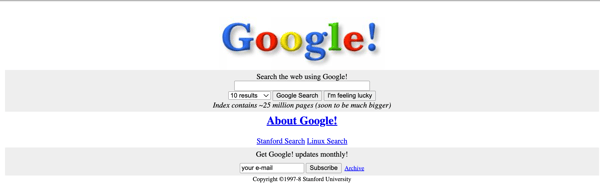
Google’s prototype homepage from 1998; Source: Wayback Machine
What keeps Google on top? It’s lightning-fast results, vast index, and seamless integration across its ecosystem — YouTube, Maps, Gmail, Chrome, Android, and more. For most users, it’s the default search engine.
According to Similarweb data, Google saw over 81 billion visits in April 2025, making it one of the most frequently used websites on the planet. It accounts for 83% of the search engine market in terms of total traffic share. On average, people spent about 10 and a half minutes on the site and clicked through nearly nine pages each time they visited.
That’s not just a reflection of dominance; it’s a sign of deep, habitual usage. We don’t say “search it,” we say “Google it.”
Interestingly, 19 percent of this traffic came from the U.S., while India accounted for 8.2 percent. This highlights how Google’s footprint spans both mature and rapidly growing internet markets.
It’s not just about how many people use Google, it’s about how often they rely on it, every second of every day.
How many Google searches are made every day?
Google handles over 5 trillion searches per year, up from just 2 trillion in 2016, according to the company. This breaks down to:
- 416.7 billion searches per month
- 13.7 billion searches per day
- 571 million searches per hour
- 9.5 million searches per minute
- 158,549 searches per second
Independent estimates put that figure even higher. SparkToro places that figure at 5.9 trillion searches annually.
Not everyone searches the same way. SparkToro’s analysis of U.S. users found that:
- 30% make just 1–20 searches per month
- 1% search over 1,000 times monthly
- The largest group, 20.2%, searches between 101 and 250 times per month
So while Google’s dominance is undeniable, actual search behavior varies more than we might think.
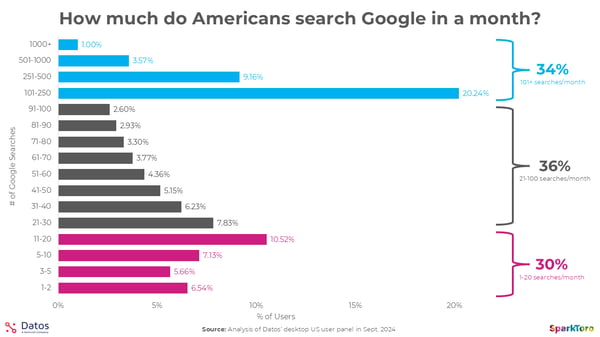
Source: SparkToro
2025 hasn’t been without its challenges for Google. It’s AI Overviews, powered by Gemini, rolled out widely this year. This feature, which summarizes answers at the top of search results, now reaches 1.5 billion users per month. It is also rolling out AI Mode, a more interactive, conversational experience designed to guide users through multi-step queries using natural language in the U.S.
While the company frames it as the future of search, blending traditional results with AI-generated summaries, the response has been mixed. Some users appreciate the conversational answers. Others find the experience cluttered or question the trustworthiness of the summaries, especially after a few high-profile misfires.
There’s also growing criticism around ad saturation, with organic results often pushed far below the fold. And while Google has made some privacy improvements, it continues to face regulatory pressure and ongoing skepticism about how user data is handled.
In a subtle but telling shift, Google’s search market share dipped below 90% for the first time at the end of 2024 and continues to do so. It’s not a collapse, but in an industry where Google has long been untouchable, it’s worth watching.
For now, thanks to its speed, reach, and familiar structure, Google remains the heavyweight champion of search. However, with AI reshaping how people interact with information, its once-unshakable lead may no longer be guaranteed.
2. Bing
Let’s be honest: Bing wasn’t exactly the search engine people got excited about. Launched by Microsoft in 2009 to replace Live Search, it spent most of the last decade as the quiet alternative to Google. Solid? Sure. Popular? Not really.
But then 2023 happened.
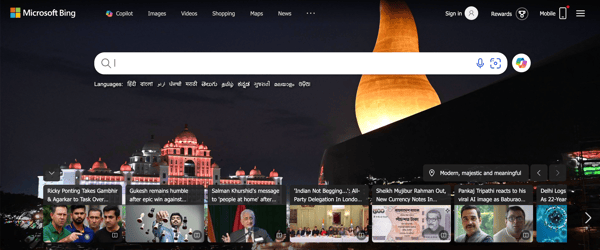
Screenshot of Bing search engine
After years of hovering around 2–3% global market share, Bing saw a real bump thanks to the launch of Bing Chat, now called Copilot. It was the first major search engine to bring generative AI directly into the search experience. Suddenly, Bing wasn’t just playing catch-up. It was leading the conversation.
By 2025, Bing holds 3.88% of global search market share. That might still sound small, but it tells a story of steady growth. The engine does especially well on desktop, where it grabs 11.73% of the market, mostly thanks to its deep integration with Windows 11 and Microsoft Edge. On mobile, it’s a different story, with just 0.64%, showing how much it still depends on the PC ecosystem.
Geographically, Bing’s strongest numbers come from North America, where it holds 7.36% overall, including 7.5% in the U.S. In Europe, it captures 4.1%, with 3.9% in the U.K.. In Asia, it struggles to gain ground, just 2.35%, including 1.3% in India, highlighting its relatively limited global reach compared to Google.
According to Similarweb, Bing saw 1.4 billion visits in April 2025, accounting for 1.44% of global search engine traffic. Users spent about seven and a half minutes per visit and clicked through 5.44 pages — lower than Google, but still notable for a longtime underdog.
And Microsoft’s AI bet? It’s working.
Microsoft shared key milestones about Bing after its AI chatbot rollout:
- 100 million daily active users on Bing (March 2023)
- Over 1 billion chats and 750 million AI-generated images within six months of the launch (August 2023)
While Google later responded with its own AI chatbot, Gemini, AIOs, and AI Mode, Bing’s first-mover advantage gave it a measurable, if still modest, boost in attention. The fact that Bing remains the default search engine on millions of Windows PCs, and is deeply integrated into Windows and Microsoft Edge, continues to give it a baked-in distribution edge, particularly among casual or enterprise users.
It’s still far from threatening Google’s dominance, but in a search world reshaped by AI, Bing finally has something it hasn’t had in years: momentum.
Curious how your browser choice impacts your search experience? Check out the best browsers of 2025 and learn more about them.
3. Yandex
With 2.53% of global search market share, Yandex is now the third most-used search engine in the world, recently overtaking Yahoo, even though it’s mostly used in just one part of the world. Its strength comes almost entirely from Russia and neighboring countries, where it’s deeply woven into everyday internet use.
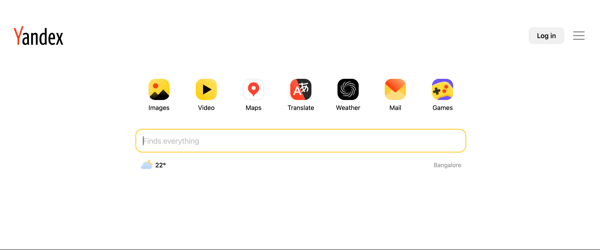 Screenshot of Yandex search engine
Founded in 1997, even before Google launched, Yandex has long been a pioneer in search. Today, it still leads the Russian search market by a wide margin, holding 75.25%, while Google trails far behind at 22.83%. Russia remains one of the few major markets where Google isn’t in control.
Source: StatCounter Global Stats – Search Engine Market Share
Often called the “Google of Russia,” Yandex offers much more than search. It has its own ecosystem of services: maps, email, cloud storage, translation tools, and smart assistants, all designed specifically for Russian users and their cultural context.
Its biggest advantage? Localization. Yandex’s algorithm is built to understand Cyrillic script and the unique nuances of the Russian language, giving it a serious edge for native queries. Add to that its investment in AI and machine learning, and you’ve got a platform that powers everything from personalized recommendations to voice tools and digital assistants. For many users, Yandex isn’t just a search engine. It’s their entire online experience.
Globally, Yandex holds 2.97% of desktop search and 2.35% on mobile, making it one of the more balanced search engines across devices, especially compared to Bing, which is far more desktop-heavy.
According to Similarweb, Yandex’s Russian homepage had 2.79 billion visits in April 2025. Visitors spent an average of 8 minutes and 28 seconds per session, clicking through more than 8.5 pages per visit. By traffic volume, Yandex gets 2.58% of global search engine traffic.
In a world dominated by U.S. tech giants, Yandex shows that a local player, with the right tools and focus, can still hold its own globally.
4. Yahoo
My first email address? Yahoo. And if my memory serves me right, I used to Yahoo things before “Googling” was even a thing. But now? Not a lot. I haven’t used Yahoo Search in years, and I’m not alone.
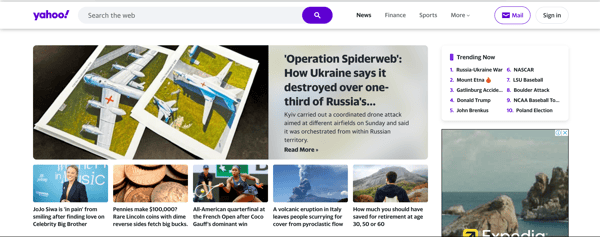 Screenshot of Yahoo search engine
Once the go-to web portal and a top search engine in the early 2000s, Yahoo’s influence in search has faded hard. Today, it holds just 1.32% of the global search engine market share, putting it in 4th place behind Google, Bing, and Yandex.
It does slightly better on desktop, where it has a 2.93% share, just behind Yandex. But on mobile, it barely registers a 0.69% market share, a sign of how much it’s fallen behind in a mobile-first world.
Yahoo Search is now powered by Bing through a long-standing partnership with Microsoft. It serves a loyal (and often older) user base who land there via the Yahoo homepage, or stick around for Yahoo Mail, Finance, News, and other familiar portals.
Interestingly, Yahoo remains unusually popular in Japan, where Yahoo Japan operates as a separate company and continues to dominate as a search and portal service. It holds 9.17% of the search engine market in Japan, second only to Google, which leads with 80.5%. In fact, Yahoo Japan (yahoo.co.jp) is the 10th most visited website globally, according to Similarweb, even outpacing yahoo.com. In the U.S. and other markets, Yahoo’s share is much smaller, though some loyal users still use Yahoo.com for search out of habit.
And it’s not all tumbleweeds. Yahoo pulls in 3.09 billion visits every month, as of April 2025. The average user spent 7 minutes and 17 seconds per visit and clicked through 5.34 pages, respectable engagement for a legacy brand.
More than half of Yahoo’s traffic (51%) comes from the U.S., with Taiwan (4.6%) and the UK (4%) rounding out the top markets. And here’s a fun twist: 5.4% of Yahoo’s traffic ends up going straight to Google.com, likely from users typing queries into the homepage search box, only to bounce to the search engine they really wanted to use.
Yahoo might not be leading the pack anymore, but its legacy as a household internet name and its familiar interface still give it just enough momentum to stay on the global leaderboard.
5. DuckDuckGo
If you’ve ever searched for something online and immediately seen ads for it on Instagram, you’ve probably wished your searches were just… private. That’s exactly the problem DuckDuckGo set out to solve.
Launched in 2008, DuckDuckGo is now the fifth most-used search engine in the world, with 0.84% of global market share. It performs slightly better on desktop (1.07%) than on mobile (0.74%).
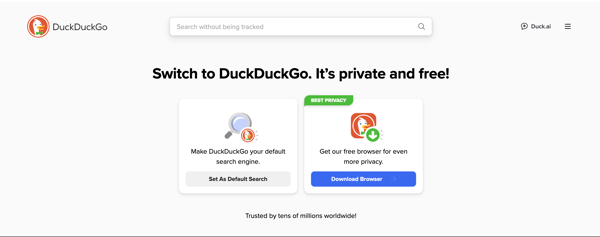 Screenshot from DuckDuckGo search engine
It’s made the global top five by doing one thing really well: protecting user privacy. It doesn’t track you, store your search history, or build a data profile around your activity. Searching on DuckDuckGo is completely anonymous — privacy by design, not as an added feature.
DuckDuckGo pulls in results from a variety of trusted sources, including Microsoft’s Bing index, Wikipedia, Apple Maps, and its own web crawler. It doesn’t create a filter bubble, and it doesn’t personalize results based on your past searches, so everyone sees the same thing for the same query. That’s a feature, not a flaw.
According to DuckDuckGo, the engine handles about 3 billion searches per month, which breaks down to:
- 100 million searches per day
- 69,000+ searches per minute
- Around 1,157 per second
As of 2022, the company had passed 100 billion total searches, and it now estimates that over 100 million people use the platform globally.
That user base is clearly reflected in third-party SEO tools, too. Similarweb data shows that that DuckDuckGo saw 713.7 million visits in April 2025. Users on average spend 7 minutes and 47 seconds per visit and click through 6.33 pages, a strong engagement for a search engine that doesn’t track or personalize.
Much of that traffic comes from privacy-conscious users in the U.S. (46%), followed by Germany (8.3%) and India (6.6%), where interest in anonymous browsing continues to grow.
It’s not aiming to dethrone Google. But for users who care more about anonymity than AI or convenience, DuckDuckGo is the go-to alternative for a privacy-focused search engine, and its numbers prove there’s a real demand for search that doesn’t watch you back.
6. Baidu
If Yandex is the “Google of Russia,” then Baidu is undoubtedly the “Google of China.” With 0.72% of global search engine market share, Baidu may seem like a niche player, but its scale in China tells a different story.
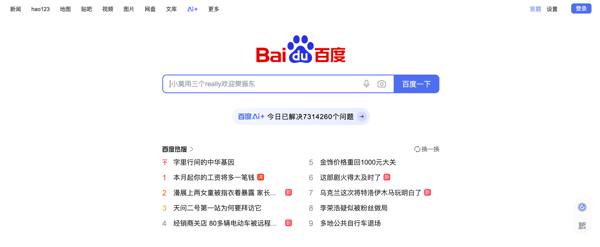 Screenshot from Baidu search engine
Founded in Beijing in 2000 by Robin Li and Eric Xu, Baidu has grown into the dominant search engine in China. Although it is used almost exclusively within one country, it consistently ranks among the top global search engines by query volume, thanks to the sheer size of its user base.
In China, Baidu commands 53.1% of the domestic search market, far ahead of Bing’s 26% there. Globally, its presence is much smaller. Most of Baidu’s services are geo-restricted and available only in Chinese, limiting their accessibility outside mainland China. It holds 0.62% of desktop and 0.64% of mobile market share worldwide — modest, but fairly balanced across platforms.
Source: StatCounter Global Stats – Search Engine Market Share
Still, Baidu’s scale within China is massive. As of December 2024, the company had around 679 million monthly active users on its app, underscoring its strong hold on the local market.
That reach shows up in web traffic, too. According to Similarweb, Baidu’s main site received 2.15 billion visits in April 2025, making it the third most-visited search engine in the world in terms of traffic. Users spent an average of 5 minutes and 27 seconds per visit and viewed 8.76 pages, a sign of strong engagement.
Unsurprisingly, that traffic is heavily concentrated in China. Nearly 95% of Baidu’s traffic comes from China, with smaller shares from Hong Kong (1.4%), Taiwan (1.15%), and less than 1% from the U.S.
Baidu may not be a global player in the traditional sense, but within China, it remains the undisputed gateway to the internet.
7. Naver
With a global search engine market share of 0.33% as of January 2025, according to Statista, South Korea’s Naver might seem like a small player globally, but inside its home market, it’s anything but.
 Screenshot from Naver search engine
Naver holds 48.4% of South Korea’s search engine market and is responsible for roughly half of all searches in the country. Its share has hovered between 40% to 50% in recent years, closely competing with Google. Outside of Korea, however, Naver is barely used, making it a uniquely regional powerhouse.
Source: StatCounter Global Stats – Search Engine Market Share
What sets Naver apart is its portal-style, content-rich approach. The search experience is designed less like Google’s minimalist model and more like a full-fledged ecosystem. Search results are divided into segments like blogs, questions and answers, news, images, videos, and more. It leans heavily on user-generated content, especially through Naver Blogs and Cafes (community forums), which often dominate results for local queries.
Naver’s homepage is a destination in itself. In addition to the search bar, it features trending topics, web comics (webtoons), shopping feeds, and entertainment news, all tailored to Korean user behavior. It’s not just a search engine; it’s a curated internet experience that fits how South Koreans consume content online.
And that