


I’ve been on both sides of the screen, literally. I’ve sat in my fair share of video interviews, nervously checking my lighting, audio, and background before hitting “join.” But in recent months, I’ve also been the one conducting them. And that’s when I realized why the best video interview software exists in the first place, because video interviews come with their own brand of chaos.
There was the candidate who joined with an AI note-taker quietly transcribing every word. Another time, I could tell someone was getting real-time help from an AI assistant feeding them cues during the conversation. Impressive? Sure. Distracting? Definitely.
Between juggling meeting links, last-minute changes, managing time zones, and trying to stay fully present while evaluating candidates, I started to wonder if there’s a better way to make this process smoother for everyone.
That’s where video interviewing software really earns its place. The best tools don’t just let you “hop on a call.” They automate scheduling, streamline feedback, and even generate AI summaries so you can focus on the person, not your notes.
For recruiters and hiring teams managing packed calendars and growing candidate pools, the best video interview software turns a messy, time-consuming process into an efficient, data-backed experience.
8 best video interviewing software in 2025: My top picks
- Metaview: Best for AI-powered interview note-taking
Structured, customizable AI interview summaries layered on top of your existing video tools($50/user/month) - AI Interviewer: Best for AI video interviews
Human-like AI interviewer that runs structured screens, coding assessments, and proctoring
($1 per interview) - Hireflix One-Way Video Interviewing: Best for one-way video interviews
Record once, invite unlimited candidates, and review responses on your own time ($75/user/month) - HackerRank Developer Skills Platform: Best for mid-market and enterprise engineering teams
Combines coding challenges, AI-led technical interviews, and integrity controls in one place ($165/month) - Spark Hire: Best for all-in-one video interviewing.
Supports one-way and live video interviews, behavioral assessments, reference checks, and an optional built-in ATS. ($299/month) - Indeed Hiring Platform: Best for virtual interviews
Lets you go from job post to browser-based interview with matching, messaging, and scheduling in a single workflow. (custom) - Willo Video Interviewing: Best for asynchronous video interviewing.
Offers simple, browser-based one-way interviews that work on any device with flexible, candidate-friendly workflows. ($233/month) - InCruiter: Best for AI + expert-led interviews.
Combines AI screening, live video interviews with code collaboration, proctoring, and a 3,000+ interviewer network. (custom)
These are top-rated in their category, according to G2’s 2025 Fall Grid Report. I’ve added their monthly pricing wherever available to make comparisons easier for you.
8 best video interviewing software I recommend
Video interviews are hard. After running a few too many interviews over random video call links, I finally understood what video interviewing software really is. It’s not just a place to talk to candidates, it’s a full hiring assistant. These tools bring everything into one space: scheduling, recording, structured feedback, and even AI-generated notes.
The best video interview software goes further: integrating with your ATS, enabling coding tests or technical assessments right within the platform, and helping teams collaborate without endless back-and-forth emails.
And the payoff is real. According to G2 Data, companies see an average ROI within nine months of adopting video interviewing software. It’s especially impactful for small businesses (42%) and mid-market teams (36%) that need to scale hiring efficiently, while 22% of enterprise users use it to bring consistency and data-backed insights into high-volume recruitment.
Whether it’s assessing a developer’s problem-solving skills in real time or capturing structured feedback across multiple rounds, the right platform turns interviews into measurable, bias-free hiring decisions.
How did I find and evaluate the best video interviewing software?
To start, I created a shortlist of video interviewing tools using G2 Grid reports for the category.
From there, I spoke with recruiters, hiring managers, and HR leaders across various industries, including tech, finance to healthcare, and retail, to understand what actually works for teams of different sizes.
Using their input, I researched each platform in depth to see how it supported real hiring workflows, from scheduling and candidate experience to AI summaries, coding tests, and feedback collection. I also used AI to analyze G2 user reviews and understand common pain points, what people loved and hated, and whether these tools lived up to the hype.
I also consulted professionals with hands-on experience with these tools and validated their insights using verified G2 reviews. The screenshots featured in this article may include those captured during evaluations from publicly available materials and those obtained from the vendor’s G2 page.
What makes the best video interviewing software?
After diving deep into research and talking to recruiters across industries, I’ve found that the best video interviewing software goes far beyond video quality. It’s about how well it supports every step of the hiring process. Here’s what I looked at:
- Seamless scheduling and calendar sync: The best tools make coordination effortless. Automatic time zone detection, real-time availability, and calendar integrations eliminate scheduling headaches. Bonus points if it adjusts for cancellations and sends smart reminders to keep everyone on track.
- Recording and transcription: Built-in recording is a lifesaver, especially when one is running multiple interviews a day. I look for platforms that generate searchable transcripts, let’s the user tag moments or keywords, and make it easy to revisit highlights for later evaluation or team discussions.
- Structured feedback tools: Having feedback forms, customizable scorecards, and shared evaluations ensures every candidate is reviewed fairly. It also speeds up debriefs without having to sift through messy notes or follow-up emails after each round.
- AI-powered summaries and insights: AI that actually helps, not distracts. I value tools that create digestible interview summaries, flag key phrases, and even suggest next steps, while still leaving the final decision in human hands.
- Built-in coding and skills assessments: For technical roles, I look for tools that integrate coding challenges, whiteboarding, or role-specific assessments within the same interface, keeping everything in one place and preserving the interview flow.
- ATS and HR integrations: The right platform should connect effortlessly with ATS, HRIS, and CRM systems. That way, candidate data, notes, and recordings sync automatically, reducing manual entry and the risk of losing context between systems.
- Scalability and security: Whether hiring for a startup or a global enterprise, the platform should grow with the organization. I always check for SOC 2 or GDPR compliance, secure data encryption, and admin-level access controls to protect candidate information.
- Candidate experience and branding: A good tool makes candidates feel seen, not processed. Custom-branded portals, prep instructions, and practice environments help present a professional, welcoming impression, especially in remote or hybrid hiring.
- Reliable performance and analytics: A smooth, lag-free experience matters more than flashy features. I look for platforms that track metrics like time-to-hire, candidate engagement, and interview-to-offer ratios to help teams measure and continuously improve their process.
I’ll be honest and admit that not every platform I’ve included in this list checks every single box, but each one shines in its own way. Whether it’s for structured interviews, technical assessments, or seamless collaboration, every tool here stands out for something it does exceptionally well.
The list below contains real user reviews from the Video Interviewing Software category page. To be included in this category, a solution must:
- Streamline and simplify the interviewing process
- Provide video interviewing technology for a wide range of roles, including pre-recorded interviews, live video interviews, or both
- Track candidate screening processes and/or provide integrations to ATS
*This data was pulled from G2 in 2025. Some reviews may have been edited for clarity.
1. Metaview: Best for AI-powered interview note-taking
When I first looked into Metaview, which is rated #1 in the G2 grid report for video interviewing software, I realized quickly that it isn’t just a “video interviewing tool” in the traditional sense. It’s more of an AI-powered interviewing copilot.
With a 4.4/5 rating on G2 and 98% of users giving it 4 or 5 stars, it’s one of those tools people tend to stick with because it quietly removes work from their day rather than adding to it.
Instead of giving you another platform to host interviews on, Metaview focuses on everything that happens around the interview: taking notes, structuring insights, summarizing conversations, and helping you follow up faster, like an AI meeting assistant.
What users on G2 consistently love is how it handles AI interview notes. The tool captures the conversation in real time and automatically turns it into clean, structured notes so they can stay focused on the candidate instead of scrambling to write things down.
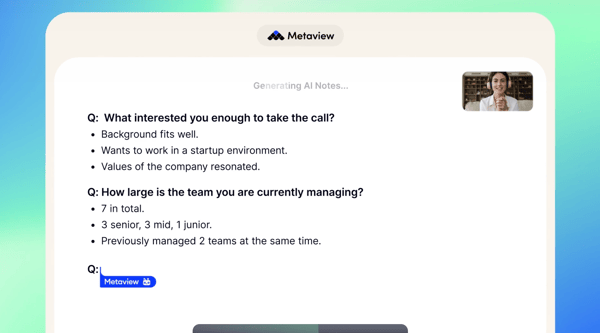
Reviewers consistently highlight how customizable the outputs are. Some teams prefer a full breakdown organized by questions and answers, while others rely on those one-paragraph summaries that hiring managers can digest in seconds.
The templates are another recurring theme in G2 reviews; they help keep interviews structured and consistent across different roles, interviewers, and departments, which is something a lot of recruiters struggle with as companies grow.
One thing I didn’t expect until I dug deeper is how broad Metaview’s AI ecosystem is. Beyond notes, it can generate one-click TLDRs, pull out specific details from conversations, suggest job post improvements based on what candidates actually talk about during interviews, and even surface insights like patterns in candidate motivations or competitive offers.
The AI sourcing agent is an interesting addition, too. It proactively surfaces potential talent using your job descriptions, past candidates, and natural-language criteria.
Its highest-rated features on G2, like performance (95%), file sharing, and user, role, and access management (91%), echo this. Teams rely on it not only for interviewing, but also for managing the flow of information and collaboration around those interviews.
And looking at the industries represented, especially staffing, IT services, software, financial services, and consulting, it’s clear Metaview resonates with teams that hire frequently and care about maintaining consistency across interviewers.
As with any AI-driven interview intelligence platform, the experience can vary depending on the interview format. Teams with straightforward, one-on-one conversations tend to get the most consistent results, especially when the dialogue follows a clear structure. Reviewers note that in more complex setups, like interviews with multiple speakers, mixed languages, or strong accents, the AI may occasionally capture details with slightly less precision, which is expected for tools analyzing live conversation.
And while Metaview already integrates with the major ATS and recruiting systems most teams use, organizations with highly customized tech stacks might prefer to pair it with additional tools to create a more unified workflow.
Metaview works across small businesses (38%), mid-market teams (43%), and even enterprise organizations (20%), which tells me it fits a wide range of hiring environments without feeling heavy or complicated. The real advantage is how much time it gives back to recruiters.
If you’re looking for a tool that makes interviews more structured, helps you collaborate with hiring managers, and reduces the messy admin work that comes with scaling hiring, Metaview is a great choice.
In my view, it’s best for teams that want AI intelligence layered on top of the video platforms they already use. And if you value fast onboarding, clean summaries, and data you can trust during debriefs, Metaview will feel like the hiring assistant you always wished you had.
What I like about Metaview:
- I really appreciate how often reviewers mention the quality of the AI-generated notes. The summaries, structured templates, and tailored outputs make it much easier to stay focused on the candidate instead of worrying about documentation.
- Users like how consistently users mention the overall ease of use. reviewers talk about the simple setup, intuitive interface, and how quickly hiring teams get comfortable with the platform.
What G2 users like about Metaview:
“I love that I can really focus on engaging with the candidate and what they are saying, while Metaview does the heavy lifting for me. I am also impressed with the quality of the notes, considering we interview lots of people who don’t have English as a first language. It is easy to use and works seamlessly with Teams. I use it for online interviews and face-to-face. I also like that I can go back into the assistant and ask specific questions about topics we discussed.”
– Metaview review, Jennie P
What I dislike about Metaview:
- Some reviewers note that the AI shines brightest in clear, one-on-one conversations. For interviews with multiple speakers, varied accents, or mixed languages, teams may want to give the notes a quick review to make sure everything aligns with their expectations.
- A few users mentioned wanting more integration options beyond the core ATS platforms Metaview already supports, so teams with very customized tech stacks might pair it with other tools to shape their ideal workflow.
What G2 users dislike about Metaview:
“Occasionally, the wording on the records is wrong. The percentage is below 5%.”
– Metaview review, Hien M.
2. AI Interviewer: Best for AI video interviews
AI Interviewer by Hyring caught my attention because it approaches video interviewing from an automation and AI-first mindset. It uses AI to conduct initial resume and phone screening as well as structured, human-like interviews, and evaluates coding assessments on its own, freeing teams to focus on later-stage candidates.
With a 4.9/5 rating on G2 and 98% of users giving it 4 or 5 stars, it’s one of the highest-rated platforms in the video interviewing category.
Interviewers can set up one-way interviews, where candidates record answers to predefined questions (one-way) or two-way interviews to have a conversational, live-style interview with the AI agent that asks follow-ups, giving flexibility to choose between one-way for high volume screening and two-way screening for deeper evaluation.
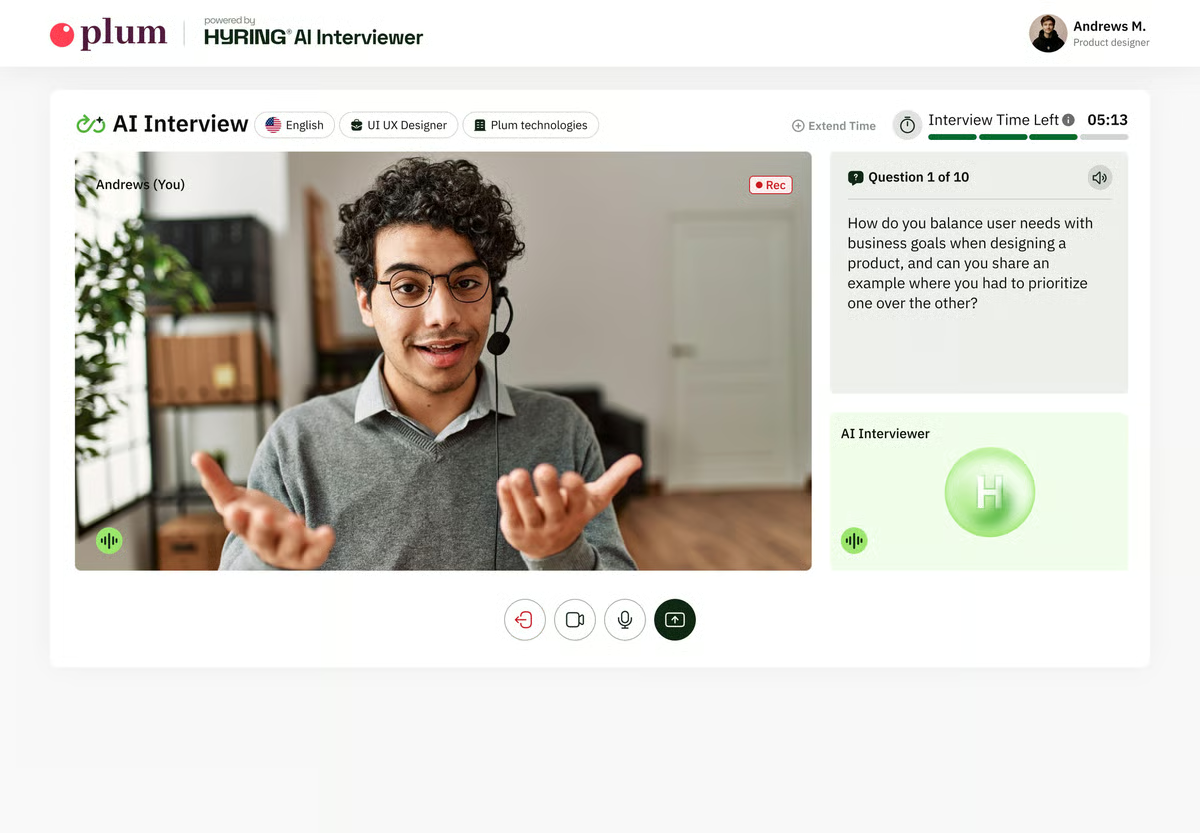
Recruiters mention that every AI interview is automatically transcribed, summarized, and analyzed with conversational insights, making it easier to review answers consistently. The detailed reports, with recordings, screenshots, proctoring results, topic-wise scores, and candidate rankings, give teams a clear snapshot of each applicant without hours of manual work.
The coding assessments are another area users praise, especially with the built-in IDE, support for 20+ languages, plagiarism detection, and logic-based evaluation that feels closer to real-world problem-solving than multiple-choice quizzes.
The platform monitors for cheating, including tab switching, multiple faces or voices, eye-gaze anomalies, background noise, and also checks for AI-generated or plagiarized responses. For high-volume or remote recruitment, this helps preserve the integrity of the interview process.
What stands out in G2 reviews is how much time teams save during early screening. AI Interviewer can run 24/7, engage candidates immediately, and deliver structured insights that help hiring teams move faster. And the satisfaction numbers reflect that: 98% ease of use, 99% ease of setup, and consistently high scores for quality of support, too.
It’s no surprise that the largest user segment is small businesses (71%), followed by mid-market teams (24%), since these companies often need automation that feels both powerful and simple.
Industries like financial services, IT services, software, marketing, and staffing appear strongly in the user mix, which makes sense for a tool focused on efficiency, fairness, and scaling candidate evaluation.
As with any AI-interviewing tools, reviewers mention that some candidates appreciate the structure, while others would benefit from a clearer introduction at the start so they understand they’re speaking with an AI rather than a live recruiter. And for teams hiring across multiple regions or markets, reviewers mention that having additional AI voice options and more local language coverage could make the experience feel even more tailored and natural for their candidate base.
On the whole, I’ve found AI Interviewer especially effective for teams dealing with high applicant volumes, because the automated screenings help you get to a shortlist much faster.
If I were looking for a tool that doesn’t just record interviews but actually runs them and delivers clear, actionable insights, AI Interviewer by Hyring would be high on my list. It’s a strong fit for small and mid-sized teams that want to speed up early-round screening, stay consistent, and give candidates a flexible, on-demand experience.
What I like about AI Interviewer:
- The AI can actually lead structured interviews, ask follow-up questions, and produce clear, actionable reports. It takes a huge amount of early-stage work off a recruiter’s plate while still giving hiring teams consistent, detailed insights.
- I appreciate how flexible it is for screening, whether it’s asynchronous interviews, coding assessments with built-in proctoring, or resume analysis; everything runs in one place and delivers standardized, easy-to-share evaluations.
What G2 users like about AI Interviewer:
“The implementation process is extremely smooth, with setup taking less than two minutes. The platform offers a wide range of features, including video interviews, phone screening, resume screening, and coding assessments with a built-in IDE that supports over 20 programming languages. I use it weekly for initial candidate screening. The interface is intuitive; simply set up your interview criteria, generate a link, and send it to candidates. The AI dynamically adapts questions in real time, rephrasing them if candidates have difficulty and probing further based on their answers. Fraud detection features are thorough, identifying multiple faces, external monitors, screen sharing, AI-generated responses, and lip-sync cheating. At only $1 per interview, it is exceptionally cost-effective for high-volume screening.”
– AI Interviewer Review, Filipe S.
What I disliked about AI Interviewer:
- For teams hiring across different regions or languages, reviewers mention that having additional AI voice options and expanded local language support would help make the interview experience feel even more tailored for their candidate base.
- Teams hiring for roles where candidates expect more human interaction may use the AI-led interviews primarily for first-round screening, and reviewers note that a clearer intro explaining the AI format upfront can enhance the candidate experience.
What G2 users dislike about AI Interviewer:
“There was a bit of a learning curve during setup, particularly with customizing the interview scripts to align with our company’s tone and culture. Additionally, while the AI is great for first-round interviews, we still prefer human interaction for later stages.”
– AI Interviewer Review, Amit K.
3. Hireflix One-Way Video Interviewing: Best for one-way video interviews
Hireflix is one of those platforms that shows just how simple and efficient one-way video interviewing can be. With a 5.0/5 G2 rating and 99% of users giving it 4 or 5 stars, it’s clear that users genuinely enjoy using it.
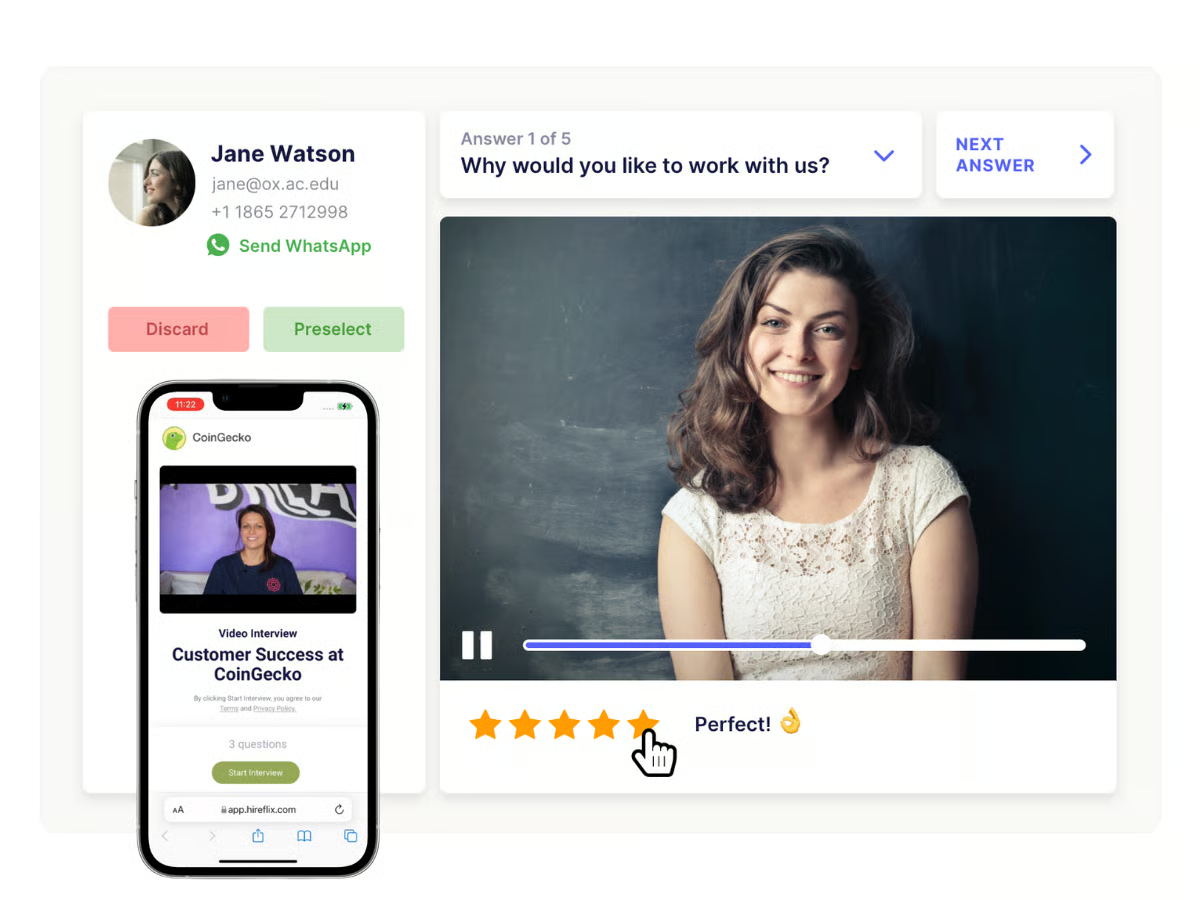
The core appeal is its simplicity of conducting one-way interviews with candidates: the recruiter records the digital interview questions once and sends them to as many candidates as needed, allowing people to respond on their schedule. There’s no need to coordinate time zones or squeeze phone screens into a packed day.
Reviewers love how Hireflix removes the back-and-forth that usually comes with screening, making it easy to evaluate candidates consistently and move top performers to the next stage. Once responses come in, users can review submissions whenever it works for them, share them with other stakeholders, and keep the entire process aligned without adding meetings to everyone’s calendars.
It also integrates smoothly into most hiring processes and plays nicely with applicant tracking systems, which helps teams avoid the friction that sometimes comes with adopting new tools.
And the satisfaction scores back that up. The platform scores 99% for ease of use, 99% for ease of setup, 99% for ease of admin, and a perfect 100% for quality of support, which makes sense given how popular it is among small businesses (63%) and mid-market teams (33%) that need hiring tools that don’t slow them down.
Industries like staffing, software, IT services, education, and marketing rely on it heavily, and it fits beautifully into fast-moving hiring environments.
Most reviewers say Hireflix already does exactly what they need it to do, and many of the comments lean more toward ideas for future enhancements rather than things that affect everyday use. Teams that enjoy fine-tuning their workflow might appreciate having even more customization or integration options as the platform continues to grow.
And for teams exploring more advanced capabilities, features like AI-assisted shortlisting, expanded analytics, or broader language support are mentioned as additions that could make an already strong experience even more powerful. These notes come from users who are clearly happy with the platform and are excited to see how it evolves alongside their hiring needs.
For me, Hireflix really shines when you need a clean, reliable way to screen a lot of candidates without adding extra meetings or coordination. It’s a great fit for small and mid-sized teams that want an efficient, flexible screening stage that candidates can complete on their own time while keeping the entire process simple and consistent.
What I like about Hireflix One-Way Video Interviewing
- From what I saw on the G2 reviews, users really like how simple and streamlined the entire process feels. Recording the interview once and sending it to as many candidates as recruiters need saves a huge amount of time, and reviewers consistently mention how intuitive the platform is from day one.
- Users appreciate how easy it is to review and share candidate responses. Being able to watch submissions whenever it works and loop in hiring managers without adding meetings makes the early screening stage much faster and more collaborative.
What G2 users like about Hireflix One-Way Video Interviewing
“Hireflix has improved our overall efficiency as a small team. It not only frees up valuable calendar space but also eliminates the frustrating back and forth of interview scheduling with multiple candidates. We were able to set up our first interview recording within a day and send it out immediately.
We have also found a way to use Hireflix for our employee check-ins, which has allowed us to connect with our team more consistently and support better retention.
From both the administrator and user perspectives, the platform is straightforward and easy to navigate. So fa,r none of our candidates have experienced technical issues.
– Hireflic One-Way Video Interviewing Review, Kally C
What I dislike about Hireflix One-Way Video Interviewing
- Teams that enjoy deeper customization or want more integration options might look forward to the additional branding controls and native integrations, as reviewers mention wanting to see as the platform continues to grow.
- For teams exploring more advanced capabilities, reviewers note that features like AI-assisted shortlisting, expanded analytics, or broader language support would be welcome additions over time, especially for organizations with more complex hiring workflows.
What G2 users dislike about Hireflix One-Way Video Interviewing
“There’s not much I dislike overall. The only thing I might change is the feature that allows candidates to access the questions only once, so they can’t prepare in advance. It happens (fortunately not often) that candidates read their answers, which is hard to spot. I would also add the possibility to schedule the next recruitment stage (a meeting, a calendar link, a survey, etc.) right after the initial link ends.”
– Hireflix One-Way Video Interviewing Review, Marta C
4. HackerRank Developer Skills Platform: Best for mid-market and enterprise engineering teams
If you have done technical hiring, you probably know about HackerRank Developer Skills Platform already. It has a long-standing presence in the developer hiring world, and as I dug through G2 reviews and its product capabilities, it’s easy to see why it continues to lead the category.
On G2, HackerRank holds a solid 4.5/5, and nearly all reviewers scored it in the top two tiers. Most of its users are mid-market (43%) and enterprise (52%) companies, exactly the kinds of organizations that need structure, scale, and repeatability in their engineering interview process.

HackerRank stands out because it evaluates developers in ways that feel rooted in real engineering work. Recruiters can screen candidates through coding tests, project-based challenges, supported with AI-powered scoring, which makes early-stage filtering more accurate and efficient.
Its AI Interviewer feature came up often in G2 user reviews too: it runs structured first-round technical interviews, ramps up complexity as candidates solve problems, offers hints without giving away answers, and generates detailed reports engineers can review quickly.
The platform doesn’t stop at coding skills either; it also evaluates AI readiness, prompting candidates to demonstrate how they work with AI tools, understand prompt engineering, or think about concepts like RAG and vector databases. Paired with its integrity stack that includes identity checks, suspicious activity detection, and proctoring controls, it gives hiring teams a lot of confidence at scale.
Its highest-rated features, technology (91%), user, role, and access management (88%), and performance (88%), reflect a platform built for reliability and scale. And the fact that so many of its users come from IT services, software, and internet companies makes sense: HackerRank is built for environments where technical accuracy and consistency matter.
And the G2 satisfaction scores back that up, with users giving it 91% for ease of use, 91% for ease of setup, and 91% for meets requirements, along with consistently strong ratings for support and admin experience.
Overall, HackerRank has a strong reputation for reliability, and most reviewers say it delivers exactly what they need, though a couple of preferences do come up depending on what different teams prioritize. Teams with a strong preference for minimal and streamlined UI might look for even more fluid navigation between test creation, candidate reports, and settings as their workflows grow.
And for teams hiring for roles where assessment integrity needs to be extremely rigorous, a few reviewers mentioned that even more advanced visibility or controls around plagiarism detection and AI assistance would be useful. Most of these suggestions come from teams that already rely heavily on the platform and are excited to see where it grows next.
All things considered, I’d say HackerRank is best for mid-sized and enterprise companies that want a technical interviewing platform capable of delivering realistic coding evaluations, deep integrity controls, and AI-ready assessments at scale.
What I like about HackerRank Developer Skills Platform:
- Being able to review candidates through collaborative IDEs, code repository challenges, debugging tasks, and structured AI-led interviews gives hiring teams a much clearer sense of someone’s actual skill level.
- Reviewers rave about the ready-made, role-based tests and Certified Assessments, which save an enormous amount of time for teams that don’t want to build everything from scratch.
What G2 users like about HackerRank Developer Skills Platform:
“I use the HackerRank Developer Skills Platform to conduct interviews for software engineering candidates and appreciate how seamlessly it integrates coding questions into the process, allowing me to view interviewees’ work on code or to whiteboard concepts. I enjoy how intuitive the coding and the whiteboard features are, as they make the technical interview process straightforward and engaging.
The coding part is particularly beneficial, as it supports many different programming languages and provides color coding, which enhances code readability and helps in assessing candidates effectively. Moreover, the initial setup of the HackerRank Developer Skills Platform was super easy, making it convenient to start using the platform without any hassle.”
– HackerRank Developer Skills Platform Review, Jennifer B.
What I dislike about HackerRank Developer Skills Platform:
- Teams that prefer a very modern, minimal interface might look forward to even more seamless navigation between test creation, candidate reports, and settings as their workflows grow.
- Teams with extremely rigorous standards around assessment integrity, some reviewers said that having deeper visibility or additional controls around plagiarism detection and AI assistance would make the process feel even more exhaustive.
What G2 users dislike about HackerRank Developer Skills Platform:
“Overall, the platform is robust, yet there is room for improvement in how plagiarism is managed and in the speed of reporting. Addressing these areas could make the experience even better for both users and recruiters.”
– HackerRank Developer Skills Platform Review, Arun K
5. Spark Hire: Best for an all-in-one video interview tool
If you’re looking for a platform that supports every flavor of video interviewing, one-way, live, mobile-friendly, and layers in behavioral assessments, automated reference checks, interview scheduling, and even a built-in ATS, Spark Hire checks a surprising number of boxes.
As I read through G2 reviews and explored its capabilities, it became clear why so many teams rely on it: it takes the busywork out of screening and gives hiring managers a much clearer, faster way to move the right candidates forward.
Spark Hire holds a strong 4.7/5 on G2. Most Spark Hire customers fall into the mid-market (48%) and small business (31%), and its features map well to what those teams typically need: flexible one-way and live two-way video interviews, automated reference checks, AI-assisted job descriptions and question sets, and even built-in scheduling for live interviews.
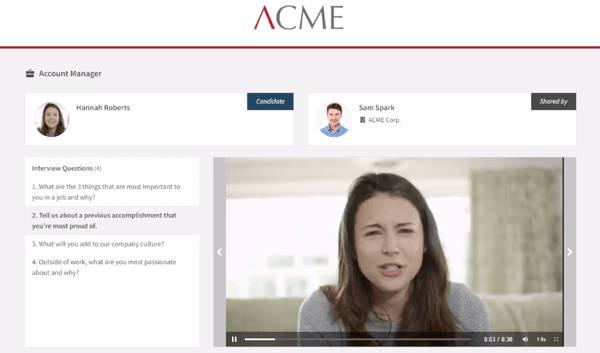
The platform also offers a built-in ATS (Recruit) or integrates with 40+ ATS systems, making it easy to fit into whatever workflow a team already has.
On the candidate side, the experience is thoughtfully designed. Hiring teams can add branded intro and outro videos, customize answer times and retake settings, and send reminders automatically, little things that make a big difference in follow-through and candidate comfort.
And when reviews need to move fast, features like AI-generated scorecards, AI video review, and searchable transcripts help hiring managers zero in on the strongest candidates without weeks of back-and-forth.
Beyond interviewing and automation, Spark Hire also excels on the collaboration front. Hiring teams can share candidate videos securely, making it easy to gather fast feedback from busy stakeholders. Role-based permissions, shared rating rubrics, and standardized evaluation templates help reduce bias and keep everyone aligned, especially in multi-team or multi-location hiring environments.
The G2 satisfaction data backs this up. Spark Hire scores over 97% on ease of use and Ease of Doing Business With, along with strong ratings for setup and support. Its highest-rated features, performance, user, role, and access management, and Technology (all 94%), reflect what I saw across reviews: it’s stable, fast, and designed for smooth collaboration.
From what I’ve seen in the reviews, most teams find Spark Hire easy to adopt and appreciate how quickly it improves their screening workflow, especially when multiple hiring managers are reviewing videos. At the same time, teams with very structured workflows, especially those screening at scale, may want more customization, more stable UI layouts, or stronger filtering tools to match their internal processes. Also, while the one-way format works really well, some users observe that candidates who prefer more traditional interactions may appreciate added guidance or alternative options alongside Spark Hire’s setup. This is something the HR teams can consider.
On the whole, if you want a platform that saves hours of manual coordination, keeps candidates engaged, and gives hiring managers clear, consistent insights, Spark Hire is an excellent choice.
What I like about Spark Hire:
- Spark Hire speeds up screening. One-way interviews, flexible live interviews, and automated reference checks make it easy to get a full picture of candidates without juggling calendars.
- G2 reviewers like how efficient the workflow feels, especially with how simple it is to review and share candidate videos, collaborate with hiring managers, and keep the process moving without back-and-forth scheduling.
What G2 users like about Spark Hire:
“What I like best about Spark Hire is how much time it saves and how well it keeps our hiring process organized. The one-way video interviews have been a game-changer; they let candidates respond on their own schedule, even at odd hours, which is incredibly convenient for both them and us. The integrated applicant tracking system (ATS) has transformed how we manage candidates, ensuring we always have a clear record of who we’ve interviewed and what decisions we made. It’s easy to use, intuitive, and makes us look much more professional to candidates.”
– Spark Hire Review, Dave G.
What I dislike about Spark Hire:
- Most workflows feel smooth, but teams with very structured processes or large reviewer groups might want deeper customization or more advanced filtering and navigation options as they scale.
- The one-way format works really well for efficiency, though some reviewers noted that candidate pools that prefer more traditional interactions may appreciate added guidance or alternative options alongside Spark Hire’s setup.
What G2 users dislike about Spark Hire:
“Would want more control over how interviews are structured, more advanced customization, or better workflows.”
– Spark Hire Review, Ashley D,
6. Indeed Hiring Platform: Best for virtual interviews
When I went through the G2 reviews for Indeed Hiring Platform, the biggest theme that stood out was reach. If you want sheer volume, more qualified candidates landing in your pipeline faster, this platform consistently delivers. With a 4.3/5 G2 rating, it’s clear that teams across small businesses, mid-market, and even enterprise rely on it as a central part of their hiring process.
What reviewers appreciate most is the combination of visibility, speed, and simplicity. Because everything lives inside a single workflow — posting, matching, screening, messaging, scheduling, and interviewing — there’s very little administrative juggling.
The matching engine learns your preferences and helps surface high-potential candidates quickly, and features like AI-generated messages and personalized templates help keep outreach efficient without feeling robotic.