


If you’re not in the trenches of search every single day, it’s hard to know how seriously to take answer engine optimization strategy. There are two dominant camps right now: those who see generative AI as the most disruptive shift search has ever experienced, and those who argue that AEO (or GEO) is simply an extension of traditional SEO.

Predictably, the truth lives somewhere in the middle — a lot of AEO is SEO, with some pivots, enhancements, or attention diverted to prominent tactics that help brands gain visibility in AI tools. On the other hand, you can gain visibility in AI tools without ranking well in traditional SEO listings; the tactics can be separated.
What‘s harder to separate is your brand from the consequences of ignoring AI’s impact on search. Google’s AI Overviews (AIO) is taking clicks from websites; clicks drop by 61% when AIO is present and more alarmingly, your potential customers are busy asking AI tools about brands before they decide to create a shortlist. If your brand isn’t getting visibility for those early searches, you’re out of the race before the buyer has even discovered your website.
If you’re creating an answer engine optimization strategy and you want something more nuanced than “just do good SEO,” this is the article for you. I’ll cover how answer engines choose what to cite, where SEO still does the heavy lifting, and what additional work is required to appear in AI-generated answers.
Table of Contents
AEO strategy foundations: how AI engines and LLMs pick sources.
The models that power LLMs, like ChatGPT, are trained on a combination of:
- Publicly available internet content
- Licensed third-party data
- Information generated by human trainers and users
Together, these sources shape how models understand entities, topics, and relationships across the web.
Read more about the foundation of ChatGPT here.
A common misconception is that LLMs were trained on a bunch of sources and that their answers are now set, but this isn’t the case.
Enter Retrieval Augmented Generation (RAG).
RAG improves AI responses by adding external context when a question is asked. Rather than relying only on what a model learned during training, RAG allows it to pull in relevant information to produce (in theory!) more accurate, grounded answers.
Here’s what a basic RAG workflow looks like:
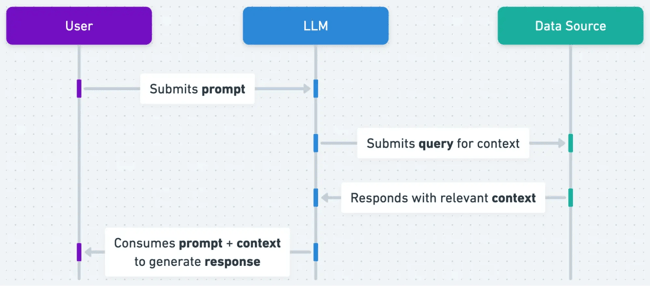
In this search evolution, your content needs to be retrievable, which means being clear in your content (and in the content others publish about you across the web) about who you are, what you do, and how everything is connected.
Entity clarity and consistency help AI systems confidently identify, extract, and reuse your content, reducing confusion and increasing the likelihood that your brand is cited accurately in AI-generated answers. On top of that, there are technical considerations to account for, such as ensuring key content is accessible in HTML. I’ll cover these tactics later.
Answer engine optimization strategy beyond the basics
If you’re a competent SEO specialist, then the five steps below may feel familiar, but it’s important to list these components of an answer engine optimization strategy because some extra focus is required from SEO or AEO teams if you want to succeed in AI-driven search results.
I’ve covered each component in detail below, but this table provides an overview of how each area is managed in an SEO vs. AEO strategy.
|
Area |
SEO |
AEO |
|
Audience targeting |
Keyword-driven intent and SERP analysis mean audience targeting can get as granular as SERPs will allow. Sometimes, only broader pages rank for specific keywords. |
Answer-driven intent allows for highly specific audience targeting based on roles, use cases, and challenges because AI can match answers precisely. |
|
Landing pages |
Pages are sometimes designed to rank broadly, and fewer pages are created to avoid keyword cannibalization. |
Granular, audience-specific pages are created to address a single audience and their challenges in detail. |
|
Content formatting |
Content is optimized for readability, user experience, and ranking signals. |
Content must be structured for extraction, such as question-led subheads and direct answer blocks. |
|
HTML and JavaScript |
Search engine bots crawl HTML and render JavaScript to discover dynamically loaded content. |
Content must exist plainly in HTML so AI systems can reliably retrieve, parse, and cite it without executing scripts. |
|
Keywords and prompt tracking |
Keywords serve as directional signals, but success is judged by whether the content meets needs and drives real on-site outcomes. |
Prompts serve as directional signals, but success is judged by whether the content meets needs and drives real on-site outcomes. |
|
Measuring success |
Organic traffic, rankings, click-through rates, and tangible business impact, such as conversions, revenue generated, and pipeline influence. |
Visibility, citations, and tangible business impact, such as conversions, revenue generated, and pipeline influence. |
1. Know your audience on a granular level.
A strong answer engine optimization strategy starts with a deeper understanding of the audience. Yes, traditional SEO typically requires this, too, but with the opportunities created by AEO, it’s extremely shortsighted not to revisit your ideal client profile (ICP) and get granular.
The next section elaborates on the why behind this, but in short, it’s no longer enough to know which keywords a broad market searches for. You need clarity on who is asking the question, why they’re asking, and what kind of answer would genuinely help them move forward.
AEO strategy requires mapping buyer questions to answer types and platforms.
Remember: people are searching for personalized, nuanced, detailed questions in AI search, and if you want to serve your audience via AI, you need to get into the nuance.
Granularity also creates strategic flexibility. You can address specific industries, roles, or use cases without forcing everything into a single, catch-all page — while still benefiting from your broader SEO foundations.
Pro tip: When planning AEO content, write down the exact person you’re answering before you write the answer. If you haven’t created buyer personas, you need them for every decision maker, especially if you’re in B2B.
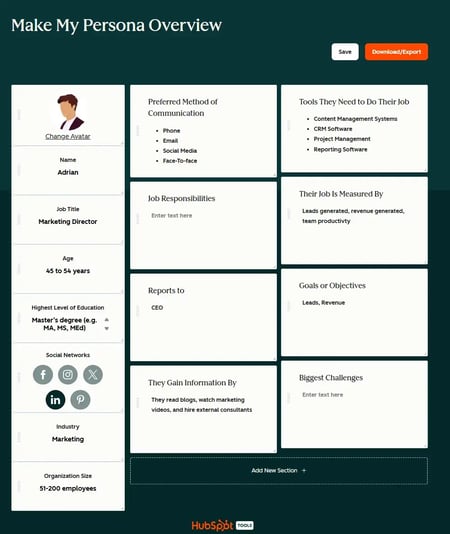
HubSpot’s Make My Persona helps marketing teams define clear buyer personas by mapping roles, goals, challenges, and decision drivers to a single, consistent profile. Clear personas create stronger entity–intent alignment, making it easier to produce audience-specific answers that AI systems can accurately extract and cite.
Once you’ve established your audience, you can serve them on your site.
2. Create targeted pages that address specific audiences and their challenges.
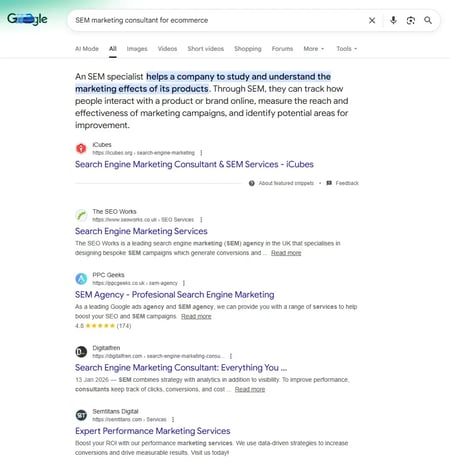
SEO landing pages have traditionally been shaped by what Google appears to reward in the search results. For example, if a search for “SEM marketing consultant for ecommerce” returns mostly broad SEO service pages, teams often conclude that the safest place to target that term is the broad service page, rather than creating a dedicated landing page for the ecommerce audience.
Here’s the SERPs showing pretty generic Search Engine Marketing (SEM) services.
While this approach can work for rankings, it’s limiting. Broad pages leave little room to address nuance or fully explain a specific offering. In this case, going deep on the PPC side of SEM might dilute relevance for an SEO-focused page, while keeping it high-level risks underselling the full service altogether. The result is content that ranks but does not effectively address any particular audience.
This is where traditional SEO fails.
With SEO, searchers have to open numerous links and explore websites to find case studies before they can feel confident that the SEM services offered are suitable and that the company excels in their industry.
AEO resolves this problem by summarizing information from across the sources and providing a solid starting point for discovery and further research. AEO-driven search creates far more freedom and opportunity to serve narrow, well-defined audiences with highly targeted content.
Here’s a screenshot of AIO taking a searcher directly to their solution by mentioning brands:
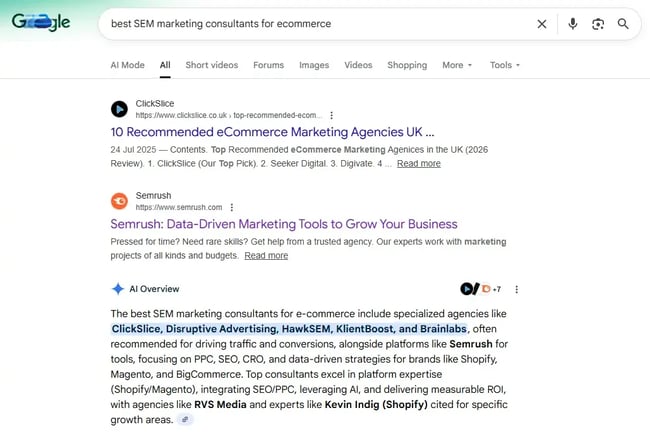
Granular pages that address a specific role, problem, or use case make it easier for AI systems to identify a clean, relevant answer and cite it. A single paragraph can surface in an AI response even if the page itself would never rank on page one of traditional search. This is why smaller brands can now earn top-of-funnel visibility in AI answers, even when their broader SEO performance isn’t especially strong.
Pro tip: If a page tries to speak to everyone, it gives an answer engine nothing specific to quote. The more precisely you define the audience, their challenges, and your solutions, the more likely your content is to be extracted and reused.
3. Format correctly in a way that helps AI
Even the most targeted pages can be overlooked by AI crawlers if the structure makes it hard for AI systems to extract a clear answer.
Content formatting should use question-led subheads, direct answer blocks, and semantic triples. I’m keeping this brief because I explore this in more detail later in the article.
4. Keep content available in HTML.
There are technical considerations that influence the success of an AI engine optimization strategy, and one of the most important is ensuring that content is available in HTML.
Google’s search crawlers can render JavaScript, which means they’re often able to discover text that isn’t present in the raw HTML. As a result, traditional SEO can sometimes rely on JavaScript to load or reveal content dynamically. Content doesn’t have to be included in HTML for SEO That said, this approach still comes with risk; not all rendered content is indexed, especially when it’s hidden behind tabs, accordions, or filters that require user interaction.
AI crawlers don’t behave like Googlebot. They rely on HTML only. If important answers only appear after scripts run, there’s a real risk they won’t be retrieved, extracted, or cited at all.
The takeaway is simple: if content is critical to being understood or referenced by AI systems, it should exist plainly in the HTML, not depend on JavaScript to appear.
5. Don’t get too wrapped up in keywords and prompts.
Over-reliance on keywords has always failed to tell the full story, but with AEO and prompt tracking in the mix, it falls short more than ever.
Keyword data can indicate demand, and prompt tracking can help determine who has visibility and where, but AI tools change their sources a lot, based on what’s recently updated, individual searcher personalization, and, of course, the nuance of prompts is impossible to track.
Is it useful to track keywords and prompts? Sure, but with caveats…
Pro Tip: Don’t get so wrapped up in prompt tracking that it becomes your primary source of success because AEO success isn’t just about whether a prompt triggers a mention. It’s about whether your content genuinely meets a specific need, answers the right question, and supports decision-making. The most reliable signal that your strategy is working is still a tangible impact on your website: engagement, conversions, and bottom-of-funnel outcomes like revenue, not isolated visibility metrics alone.
How to format AEO content so LLMs extract and cite it.
LLMs need content to be clearly structured and easy to extract. The formatting principles below build on familiar SEO best practices but apply them more deliberately so that individual passages can stand on their own within AI-generated answers.
Write question‑led subheads with direct answers.
LLMs are optimized to respond to questions, so your content should mirror that structure.
There’s no strict format, but here’s a guide to help you write succinctly:
- Write a 40–80-word answer directly under each question. You can elaborate further after the first sentence or two if you want to.
- Stick to one idea per sentence, so it’s simple.
- Use clear subject–predicate–object phrasing to reduce ambiguity. More tips on this later.
These formats are not exactly new, and are likely already included in your digital strategy guide, particularly in your SEO blog.
When it comes to AEO strategy, it doesn’t hurt to give this format some extra thought.
Tools like Breeze AI Suite help marketers write content that ranks in AEO and SEO. Breeze AI helps writers research common buyer questions and plan extraction-friendly answers directly inside their workflow. Combined with Content Hub, writing and marketing teams become an unstoppable force. Content Hub operationalizes templates, briefs, and reusable content patterns that support extractable answers at scale.
Combined with HubSpot’s Marketing Hub, markets can orchestrate cross‑channel promotion and nurturing around answer‑ready content.
Use semantic triples
Semantic triples are a writing and structuring technique that expresses meaning through explicit relationships: a subject, a predicate, and an object. This approach makes it easier for AI systems to understand not just the words on a page, but how concepts relate to one another.
HubSpot does this particularly well. Instead of vaguely describing capabilities, HubSpot explicitly states what its product is, what it offers, and how it’s used.
For example, instead of a vague description like “HubSpot offers powerful tools to help businesses grow and improve their marketing efforts.” We use explicit, entity-driven descriptions, like “HubSpot is a CRM platform that provides marketing automation, sales enablement, and customer service tools for B2B companies.”
Broken down into a semantic triple:
- Subject: HubSpot
- Predicate: is a
- Object: CRM platform
In this structure:
- The subject is a clearly identifiable entity that AI systems can recognize and classify, such as a company, product, person, or concept.
- The predicate defines the relationship between the subject and the information that follows.
- The object provides the specific, factual information that defines or explains the subject.
This level of clarity helps AI systems understand not just keywords, but meaning. Use them to identify who the expert is, what they’re authoritative on, and how concepts relate to one another.
Pro Tip: Semantic triples don’t have to take over your writing; just consider them in your next piece. In my experience, with semantic triples front of mind, I use them a lot more now than I did before, and I like them! It makes sense to me that semantic triples lead to unambiguous content, and that must be helpful for AI.
Chunk content for AI and humans.
Chunking is the practice of breaking content into small, self-contained sections that communicate a single idea clearly and efficiently. This approach improves readability for humans and makes it easier for AI systems to identify, extract, and reuse relevant information.
For AEO, chunking means using:
- Short sections
- Clear subheads
- Bullets
- Code or callout blocks
Every key section should be able to stand alone as a complete answer. If a paragraph only makes sense in the context of the full page, it’s harder for an AI model to quote or summarize it confidently.
Important note: There are many criticisms of chunking content because it reads like “use paragraphs.” And while that is part of it, chunking content isn’t just about implementing paragraphs. The concept of chunking is designed to help writers get the most important information out first. Instead of overwhelming objective facts with opinion or nuance, chunk content so the fact comes first, then your opinion later; don’t combine the two.
How to build authority so answer engines trust you.
The importance of showcasing authority became prominent among SEO specialists, alongside Google’s Experience, Expertise, Authority, and Trust (E-E-A-T). Emphasis on authority signals seems to carry on into answer engine optimization.
The following principles help ensure your content remains authoritative (and extractable) regardless of how many AI or Google’s EEAT updates occur.
-
1. Show expertise and author identity.
Showcasing expertise starts with the content itself. Clear explanations, confident language, and evidence of real-world experience signal credibility to readers, Google, and AI systems.
This includes:
- Referencing first-party research
- Citing reputable sources
- Demonstrating depth on the topic rather than surface-level commentary
If your content doesn’t clearly reflect expertise, no amount of technical optimization will compensate for it.
Important note: Demonstrating expertise isn’t just a content decision; it’s a technical one.
Within the HTML of your website, you can add or reinforce author bios, credentials, and references to help AI understand your content and find more words to cite. You do this through the schema. JSON-LD schema improves AI extraction and citation of content.
Schema lives in the HTML and can surface detailed information about a person (an author on your site or a team member), including their role, experience, areas of expertise, and publications. Since it’s in the HTML, AI crawlers can read it and summarize it in the answers.
While schema is (currently) just more words on a site for AI crawlers, it’s an excellent tactic for SEO, so there’s every reason to use it.
Why I like schema: In some cases, adding or improving schema can show a tangible impact within days. In my experience, rich snippets or knowledge panels can appear shortly after implementation, a reminder that this work pays off for SEO and benefits the AEO strategy.
Interested in schema? Read my article Schema markup for AEO: How to implement it to boost answer engine visibility in 2026
2. Diversify citations across platforms that AI engines favor.
Answer engines don’t rely on a single source type; you can’t just optimize your website and expect this to be enough. When people search for AI, they’re looking for third-party validation and branded content. For example, research shows that 32% of buyers discover new B2B vendors using generative AI. To discover vendors using AI, searches are likely looking for “the best [solution] for [highly detailed problem].”
No marketer should expect branded content to be consistently cited in searches like this. There needs to be proof, and AI tools pull from a mix of brand-owned content, trusted publications, expert commentary, documentation, and community-driven platforms.
Here’s an example:
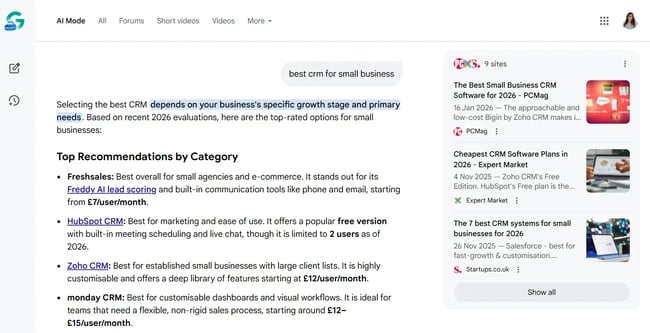
The search in the previous image shows three sources. They’re industry-expert listicles, not content from the recommended company’s website.
That means building authority for AEO requires more than publishing on your own site; it requires earning high-quality mentions in the places AI engines already trust and cite.
A digital PR approach works best here.
Focus on:
- Contributing genuinely helpful, non-promotional insights to industry publications, podcasts, reports, and expert roundups.
- Prioritize clarity and usefulness over links or brand mentions.
- Ensure consistency in how other sites talk about you by providing brand guidelines.
When multiple credible sources consistently reference your expertise, AI systems are more likely to cite your brand accurately as part of an answer.
Once those mentions exist, marketing teams can measure how their brand appears in AI-driven results. HubSpot’s AEO Search Grader benchmarks brand visibility in AI answer engines. This AI search tool makes it easier for marketers to understand where the brand is appearing, where they’re missing, and how citation patterns change over time.
Read more on AI visibility: Quick Guide to AEO with HubSpot.
3. Keep facts fresh and consistent everywhere.
AEO specialists must work toward earning consistent citations. To some degree, what generative AI tools produce is out of a brand’s control, but maintaining consistency across names, product descriptions, locations, and other attributes increases the likelihood of AI citing information about your brand that is correct.
This mirrors the logic behind local SEO and Name, Address, and Phone number (NAP) consistency. When AI systems pull information from multiple sources, even small discrepancies can lead to outdated and incorrect answers being surfaced.
That’s why it’s critical to regularly update the key pages, profiles, and feeds that AI engines are most likely to revisit.
Pricing is a particularly important example. AI tools surface pricing information quickly and prominently, and accurate, accessible pricing can actively influence buying decisions.
In his article, AI tools are already reshaping B2B purchasing behavior, Constantine von Hoffman explains, “AI can compress buying cycles dramatically for larger companies with complex, committee-driven purchasing processes. Stakeholders can rely on AI-generated shortlists built around specified criteria, shifting the onus to vendors to maintain explicit, searchable, and accessible content — especially pricing — on their websites.”
In the same piece, Hoffman interviews Chris Penn, Co-founder and Chief Data Scientist at TrustInsight.AI. Penn describes asking Gemini’s Deep Research to find alternatives after his existing SaaS provider raised prices. Within minutes, the AI produced a shortlist based on publicly available information, and he switched vendors without ever engaging a traditional sales process.
The takeaway is clear: when facts like pricing, positioning, or availability change, they need to be updated everywhere — quickly. In an AI-driven buying journey, stale or inconsistent information doesn’t just create confusion; it can cost you the deal before your team even knows a decision is being made.