



If your buyers are asking ChatGPT for vendor recommendations instead of scrolling through Google results, your brand’s visibility in AI search engines matters as much as your organic rankings … maybe more. That shift is what’s driving the rapid adoption of answer engine optimization as a discipline, and it’s why marketers are now evaluating dedicated tools to track, measure, and improve how AI platforms characterize their brand. The challenge isn’t awareness that AI is reshaping search; it’s choosing the right tool to address it.

HubSpot AEO and Peec AI are two of the most visible platforms in this space, but they serve meaningfully different functions. One connects AI visibility insights to a CRM-driven content execution workflow. The other delivers deep monitoring and reporting infrastructure designed to feed external tools and agency dashboards.
Choosing the wrong one for your team’s stage, stack, and resources means either paying for execution capabilities you won’t use or collecting data you can’t act on. This post breaks down features, pricing, engines tracked, integrations, and actionability side by side, so you can effectively match the tool to your AI SEO workflow.
Let’s begin.
Table of Contents
What is HubSpot AEO Grader and Peec AI?
HubSpot’s AEO Grader is a free page grader that evaluates what ChatGPT, Perplexity, and Gemini say about your brand based on their training data. No account, no credit card, no usage caps.
It’s pretty simple to get started with AEO Grader. To run your first report, you enter your:
- Company name
- Location
- Industry
- Product description
Then, the tool runs dozens of test queries across all three AI engines, returning a composite score out of 100 with a written interpretation of your results in three to five minutes.
Peec AI, on the other hand, is a visibility monitoring platform that tracks how often your brand appears in AI-generated responses to buyer questions. The platform uses UI scraping technology to simulate real user interactions rather than querying APIs, so the responses it logs reflect what actual users see.
Now, when comparing HubSpot AEO versus Peec AI, the first thing to understand is that these are not interchangeable tools.
HubSpot’s AEO Grader provides a one-time brand visibility check across five key categories. In short, each tool serves a distinct role in your AEO stack, and the right choice depends on where your team stands today.
HubSpot AEO Grader: Your Free Baseline Score
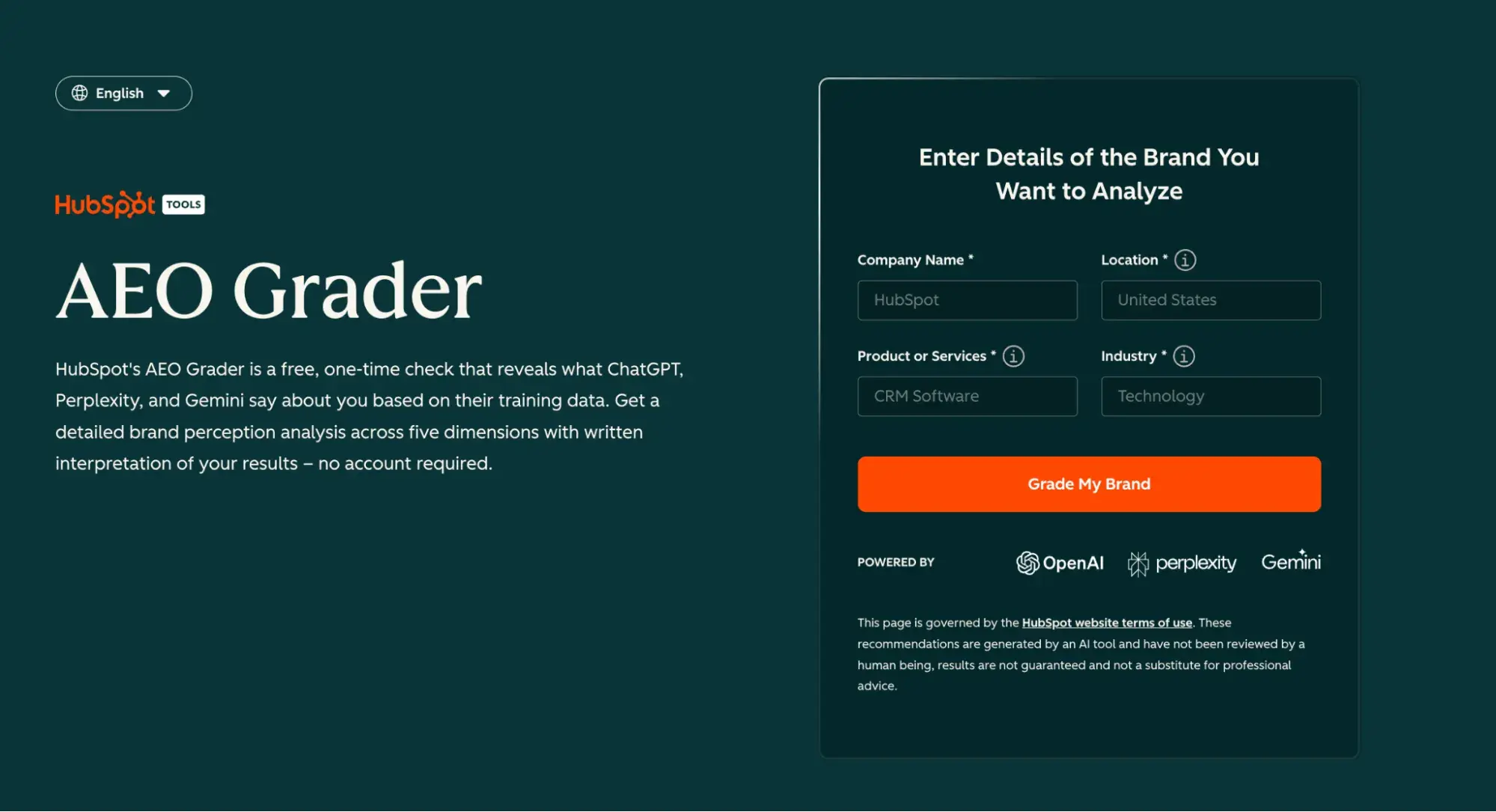
As I previously mentioned, HubSpot’s AEO score baseline is structured around five factors, each weighted to reflect its impact on how AI characterizes your brand.
Take a look at the chart below to see how each dimension is scored and what it measures:
|
Dimension |
Max Score |
What It Measures |
|
Sentiment Analysis |
40 pts |
The overall tone AI uses when describing your brand spanning general sentiment, contextual sentiment across topics, and the credibility of the sources shaping that characterization. |
|
Presence Quality |
20 pts |
The depth and accuracy of how AI engines describe your offerings, capabilities, and differentiators. |
|
Brand Recognition |
20 pts |
Whether AI engines reliably identify, name, and categorize your brand when responding to relevant queries. |
|
Share of Voice |
10 pts |
How frequently your brand appears in AI responses relative to competitors in the same category. |
|
Market Competition |
10 pts |
Your perceived competitive positioning and market standing within AI-generated answers. |
Overall, Sentiment Analysis carries the most weight among these areas because it measures how AI characterizes your brand.
HubSpot AEO: Continuous Monitoring Plus Execution
This article positions HubSpot AEO as the primary product comparison, and AEO Grader as the low-friction entry point.
Here’s why: AEO Grader answers, “How does AI represent my brand right now?” HubSpot AEO answers, “How is that changing, and what should I do about it?”
Additionally, the platform includes:
- Prompt tracking across ChatGPT, Perplexity, and Gemini with week-over-week trend data.
- Brand visibility and citation analysis to surface how and where your brand is mentioned.
- Competitor share of voice to benchmark your position against named rivals.
- Prioritized recommendations that tell you what content to create or update (and connect directly to your existing HubSpot content tools).
Peec AI: Monitoring and Reporting at Scale
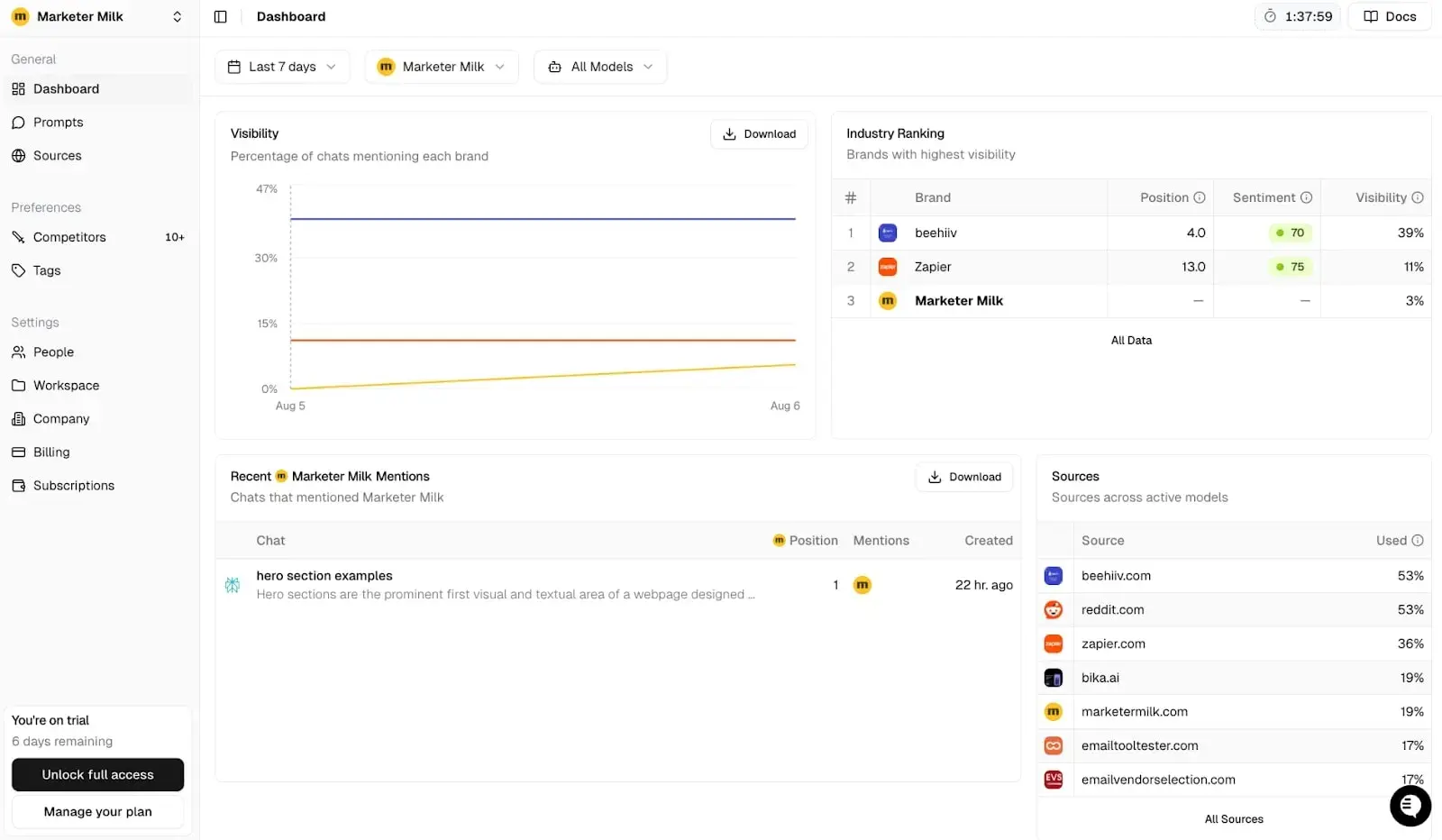
This comparison evaluates features, pricing, engines tracked, prompts, integrations, and actionability, so here’s what Peec AI delivers:
- Daily visibility tracking across ChatGPT, Perplexity, and Google AI Overviews on every plan, with Claude, Gemini, and DeepSeek available as add-ons.
- Source-level citation intelligence that shows exactly which URLs AI engines cite when answering your prompts, categorized by domain type, page type (homepage, article, listicle, comparison), and whether it’s your domain, a competitor, or a third party.
- Gap Analysis that surfaces sources frequently citing competitors but not you, scored and prioritized for outreach.
- Sentiment scoring that measures how your brand is discussed, not just whether it’s named.
- Multi-language, multi-region tracking across 14+ languages and any supported country at no extra prompt cost.
How do I choose between a snapshot and continuous AEO monitoring?
The right tool depends on your stage of AEO maturity and what you intend to do with the data.
Here’s a practical decision framework to utilize when it’s time to make a choice:
|
Your situation |
Recommended tool |
Why |
|
You’ve never measured AI brand visibility. |
HubSpot AEO Grader (free) |
Establishes a scored baseline across five categories in under five minutes — zero commitment required. |
|
You need continuous tracking and competitor benchmarking. |
HubSpot AEO ($50/mo) or Peec AI ($95+/mo) |
Both offer ongoing monitoring. HubSpot AEO includes CRM-connected recommendations; Peec AI offers deeper multi-engine reporting. |
|
You need to act on visibility gaps (not just measure them). |
HubSpot AEO + Marketing Hub |
HubSpot AEO surfaces what to fix. Marketing Hub is where you build and publish the content that fixes it. |
|
You manage multiple client brands and need scaled reporting. |
Peec AI |
Multi-project accounts, agency credit systems, white-label dashboards, and per-project engine selection. |
|
You’re building a business case for leadership buy-in. |
HubSpot AEO Grader (free) |
A composite score out of 100 with a written interpretation is significantly more communicable than paid-tool dashboards. |
Pro tip: If you’re unsure whether continuous monitoring is worth the investment, I recommend starting with the AEO Grader. A low Sentiment or Share of Voice score signals that monitoring (and execution) should follow quickly.
A strong baseline may mean the priority is maintaining visibility rather than rebuilding it. Either way, HubSpot’s brand visibility report with AEO Grader gives you a concrete data point to bring into the conversation rather than a theoretical pitch.
HubSpot AEO vs. Peec AI Features and Engines
To help you make a confident decision, I’ve compared the following:
- Features
- Pricing
- Engines tracked
- Prompts
- Integrations
- Actionability
When choosing between AEO tools, the feature list matters far less than what you can actually do with the data.
Here’s a transparent breakdown of how HubSpot AEO and Peec AI stack up across the capabilities that shape your day-to-day workflow:
1. Engines Tracked
HubSpot AEO tracks brand visibility across three answer engines:
- ChatGPT
- Gemini
- Perplexity
All three are included on every plan with no add-on fees.
HubSpot’s broader web analytics also recognizes AI referral clicks from Copilot, Claude, and Meta AI inside its “AI Referrals” traffic source, so while prompt-level tracking covers three engines, your attribution picture extends further.
Alternatively, Peec AI tracks ChatGPT, Perplexity, and Google AI Overviews on every plan, with Claude, Gemini, DeepSeek, and Grok available as paid add-ons. Every self-serve plan limits engine selection to three out of the seven available options (a constraint that holds from the Starter through the Advanced tier).
Pro tip: If Gemini is a priority engine for your audience, note the difference. HubSpot AEO includes Gemini across all plans. With Peec AI, Gemini is an add-on, and choosing it means dropping one of your three default engines unless you pay extra.
2. Prompt Tracking and Caps
No matter what the feature lists say, prompt tracking is the core of both platforms. However, how prompts are generated, capped, and connected to your business context varies significantly between HubSpot AEO and Peec AI.
HubSpot AEO uses your Smart CRM data (i.e., products, ICPs, competitor names, and deal stages) to auto-generate prompt suggestions tailored to your actual business. Then, the CRM connects contact and company records directly to AEO prompt recommendations, so tracking starts with buyer-relevant queries from day one rather than generic industry templates.
I’ll get into pricing for both tools in more detail later on, but for now, here’s a brief look at HubSpot AEO pricing as it relates to prompt caps:
- Free trial: 10 prompts on ChatGPT for 28 days.
- Standalone ($50/month): 25 prompts, daily tracking across all three engines (up to 2,500 answers/month).
- Marketing Hub Professional (included): 25 prompts, daily tracking, 2,500 answers/month.
- Marketing Hub Enterprise (included): 50 prompts, daily tracking, 5,000 answers/month.
- Expansion packs: +10 prompts each (1,000 answers/month), stackable.
Peec AI suggests prompts based on search intent signals and lets teams organize them by persona, funnel stage, or topic tags.
Here’s a brief look at Peec AI pricing as it relates to prompt caps:
- Starter ($95/month): 50 prompts, 3 AI models, 1 project.
- Pro ($199/month): 100 prompts, additional engine options.
- Advanced ($945/month): 300 prompts, custom pricing for higher volumes.
Basically, Peec AI offers more raw prompt volume at each tier. HubSpot AEO offers fewer prompts but connects them directly to your CRM context and content execution workflows, which is a considerable trade-off between breadth and depth of integration.
3. Citation and Source Insights
Both platforms surface which domains and pages are cited in AI-generated responses, but the depth and how you use those insights differ.
HubSpot AEO connects visibility insights to content and campaign execution workflows. Its citation analysis breaks down sources by the following types:
- Owned content
- Competitor domains
- Social platforms
- User-generated content (UGC)
- Affiliate pages
- Content format (blog, news, product, social)
When a gap appears, HubSpot AEO surfaces prioritized recommendations and connects them directly to HubSpot’s Marketing Hub content tools, so your team can create or update the content that closes that gap without leaving the platform. (Also, Marketing Hub supports content and campaign execution after AI visibility insights are identified. The blog post, landing page, or LinkedIn post all get built where the data lives.)
Conversely, Peec AI focuses on AI visibility monitoring and reporting through its Sources feature, which shows the exact URLs that AI engines cite for each prompt. These cited URLs are categorized by:
- Domain type
- Page type (homepage, article, listicle, comparison, product)
- Ownership (your domain, competitor, or third party)
Its Gap Analysis scores sources that frequently cite competitors but not you, giving teams a prioritized target list for digital PR and authority-building outreach.
4. Update Frequency
HubSpot AEO runs every tracked prompt daily across all three engines on a 24-hour refresh cycle. Data refreshes automatically. No manual runs required.
Now, Peec AI also tracks daily on all paid plans. But because Peec uses UI scraping technology rather than API calls, responses reflect what real users see in each engine’s interface, which can surface formatting and citation differences that API-based tools miss.
Nevertheless, both platforms deliver daily data, so the update cadence is effectively equivalent.
5. Exports, Reporting, and Integrations
This is where the platforms diverge most sharply, and where the HubSpot AEO or Peec AI choice often comes down to your team’s reporting stack.
To save you the stress of going back and forth between product pages, here’s a brief, quick hit guide to export, reporting, and integration capabilities for both tools:
|
Feature |
HubSpot AEO |
Peec AI |
|
Internal dashboards |
Native inside Marketing Hub |
Standalone dashboard |
|
CSV exports |
Via HubSpot reporting |
All plans |
|
Looker Studio |
Not native (HubSpot reporting instead) |
Advanced+ plans |
|
API access |
Via the HubSpot API ecosystem |
Enterprise only |
|
MCP integration |
Not available |
All paid plans |
|
Mobile access |
Mobile-friendly dashboard cards |
Responsive web UI |
|
CRM connection |
Native Smart CRM integration |
Requires manual configuration |
6. Alerting
HubSpot AEO surfaces visibility changes through its dashboard, trend views, and recommendation updates inside Marketing Hub.
While not a standalone alerting system, the prioritized recommendations act as a functional alert layer; when visibility drops or a competitor gains share of voice, a new recommendation appears with a specific action attached.
Now, Peec AI, on the other hand, is a little different. It offers more configurable alerting through its MCP integration. Teams can wire up daily sentiment checks that trigger Slack or email alerts when a brand’s sentiment drops below a defined threshold, including the exact AI responses that caused the shift. (This is available on all of its paid plans.)
7. The Page Grader Connection
If your team started with the free AEO Grader, you already have a baseline score across the following AI search dimensions:
- Sentiment Analysis
- Presence Quality
- Brand Recognition
- Share of Voice
- Market Competition
Peec AI does not offer a free baseline diagnostic. Teams evaluating Peec start with a paid subscription from day one.
Quick Summary: What Each Platform Does Best
Here’s the (short) scoop on what each platform does best: HubSpot AEO is the right choice when your priority is connecting AI visibility data to content execution and pipeline reporting in a single platform. However, Peec AI is the strongest choice when your priority is scaled monitoring, external reporting, and multi-engine analytics.
Use this chart to help assess which strengths matter most for your team:
|
Strength |
HubSpot AEO |
Peec AI |
|
CRM-connected prompt generation |
Yes (Smart CRM) |
No |
|
Content execution from insights |
Yes (Marketing Hub) |
No |
|
Multi-engine coverage (7+ engines) |
No (3 included) |
Yes (7 engines, 3 per plan) |
|
BI tool integrations |
Via HubSpot reporting |
CSV, Looker Studio, API, MCP |
|
Agency multi-client management |
Multiple purchases required |
Built-in multi-project + credits |
|
Free baseline diagnostic |
Yes (AEO Grader) |
No |
|
Sentiment depth |
Included |
Best-in-class |
Pro tip: These tools aren’t mutually exclusive. Some teams run HubSpot AEO for CRM-connected execution and Peec AI for expanded engine coverage and client reporting, using each where it’s strongest rather than forcing one platform to do everything.
HubSpot AEO vs. Peec AI Pricing and Limits
Pricing is where the HubSpot AEO versus Peec AI comparison gets concrete.
Both platforms use prompt-based billing, but they structure costs, trials, seats, and scaling very differently, and those differences have real implications depending on whether you’re an SMB testing AEO for the first time, a mid-market team embedding it into an existing CRM workflow, or an agency managing ten client brands.
In this section, I’ll provide a transparent, no BS breakdown that’ll help you make a decision grounded in your budget, team size, and reporting needs.
Entry Pricing and Free Tiers
The article positions HubSpot AEO as the primary product comparison and AEO Grader as the low-friction entry point, and the pricing structure reflects that philosophy.
HubSpot AEO offers two free entry paths before any spend:
- AEO Grader (free, unlimited): HubSpot’s scanner for AI brand visibility. No account required, no usage caps, run it on your own brand or competitors as many times as needed.
- 28-day trial (free, no credit card): Track 10 prompts on ChatGPT with daily data for nearly a month. Enough to validate whether prompt tracking adds value before committing budget.
After the trial, HubSpot AEO’s standalone plan is $50/month ($45/month on annual billing). That includes 25 prompts tracked daily across ChatGPT, Gemini, and Perplexity, with up to 2,500 answers per month. No additional HubSpot subscription is required.
Peec AI does not offer a free tier or a free baseline diagnostic. Instead, it offers:
- A 7-day free trial with no credit card required. This leeway gives users enough time to set up prompts and see initial visibility, sentiment, and source data.
- Paid plans that start at $95/month for the Starter tier (50 prompts, 3 AI models, 1 project, unlimited users, daily tracking). Annual billing reduces all plans by approximately 15%.
Tier-by-tier Comparison (at a Glance)
|
HubSpot AEO Standalone |
Marketing Hub Pro (AEO included) |
Marketing Hub Pro (AEO included) |
Peec AI Starter |
Peec AI Pro |
Peec AI Advanced |
|
|
Monthly price |
$50 |
$890 ($800 annual) |
$3,600 (annual only) |
$95 |
$245 |
$495 |
|
Prompts |
25 |
25 |
50 |
50 |
150 |
350 |
|
Engines |
3 (ChatGPT, Gemini, Perplexity) |
3 |
3 |
3 of 7 (choose) |
3 of 7 (choose) |
3 of 7 (choose) |
|
Update frequency |
Daily |
Daily |
Daily |
Daily |
Daily |
Daily |
|
Seats |
Unlimited viewers; core seats vary |
3 core seats included |
5 core seats included |
Unlimited |
Unlimited |
Unlimited |
|
Projects |
1 brand |
1 brand |
1 brand |
1 |
2 |
5 |
|
Geo/language |
No extra cost |
No extra cost |
No extra cost |
No extra cost |
No extra cost |
Multi-country |
|
Exports |
HubSpot reporting |
HubSpot reporting |
HubSpot reporting |
CSV |
CSV, Looker Studio |
CSV, Looker Studio |
|
API access |
Via HubSpot API |
Via HubSpot API |
Via HubSpot API |
No |
No |
No (Enterprise only) |
|
Free trial |
28 days (10 prompts, ChatGPT) |
N/A |
N/A |
7 days |
7 days |
7 days |