


Over the past two years, enterprise AI conversations have focused heavily on models, agents, and infrastructure. Organizations have evaluated foundation models, experimented with agent frameworks, invested in AI-native cloud architectures, and raced to deploy copilots and autonomous systems. Yet many of these initiatives have encountered the same obstacle: agents are only as effective as the context they receive.
As agentic AI evolves from question-and-answer systems into autonomous systems that reason, plan, use tools, and execute business processes, context becomes a production dependency rather than a supporting asset. Agents cannot rely on intuition, institutional memory, or human judgment. They require accurate, timely, and situationally relevant context that combines business knowledge, operational state, goals, constraints, and historical experience. This shift pushes enterprises from data-driven work toward knowledge-driven execution.
The challenge is that most enterprises were never designed to deliver context in this way. Knowledge remains fragmented across applications, documents, databases, emails, business processes, and the expertise of experienced employees. Data alone is insufficient. Data describes reality, knowledge explains reality, and context applies relevant knowledge to a specific situation so an AI agent can reason, decide, and act effectively.
This is why context engineering is emerging as a foundational discipline for agentic AI. While the term has become increasingly common across the AI ecosystem, organizations often define it narrowly around prompt construction or retrieval. Forrester formally defines context engineering as the practice of designing, orchestrating, and delivering structured, relevant, and timely context to AI systems so their outputs are accurate, grounded, and compliant. Unlike prompt engineering, which focuses on instructions, context engineering focuses on the information, semantics, tools, memory, and policies that shape agent behavior before, during, and after execution.
Four foundational elements make up modern context engineering:
- Retrieval-augmented generation (RAG) provides the knowledge foundation by acquiring relevant information from enterprise data, documents, metadata, and knowledge systems, transforming fragmented information into grounded and situationally relevant context.
- Function calls connect agents to enterprise applications, workflows, APIs, and services, allowing them to retrieve live business information, invoke actions, and continuously adapt to changing operational conditions.
- Memory management preserves interactions, workflow states, observations, preferences, and prior decisions across tasks and sessions, giving agents continuity, personalization, and long-term situational awareness.
- Context models unify knowledge acquired through RAG, operational awareness generated through function calls, and continuity maintained through memory management into a coherent representation of business reality, providing the structure that enables agents to reason, plan, and act consistently across complex workflows.
Building context, however, is only half the challenge. Enterprises must also operationalize, govern, monitor, secure, and continuously improve context at scale. This is where ContextOps emerges. Forrester defines ContextOps as the operational discipline for managing, governing, monitoring, and improving context assets and context flows across their full lifecycle, including design-time development, runtime execution, and offline updates. ContextOps extends DataOps, MLOps, and AIOps principles into the context layer, ensuring that context remains trusted, observable, compliant, and effective as agents evolve and scale across the organization.
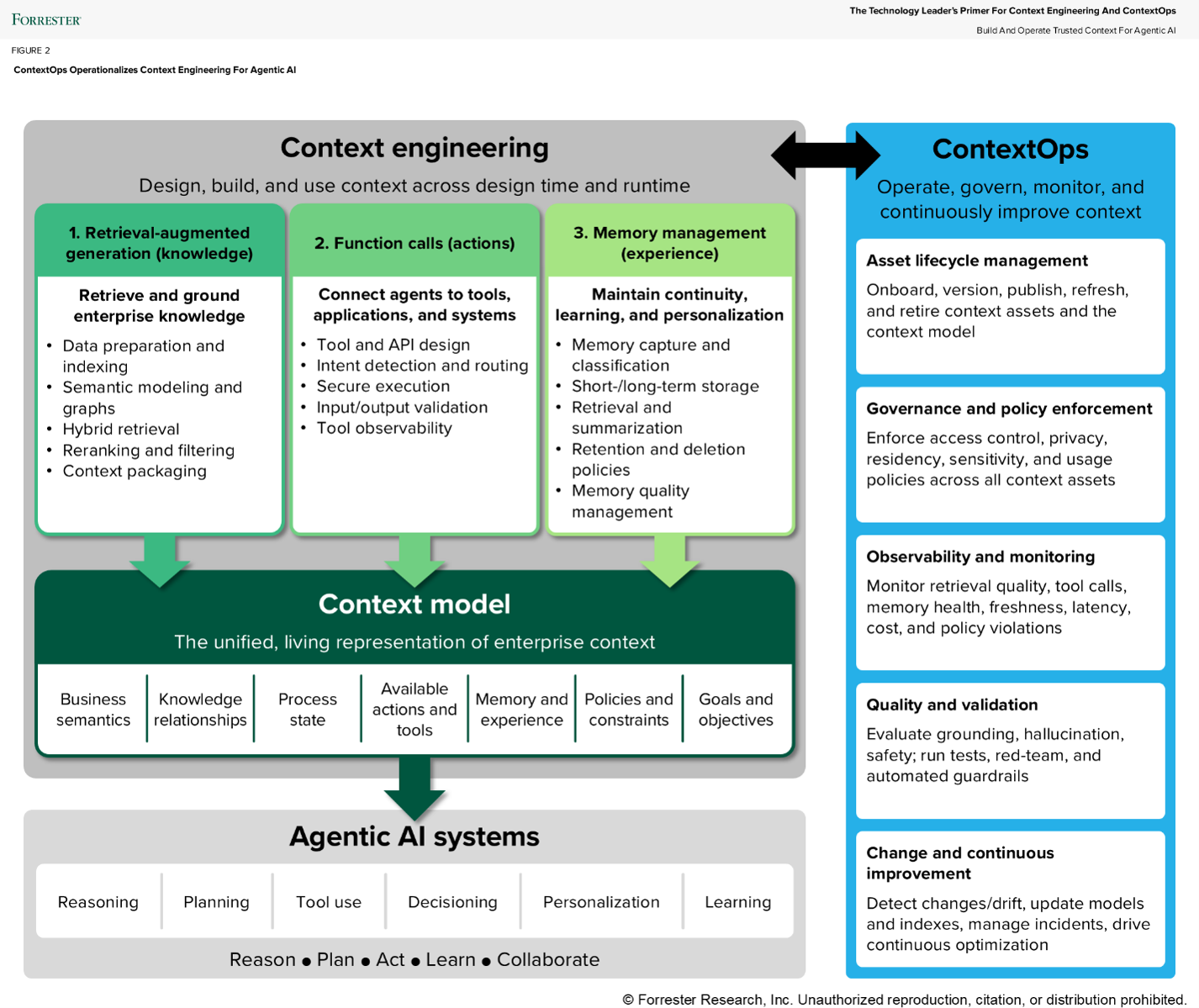
The next phase of enterprise AI will not be determined solely by model performance or agent sophistication. It will be determined by an organization’s ability to platformize context engineering. As AI adoption scales, enterprises need shared context services, reusable context assets, and common governance rather than siloed implementations of RAG, memory, and tool integration. Context engineering must evolve from a project-level practice into an enterprise platform capability, with ContextOps providing the operational foundation to keep it trusted, governed, and scalable. The winners in the agentic AI era will not simply deploy more agents; they will build better context platforms.
If you would like to have strategic guidance to build context engineering capabilities and improve ContextOps practices, please book an inquiry with us to discuss.

