

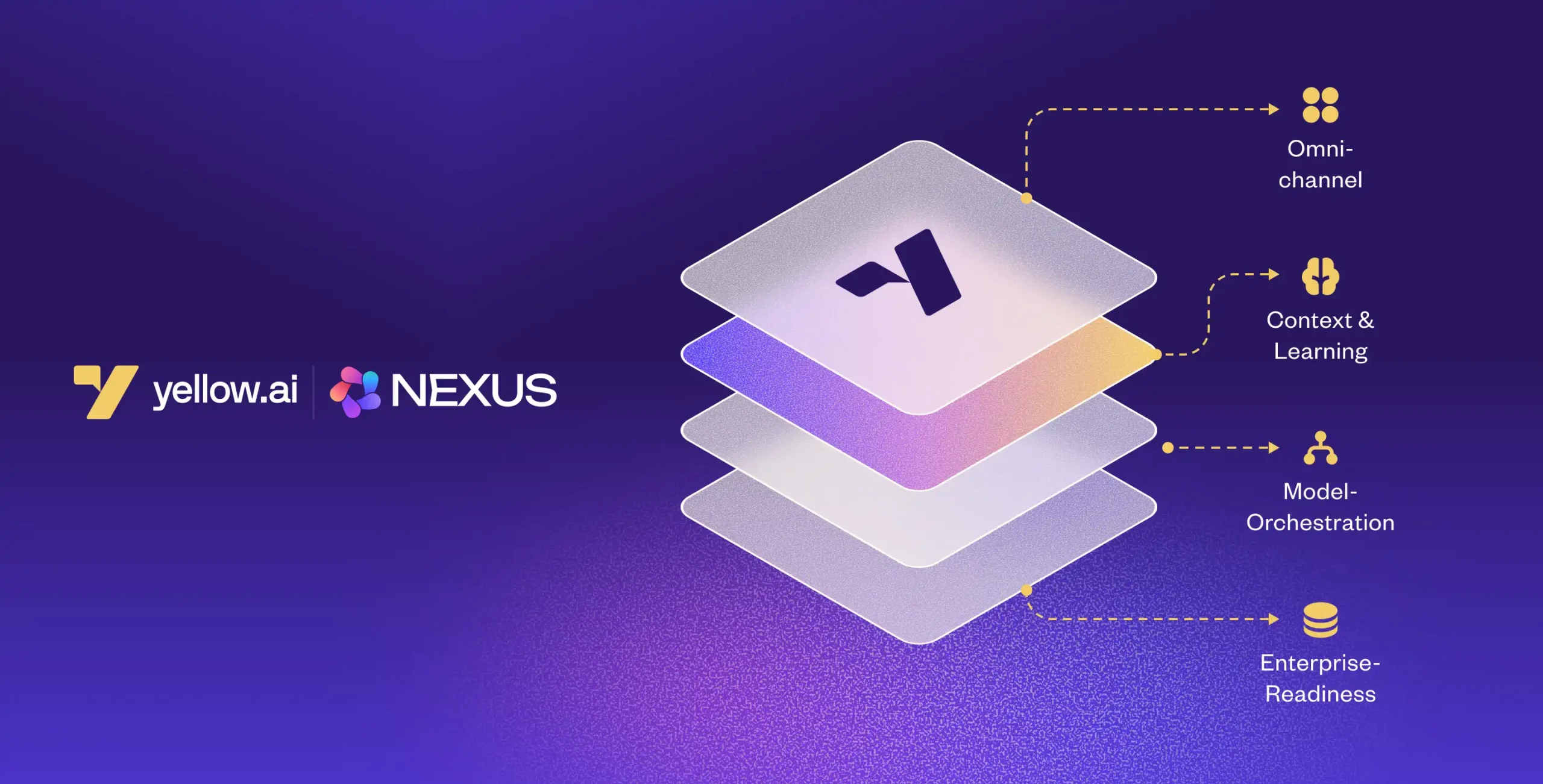
Over the next twelve weeks, our team will take each of the four layers behind every Yellow.ai deployment apart in public. This is the first piece: why we built it this way.
There is a difference between AI that works in a demo and AI that works in an enterprise, and after three years of pilots most customer experience leaders have learned it the expensive way. Pilots often begin with strong results, only for containment, the share of conversations resolved without a human agent, to plateau well short of target as edge cases multiplyand expansion into a second market exposes limitations that were not apparent in the first. The vendor relationship then becomes a standing negotiation over what the platform was supposed to do and what it actually does.
The instinct is to blame the model, and the industry has encouraged it. Every quarter brings a new leaderboard, a new benchmark, a new reason to believe that the next model release will fix what the last one couldn’t. It won’t, because none of those failures are model failures. They are architecture failures, and architecture is what buyers should be evaluating. say this from a particular vantage point. The Yellow.ai platform handles more than 16 billion conversations a year for 650+ enterprises across 85+ countries and 135+ languages. At that scale you stop hearing anecdotes and start seeing patterns.
When I look at deployments that kept improving after month six and the ones that stalled, the difference is rarely which model was underneath. It is whether four things are true of the platform around it.
It works inside the business as it already is
Enterprises run on CRMs, ticketing systems, ERPs, and knowledge bases that were never designed to talk to each other across markets with distinct languages, locales, and regulatory requirements.
Some AI platforms require systems to be consolidated before they can reason across them. Others need bespoke development for every integration, or a separate implementation for every market. Either way, the result is little more than a proof of concept with a long services bill attached.
Enterprise readiness means integrations out of the box.
It requires a data layer that reasons across silos without a warehouse project, and security and governance built in before the pilot, not bolted on after the risk review. It means language and locale are handled natively by the platform, not translated at the edges.
When it works, enterprise readiness is invisible. When it doesn’t, it becomes a many-headed problem, and every fix exposes two more.The model is a variable, not a foundation
The model landscape moves faster than enterprise procurement. The benchmark leader of six months ago has been overtaken and pricing has changed with the launch of new models.
A platform dependent on one provider inherits its volatility, with few options beyond waiting for conditions to change. An orchestration layer instead selects, combines and routes across models based on task, language, cost and quality requirements. When a better model becomes available, when prices change or when a provider experiences an outage, the platform can adjust its routing without rebuilding the architecture. If you are signing a three-year contract, this is what makes year three still relevant.
It gets smarter in deployment, not just bigger
Every enterprise carries knowledge that isn’t written down: how customers phrase the same problem a dozen ways, which resolution paths create satisfaction and which create escalations, what the best agents do with the cases that don’t fit the script. That knowledge lives in people and walks out of the building when they leave.
A generic model gives you the same approximation of your business on day 900 that it gave you on day one. A platform that captures how your operation actually resolves things and learns what worked rather than merely recording what happened, compounds instead of plateauing. The longer it runs, the more of your business it holds, and what it holds is yours. For a buyer, that is the thing worth paying closest attention to, because it is the only part of the stack that becomes more valuable with time. It is the part of your operation no competitor can buy.
Every channel draws on the same intelligence
Customers don’t think about channels when they have a problem that needs to be resolved.
They start on chat, escalate to voice when it gets complicated, and follow up by email the next morning. A platform built for one channel and retrofitted for the rest creates seams: inconsistent behavior, lost context, and resolution quality that depends on where the conversation happened to start. When it comes to AI, omnichannel is not a channel count. It is whether voice, chat, email and messaging are surfaces on one shared intelligence, or you have four systems pretending to be one.
Why these four, and why together
At Yellow.ai, we describe these as four layers: enterprise readiness, LLM-agnostic orchestration (the platform is not tied to any single AI model provider), the Context Graph, and omnichannel. We build them as a stack rather than a menu, because the value shows up at the intersections.
Readiness without orchestration gives you a multilingual, secure platform still exposed to single-model risk.Orchestration without context gives you a flexible AI with no institutional memory. Context without omnichannel locks your compounding intelligence behind a single touchpoint.
When all four are in place, the conversation with the vendor changes in ways that a feature comparison can easily miss. Instead of asking “can your platform handle our CRM?” it becomes “what does 75% automation mean for our customer satisfaction scores?” Instead of debating which model to use, buyers can focus on how quickly they can go live.. With the infrastructure questions already answered, the discussion naturally shifts toward business outcomes.
That is the test I would put to any vendor, including us.
Not which model. What happens when the model changes? What happens in the second market? And is the platform smarter in month twelve than it was in month one?
Enterprises that get the architecture right stop solving infrastructure problems and start solving business ones. That is the only outcome worth paying for. Next week: the month-six problem, and why the plateau arrives when it does.
The post It’s not the model. It’s the stack. appeared first on Yellow.ai.

