



When I started comparing AI chatbots for everyday work, I assumed the choice would come down to who gave better answers. It didn’t. I quickly found myself switching between Grok vs. Claude because Grok gave me more depth when researching fast-moving topics, while Claude felt more reliable for writing, reasoning, and working with long documents. That’s when I realized this wasn’t just a comparison of two AI models; it was a comparison of two very different ways of getting work done.
To see where each one truly shines, I tested Grok and Claude across the tasks I use AI for most: real-time research and news analysis, long-form writing, complex reasoning, document analysis, coding and debugging, image understanding, and multi-turn conversations. I used the same workflows for both tools to keep the comparison fair, then cross-checked my findings with G2 reviews to see whether other users reported similar experiences.
Here’s what I found: Grok stood out for real-time research, particularly when I wanted broader source discovery and room to keep exploring, while Claude consistently performed better for writing and document analysis. Reasoning, coding, and multi-turn conversations were much closer, with neither chatbot clearly outperforming the other across every aspect.
If you’re deciding between the two, this hands-on Grok vs. Claude comparison breaks down how each model performed in real-world workflows so you can choose the one that best fits the way you work.
Grok vs. Claude at a glance
| Feature | Grok | Claude |
| G2 rating | 4.2/5 ⭐ | 4.6/5 ⭐ |
| Developer | xAI / SpaceXAI | Anthropic |
| Ideal users | Developers, researchers, knowledge workers, teams using connected business apps, and users tracking live web/X information | Writers, developers, analysts, researchers, knowledge workers, and teams using connected business apps |
| Current models | Grok 4.7 (flagship) | Fable 5.1, Opus 5.5, Sonnet 5.5, Haiku 5.5 |
| Best for | Real-time web/X research, coding, knowledge work, connected workflows, and native image/video creation | Writing, coding and agents, long-document analysis, structured knowledge work, and connected enterprise workflows |
| Context window | 500K tokens (Grok 4.7) | Up to 1M tokens, depending on model |
| Response speed | Varies with reasoning effort and workload | Varies by model and reasoning effort |
| Memory | Persistent context available in Grok Bot; consumer memory capabilities vary by experience | Memory across conversations; up to five Projects on Free, with expanded project and work capabilities on paid plans |
| Real-time data access | Native web search and dedicated X Search for live posts and X content | Native web search with citations, including on Free |
| Image & video generation | Native image and video generation and editing through Grok Imagine | No native photo/illustration generation; can create charts, diagrams, interactive HTML/SVG visuals, designs, and other Artifacts |
| Multimodality | Text and image input; file/audio/video analysis; native voice; image and video generation | Text and image input; file analysis; native Voice mode; structured visual and Artifact creation |
| Coding assistance | Grok 4.7 for coding, debugging, tool use, and agentic workflows; Grok Bot for longer-running work | Claude Code plus Sonnet, Opus, and Fable models for coding, debugging, agents, and long-running development work |
| Reasoning | Configurable reasoning on Grok 4.7: low, medium, high, xhigh | Adaptive reasoning on current Fable, Opus, and Sonnet models; effort varies by model |
| Ecosystem and integrations | Gmail, Google Calendar/Drive, Microsoft 365 services, Salesforce, GitHub, Notion, Linear, Box, Canva, Vercel, and custom MCP connectors | Google Workspace, Microsoft 365, Slack, GitHub, Notion, Linear, Atlassian, Canva, HubSpot, Asana, and custom remote MCP connectors |
| Privacy and data control | Standalone and business workspaces; connector permissions are scoped to connected accounts; xAI says supported connector data such as Google Drive and Salesforce isn’t used for model training | Consumer model improvement is opt-in with specified exceptions; commercial inputs/outputs aren’t used for model training by default; connector access inherits source permissions |
| Pricing | Free to start; paid SuperGrok plans increase usage and unlock more capabilities | Free; Pro $17/month billed annually ($20/month billed monthly); Max from $100/month (monthly billing only); Team from $20/seat/month billed annually |
| Free plan | Yes. Free access with lower limits than paid SuperGrok plans | Yes. Includes Sonnet/Haiku access, web search, memory, voice, artifacts, file/code creation, extended thinking, and connectors |
Note: Grok and Claude frequently release new models, features, and pricing changes. The details above reflect information available as of October 2026 and may change over time.
Grok vs. Claude: What’s different and what’s not?
Grok and Claude can both write, code, summarize documents, analyze files, and answer complex questions, so it’s easy to assume they’re interchangeable. As I compared them across different workflows, I found that, like many modern LLMs, they share similar capabilities but solve problems in very different ways. Those differences become much easier to spot once you move beyond feature lists and start evaluating how each chatbot fits the work you actually do.
Grok vs. Claude: What’s different?
Although Grok and Claude overlap in many areas, the following differences have the biggest impact on how each chatbot fits into real-world workflows.
- Real-time access to X data (Grok’s biggest competitive advantage): Grok’s direct connection to X changes the way it approaches research. In addition to web search, it has a dedicated X Search for live posts, users, threads, and other social content. Claude also supports real-time web search with citations, but it doesn’t have an equivalent native X search layer. If your work depends on monitoring industry conversations, tracking public sentiment, or following discussions as they evolve, Grok offers a distinct advantage.
- Visual creation (Grok generates media; Claude builds structured visuals): Grok natively generates images and videos via Grok Imagine, making it well-suited to workflows involving original visual media. Claude takes a different approach: it can analyze images and also create charts, diagrams, interactive visuals, designs, presentations, and other Artifacts. The distinction is no longer simply “creates vs. analyzes,” but native media generation vs. structured visual creation.
- Voice interactions (Both support voice, but Grok goes further with camera input): Grok offers native voice conversations with live camera-based interactions, so it can respond to what you show it in real time. Claude also supports full Voice mode, letting users switch naturally between speaking and typing, use web search, and access connected tools during a voice conversation.
- Safety philosophy (Claude is constitution-led; Grok is more openly positioned): Claude is explicitly shaped by Anthropic’s Constitution, which guides its values, behavior, and safety boundaries. xAI has historically positioned Grok as more willing to engage broadly and with a less conventional tone. My intent here is not to imply that one is universally more restrictive or permissive, since both products continue to evolve.
- Workflow integrations (Both now connect broadly across business apps): Claude supports a wide range of web and custom MCP connectors across tools like Slack, Google Drive, GitHub, Notion, Linear, and more, with some connectors offering interactive in-chat experiences. Grok has also expanded significantly, with connectors for services such as Box, Canva, GitHub, Linear, Notion, Vercel, Salesforce, and custom MCP servers. At this point, the difference is less about connector breadth and more about how each assistant fits into your existing workflow.
Grok vs. Claude: What’s similar?
Even though they take different approaches, Grok and Claude share many of the capabilities people now expect from a modern AI assistant. Whether you’re creating content, researching a topic, or solving technical problems, both platforms provide a solid foundation before their individual strengths begin to stand out.
- Everyday AI assistance (Built for modern knowledge work): Writing emails, summarizing reports, brainstorming ideas, explaining technical concepts, reviewing code, and answering general questions are all tasks that both chatbots handle confidently. It’s one of the reasons they continue to rank among the AI chatbots worth using for everyday productivity.
- Persistent conversations (Designed for ongoing projects): Neither chatbot limits you to one-off interactions. Both support longer conversations through memory and project-based capabilities, making it easier to revisit previous discussions, build on earlier responses, and keep complex work moving without constantly repeating context.
- Large document understanding (Made for long-form content): Whether I’m working with lengthy research papers, technical documentation, contracts, or extensive codebases, both platforms are built to process substantial amounts of information in a single conversation. That makes them far more practical for knowledge-intensive work than earlier generations of AI assistants.
- Multimodal understanding (More than just text prompts): Images, screenshots, PDFs, spreadsheets, and other uploaded files become part of the conversation on both platforms. Instead of simply describing visual content, each chatbot can reason about what it sees and combine that information with text-based instructions to produce more relevant responses.
- Flexible entry point (Easy to try before committing): Both platforms offer free access alongside premium subscriptions, allowing users to explore their capabilities before paying for higher usage limits or advanced features. That also makes it easier to compare them against some of the most popular AI tools right now before deciding which assistant best fits your workflow.
Features and product pages can only tell you so much. To understand how Grok and Claude actually perform, I put both chatbots through a series of real-world tasks that reflect how people use AI every day.
How I compared Grok vs. Claude: My prompts and evaluation criteria
To keep the comparison as fair as possible, I tested Grok and Claude using the same prompts, workflows, and success criteria across a series of real-world tasks. I used their free plans, avoided any custom instructions or model-specific optimizations, and evaluated each chatbot based on how it handled everyday work rather than benchmark scores.
I tested both chatbots across the following workflows:
- Real-time research: Summarizing recent AI news, distinguishing confirmed information from speculation, and identifying emerging trends.
- Long-form writing: Drafting a blog introduction while following tone, audience, and style constraints.
- Reasoning and decision-making: Solving a realistic B2B SaaS marketing scenario with multiple business constraints.
- Document analysis: Reviewing a 425-page research report, extracting key findings, flagging claims for verification, and summarizing insights.
- Coding and debugging: Finding bugs, explaining issues, correcting JavaScript code, and handling additional edge cases.
- Image understanding: Interpreting a benchmark chart and answering questions based only on the visual information provided.
- Multi-turn conversations: Rewriting content for a different audience while preserving context and following new instructions.
I evaluated every response using the same criteria:
- Accuracy: Did the chatbot answer the prompt correctly without making unsupported assumptions?
- Instruction following: Did it satisfy every requirement, including formatting, tone, and constraints?
- Reasoning and usefulness: Were the explanations logical, actionable, and appropriate for the task?
- Output quality: Was the response well organized, easy to use, and ready with minimal editing?
To complement my hands-on testing, I also reviewed G2 product data and user feedback to assess whether my experience aligned with verified users’ reports.
Disclaimer: AI responses can vary based on model updates, session history, and prompt wording. I conducted these hands-on tests in October 2026; the results reflect the models and features available at that time.
Grok vs. Claude: How they actually performed in my tests
To see how Grok and Claude compare beyond feature lists, I tested them across a range of real-world tasks, from researching current events and writing long-form content to solving complex problems, analyzing documents, and generating code. For each test, here’s how I’ll break it down:
- What stood out? I’ll highlight the biggest differences I noticed in how each chatbot approached the task, including response quality, reasoning, accuracy, and any unexpected nuances.
- Who did it better? I’ll tell you which chatbot delivered the more useful overall experience, based on the quality of its output, the amount of refinement it required, and how effectively it completed the task.
- Final verdict: My honest take on which chatbot I’d choose for that specific use case and why.
Let’s get into it!
1. Real-time research and news analysis: Grok researches deeper, Claude curates better
One of the first things I wanted to evaluate was how well Grok and Claude handled a time-sensitive research task. I asked both chatbots to summarize the five biggest AI news stories from the past 30 days, distinguish confirmed developments from speculation, and identify the trends business professionals should keep an eye on. I used the exact same prompt on both tools.
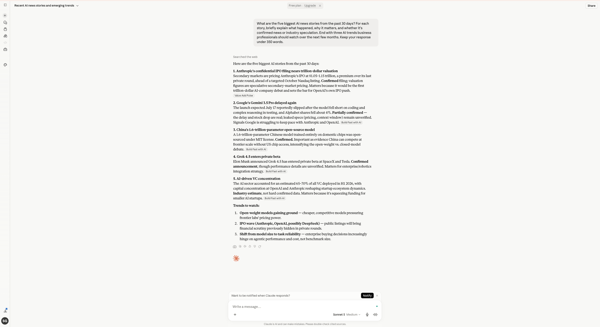
Claude’s response to the real-time research prompt
Claude automatically searched the web before responding, even on the free plan. It returned five well-structured AI news stories, clearly labeling each one as Confirmed, Partially confirmed, or an Industry estimate, while supporting the summaries with inline source citations. I also liked that every story briefly explained why it mattered instead of simply reporting the news. Rather than trying to cover every recent development, Claude focused on producing a concise, editor-like briefing that was easy to scan and understand.
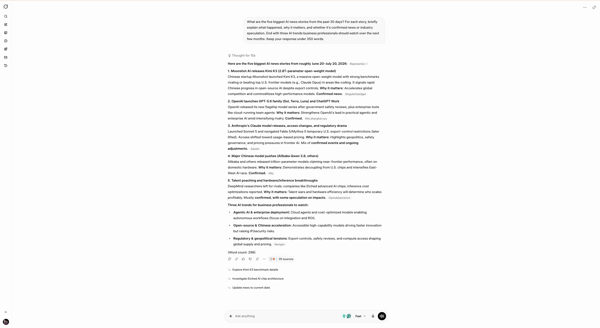
Grok’s response to the real-time research prompt
Grok took a more research-oriented approach. After spending 15 seconds reasoning through the prompt, it returned five stories backed by 35 sources and covered a broader mix of AI developments, from frontier models and open-source AI to hardware, regulation, and enterprise adoption. What stood out most was that every story paired the news with a dedicated “Why it matters” explanation, helping connect individual updates to broader industry trends. It also surfaced follow-up research suggestions after completing the summary, making the response feel less like a finished briefing and more like a starting point for deeper research. For anyone trying to keep up with developments in emerging AI software, that additional breadth and discoverability added meaningful value.
Both chatbots handled the task well, but they approached it differently. Claude delivered a concise, editor-like briefing, while Grok surfaced a broader range of AI developments backed by significantly more sources and follow-up research paths. Since this test focused on supporting real-time research rather than simply summarizing recent events, Grok ultimately provided the more useful research experience.
Winner: Grok
2. Long-form writing and editing: Claude sounds more human, Grok stays on message
One of the most common reasons people use AI chatbots is to draft content, so I wanted to see how each handled a realistic writing assignment. I asked both Grok and Claude to write a 200-word introduction for a blog post titled “Why AI Agents Are the Next Big Shift for Business Teams.” The prompt also asked for a professional yet conversational tone, to avoid common AI buzzwords such as “revolutionary” and “game-changing,” and to end with a hook that would encourage readers to keep reading.
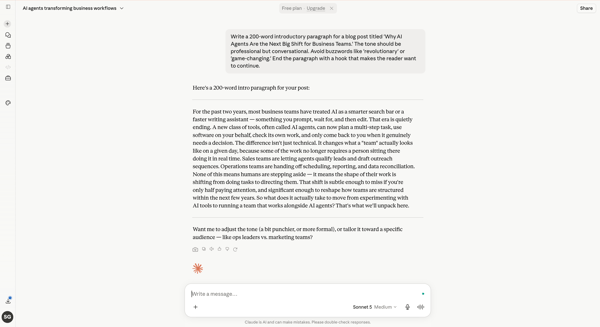
Claude’s response to the writing prompt
Claude took a noticeably different approach from the very first sentence. Instead of relying on a familiar AI opener, it reframed how businesses have traditionally used AI before introducing the shift toward AI agents, giving the introduction a clearer narrative progression. The writing remained conversational without becoming overly casual, avoided the buzzwords I explicitly asked it to omit, and naturally built toward the closing hook.
The opening paragraph immediately establishes why AI agents matter to business teams before transitioning into the main topic. It already read like something I’d expect from one of the better AI writing generators. If I were editing it for publication, I’d mainly tighten a few sentences for brevity and adjust the phrasing to better match G2’s editorial style, but I wouldn’t feel the need to rewrite the introduction itself.
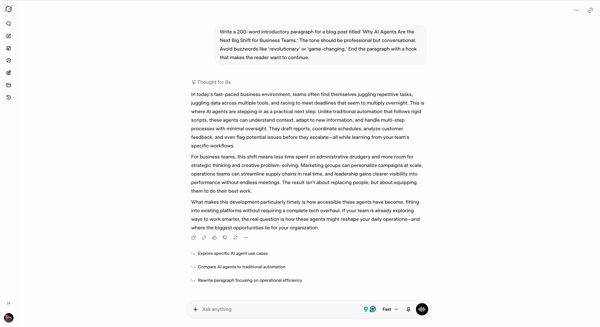
Grok’s response to the writing prompt
Grok produced a well-structured introduction that stayed on topic and covered the key ideas I was looking for. It explained AI agents through practical business examples and maintained a logical flow from beginning to end. However, the opening immediately stood out to me: “In today’s fast-paced business environment…”
As someone who writes professionally, that’s one of the most recognizable AI-generated openings, and it made the introduction feel predictable before I even reached the second sentence. The rest of the response remained informative, but I’d still want to rewrite the opening to give it a more distinctive opening.
Both chatbots followed the prompt and produced well-structured introductions. Grok focused on communicating the key ideas clearly, while Claude paired that clarity with a more original opening and a more natural narrative flow. That made Claude’s introduction feel closer to something I’d publish with only light editing.
Winner: Claude
3. Complex reasoning and decision-making: Claude structures better, Grok thinks more practically
I wanted to see how well Grok and Claude handled a business decision without a straightforward answer. Rather than asking a logic puzzle, I gave both chatbots a realistic B2B SaaS marketing scenario with multiple budget allocation options, business constraints, and one clear objective: recommend the option most likely to maximize pipeline impact before the end of Q3 while explaining the reasoning behind the decision. I wasn’t looking for the “right” answer as much as I wanted to understand how each chatbot evaluated trade-offs before making a recommendation.
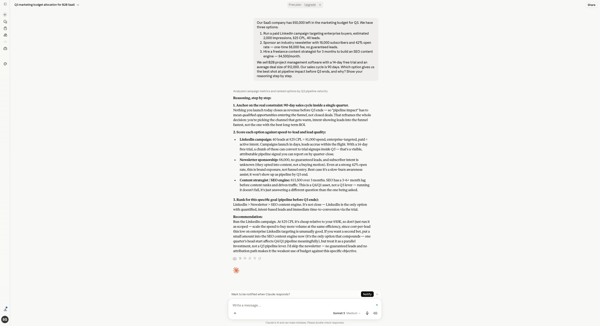
Claude’s response to the reasoning prompt
Claude approached the problem methodically, first defining what “pipeline impact before Q3 ends” meant before evaluating each option against the same criteria. It walked through the strengths and limitations of every recommendation, explained why LinkedIn best matched the objective, and kept the reasoning tightly organized from start to finish. I also liked that it acknowledged where the other options still made sense rather than dismissing them outright, making the final recommendation feel balanced and well-supported.
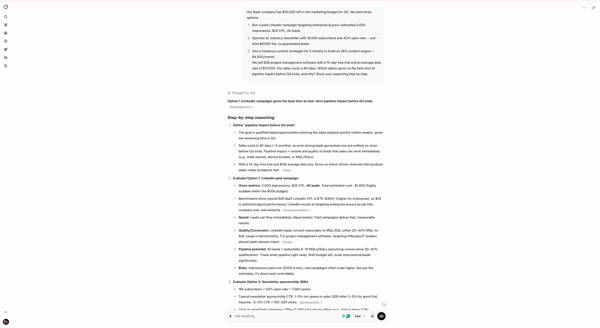
Grok’s response to the reasoning prompt (part 1)
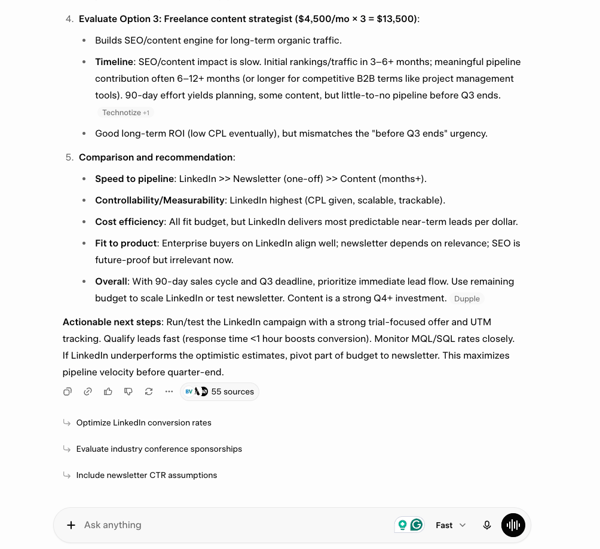
Grok’s response to the reasoning prompt (part 2)
Grok reached the same recommendation but took a more execution-oriented approach. Beyond comparing the three options, it estimated potential outcomes, highlighted practical risks, and finished with actionable next steps for implementing the recommendation. I also appreciated the follow-up suggestions for optimizing campaign performance, which made the response feel less like a one-time answer and more like a practical decision-making guide.
Both chatbots handled the scenario thoughtfully without overlooking the business constraints in the prompt. Claude made it easier to understand why the recommendation was the best fit, while Grok focused more on how to execute it once the decision had been made.
Winner: Split (Claude provided a more structured reasoning framework, while Grok matched it with actionable recommendations and detailed decision-making guidance.)
4. Large document analysis: Claude follows instructions better, Grok adds strategic context
One of the most practical uses for an AI chatbot is making sense of long reports without having to read hundreds of pages yourself. To test this, I uploaded the 425-page Stanford HAI AI Index Report 2026 and asked both Grok and Claude to identify the three most important findings for a B2B SaaS founder, flag claims that deserved additional verification, and summarize the report’s position on AI adoption in enterprise software.
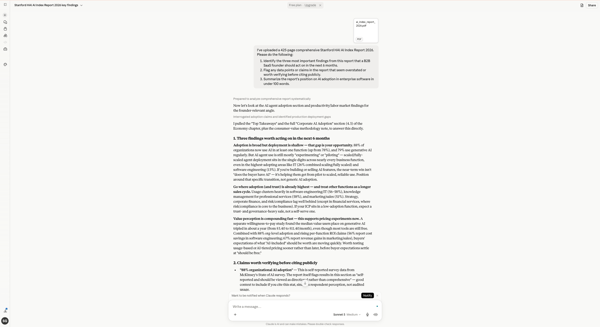
Claude’s response to the document analysis prompt (part 1)
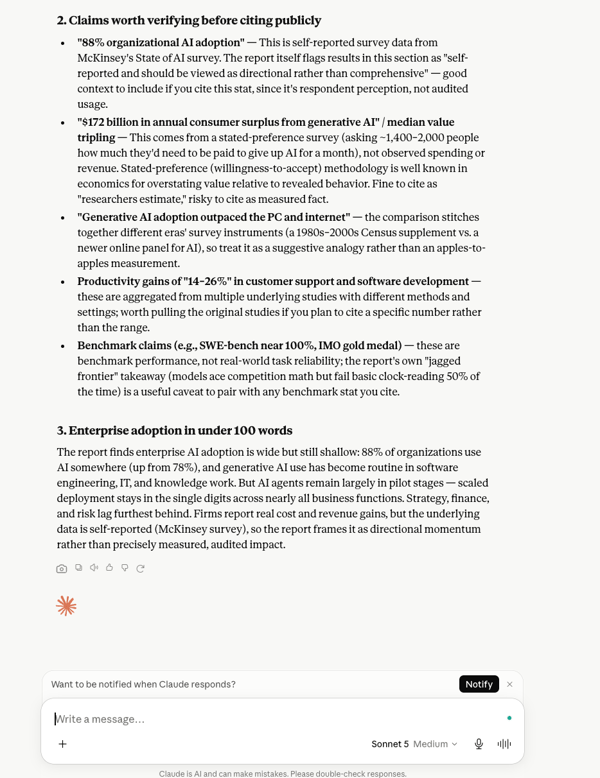
Claude’s response to the document analysis prompt (part 2)
Claude followed the structure of my prompt closely, separating its response into the three requested sections. It identified the key findings, explained why certain statistics warranted additional verification, and summarized the report’s position on enterprise AI adoption within the requested word limit.
I particularly appreciated how it explained the methodology behind several claims, making the findings easier to cross-check against the original report. The response stayed focused on the source material and presented the information clearly without adding unnecessary interpretation.
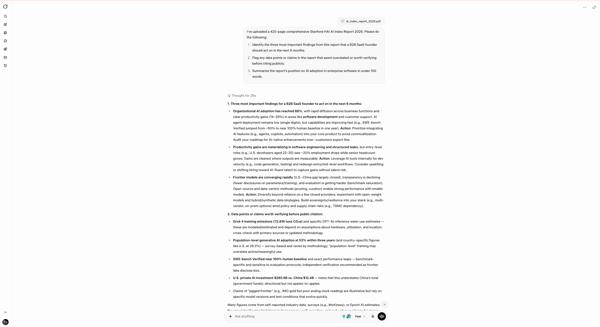
Grok’s response to the document analysis prompt (part 1)
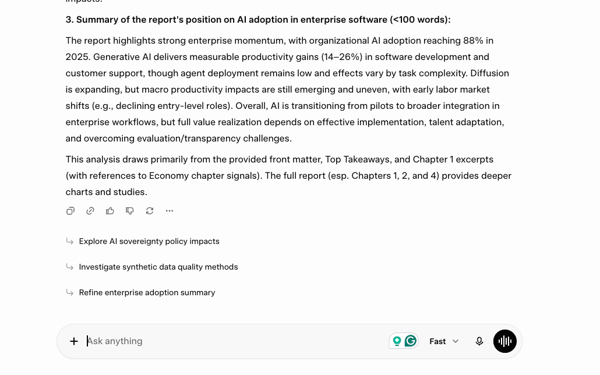
Grok’s response to the document analysis prompt (part 2)
Grok also completed all three parts of the prompt, identifying key findings, flagging statistics requiring verification, and summarizing enterprise AI adoption. What stood out was how it translated the research into practical recommendations through dedicated Action callouts, connecting the findings to broader business decisions.
I also liked that Grok explained why certain statistics deserved additional scrutiny rather than simply listing them. Its response combined document analysis with actionable insights, making it useful for readers looking to understand the findings and consider their business implications.
Both chatbots successfully completed the document analysis task, but their approaches differed. Claude emphasized structured, source-focused reporting, while Grok connected the findings to practical business decisions. Neither showed a clear shortcoming in completing the requested work, making this a fair split.
Winner: Split (Claude delivered a structured, source-focused analysis, while Grok complemented its findings with actionable business recommendations.)
5. Coding and debugging: Claude explains better, Grok validates further
Writing code is one thing, but debugging existing code usually tells me much more about an AI assistant’s reasoning. For this test, I gave both Grok and Claude a broken JavaScript function and asked them to identify the bugs, explain what was wrong, and provide a corrected version that also handled additional edge cases.