



As a marketer, surveys are a core part of what I do.
Whether I’m collecting data for my articles, researching market trends, or getting feedback from my team on recent collaborations and projects, surveys guide so much of what I do. But finding the best survey tool that’s easy to use, and adaptable to different needs? That’s been a journey.
From my college days, when I relied on free survey apps like SurveyMonkey and Google Forms to conduct field surveys for class projects, to my recent work using advanced platforms like Qualtrics and Alchemer for market research, finding the best survey tool that ticks all the boxes has always been a bit of a challenge.
Some apps excel at creating visually stunning surveys but fall apart when I actually need to analyze data. Other form builders have amazing analytics, but I feel like they were designed in the ’90s. And don’t even get me started on tools that promise everything but limit questions, responses, and features, giving me frustration.
So, I decided enough was enough. I rolled up my sleeves and tested more than 30+ survey software, from classics like Google Forms and SurveyMonkey to emerging players like Alchemer and Zoho Survey. My mission? To find the best survey tools of 2025 that truly deliver and are worth our time and money.
12 best survey tools for 2025: My picks
- Google Forms: Best free online survey app
Simple setup, easy sharing, Google integration, and quick results for educators and small teams. ($6/user/month). - SurveyMonkey: Best overall
Advanced branching, analytics, and enterprise-grade feedback collection. (Starts at $23/month). - Jotform: Best for robust customization and data collection
10,000+ templates, workflow automation, and powerful integrations. (Starts at $34/month). - Qualtrics Strategy & Research (formerly CoreXM): Best for complex, enterprise-level research
Deep analytics, custom dashboards, and predictive insights. (pricing on request). - QuestionPro: Best for academic research and market analysis
Advanced logic, panel management, and sentiment analysis. ($85/user/month). - Microsoft Forms: Best for Microsoft users
Seamless integration with Microsoft 365, AI-assisted question suggestions ($9.99/user/month). - Mentimeter: Best for live polling in presentations
Real-time engagement tools, word clouds, and quizzes for hybrid events. ($11.99/user/month). - User Interviews: Best for user research and product testing
Access to verified participants, automated scheduling, and session insights. ($36/session). - SurveySparrow: Best for chatbot-style surveys
Chat-like survey experience, recurring surveys, and offline data collection ($19/month). - SOCi: Best for multi-location feedback management
Centralized customer experience platform for franchises and enterprises(pricing on request). - Typeform: Best for beginners
Interactive forms, conditional logic, and brand customization. ($25/month). - Zoho Survey: Best survey software for small business
Tight ecosystem integration, multilingual surveys, and advanced analytics. ($7.42/month).
*These online survey tools are from the G2’s Winter 2025 Grid report. Most of them come with a free plan or free trial. I have included their starting price for your easy comparison.
I’ll share my experience, breaking down the pros and cons of each tool I tested so you can find the perfect fit for your needs.
Whether you’re a small business owner or marketing professional trying to connect with customers, a team lead looking for internal feedback, or a teacher building engaging quizzes, this guide has something for you.
12 best survey tools I personally recommend
We usually think of survey tools as straightforward solutions for creating questionnaires, such as feedback forms, quizzes, or research surveys.
But in my experience, they are so much more. They act as the ultimate organizers for data interaction. These tools assist me in designing and sharing surveys that are not only precise and clear but also engaging and tailored to specific needs. Moreover, these tools are crucial in analyzing the collected data. They go beyond mere collection; they help me thoughtfully visualize responses to identify trends, recognize patterns, and make data-driven decisions with confidence.
Honestly, once you start using the right survey tools, it’s hard to imagine conducting research or gathering feedback without them.
According to G2 Data, survey platforms score consistently high on essential features like survey builder (91%), question types (90%), survey distribution (89%), and templates (87%), proving that users value tools that make the process intuitive, flexible, and efficient from start to finish.
How did I find and evaluate these online survey tools?
With over 400 survey software options available, testing them all isn’t feasible. So, I relied on G2’s survey software category page, grid reports, and product reviews to create an initial list of contenders. I used AI to analyze hundreds of G2 reviews to gauge how real users rated these tools based on their experiences, needs, and pain points and created my initial shortlist.
Once I had my shortlist, I sat down to test them all. For me, testing these survey apps wasn’t just a matter of signing up and skimming through features. I set up each tool to run a realistic survey, complete with different types of questions, skip logic, and conditional branching. This approach allowed me to see how each tool handled different survey needs.
I also focused on how each tool handled the survey distribution. This approach allowed me to mimic the demands of actual survey projects, ensuring that the tools were tested in conditions similar to how they would be used in practice.
I also used AI-assisted analysis of G2 review data to uncover recurring feedback themes. In cases where I couldn’t personally test a tool due to limited access, I consulted a professional with hands-on experience and validated their insights using verified G2 reviews. The screenshots featured in this article may be a mix of those captured during testing and ones obtained from the vendor’s G2 page.
It was during these rigorous tests that I started to develop clear opinions on what distinguishes the best survey tools from the merely good.
What makes the best survey tools: My criteria
SurveyMonkey’s report reveals how these tools are actually used: 58% of surveys are taken on mobile, 23% include matrix questions, 12% use skip logic, and 21% are multilingual. In short, modern survey tools must be mobile-friendly, smartly structured, and inclusive to meet today’s expectations.
I look for the same qualities. The best platforms simplify how you design, distribute, and analyze surveys, while ensuring accurate, high-quality data. Whether you’re gathering customer feedback, conducting research, or trying to understand your audience better, the right tool should make every step intuitive, collaborative, and secure. Here are the criteria that I looked at when evaluating the tools:
- Ease of use: There’s nothing better than picking up a new tool and feeling like an expert right away. I appreciate survey platforms with intuitive interfaces and drag-and-drop functionalities that make survey creation, designing, and deployment a breeze. It’s crucial that these tools are easy to navigate.
- Customization options: I often adjust the look and feel of my surveys to include logos, colors, and themes that match our company’s brand identity. This is important as I want our surveys to appear more professional and trustworthy.
- Question types and formats: From multiple-choice to more complex formats like Likert scales or matrix questions, I need the survey app to offer all these and even allow randomizing question order to keep responses unbiased. Advanced types like NPS (net promotional score) or sliders help me dig deeper into what people really think.
- Distribution and reach: I need to get my surveys out there, whether it’s through email, social media, SMS, or even QR codes. It’s also essential that my surveys look good on any device, ensuring no respondent is turned away because of formatting issues.
- Response management: Seeing responses roll in in real-time is incredibly satisfying. Tools that help manage responses effectively, prevent fraud, and offer both anonymous and identifiable response options are at the top of my list.
- Analytics and reporting: Once I’ve collected all those responses, having sharp analytics tools is crucial. I need something that simplifies data interpretation and enhances it with visual capabilities. I love it when I can easily switch between basic charts and graphs for quick looks and more intricate analytics, like sentiment or trend analysis, for deeper dives. Major bonus points would be if the tool allowed me to export data directly into programs like SPSS or Tableau. This flexibility helps me make the most of the data, whether I’m presenting simple results or engaging in complex statistical analysis.
- Collaboration features: I want to easily collaborate with my team when designing and analyzing the surveys. So, I really need a form builder that lets me add users, assign them roles, and provide any collaborative features.
- Integration and compatibility: Integration with other platforms like Google Workspace or my marketing and CRM systems is a must for keeping my workflow smooth. API access for custom integrations gives me the flexibility to adapt the tools to my needs.
- Security and privacy: This is non-negotiable. I use tools that encrypt data at all stages and comply with major data protection regulations, like GDPR. Knowing that my respondents’ data is safe gives me peace of mind.
After trying out 30+ survey tools, I’ve identified my top 12 favorites that meet most of these criteria. My list of best software for creating professional surveys includes a variety of survey tools, including dedicated form builders like SurveyMonkey, marketing platforms with integrated survey capabilities like SOCi, and interactive tools designed for quizzes, polls, and audience engagement like Mentimeter.
While they may not check every box on the ideal features list, each one brings something distinct to the table.
The list below contains genuine user reviews from G2’s survey software category page. To be included in this list, a tool must
- Enable the creation and customization of questions.
- Gather, report on, and archive response data.
- Be shareable and distributable.
* This data was pulled from G2 in 2025. Some reviews may have been edited for clarity.
1. Google Forms (part of Google Workspace): Best free survey app
I’ve been using Google Forms, which is part of Google Workspace, since my undergraduate days, and it is never going to leave my arsenal of survey tools. I don’t think there’s a survey tool as simple and integrated as Google Forms. And the biggest plus? It’s completely free to use with my Google account and has no limits on the number of responses or questions I can add.
Setting up forms takes just minutes. One of the features I love most is the variety of question types it offers. Whether I need a simple multiple-choice question, a dropdown menu, or even a field for file uploads and ratings, Google Forms has it all.
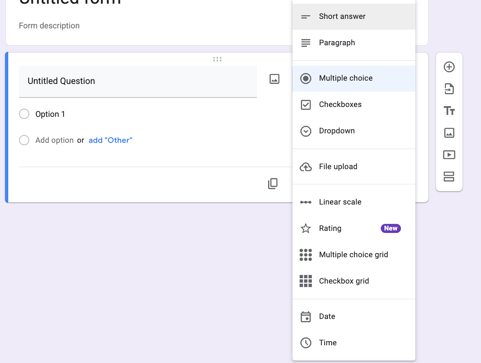
Question types on Google Forms
Another remarkable aspect of Sheets is the real-time collaboration. Just like other tools in the Google Workspace suite, I can invite colleagues to edit or build the form with me, which is invaluable when working on team projects.
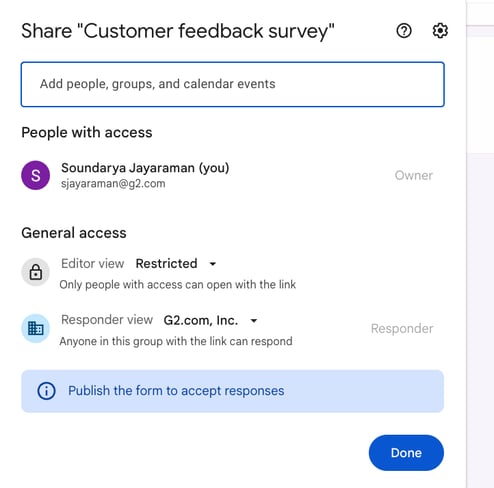
Options to sharing the survey form with my colleagues to invite them to collaborate
As soon as responses come in, I can choose to view them there with simple data charts or in Sheets, making it incredibly easy to analyze data or share insights with others.
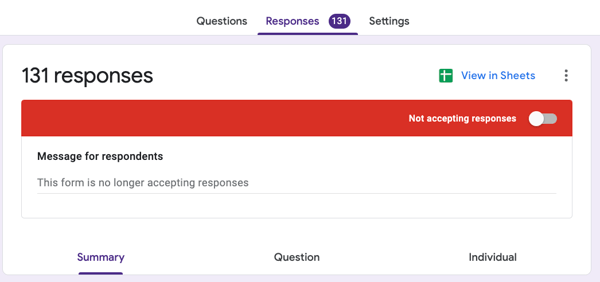
Options to View in Sheets
Now, Google Forms has 17 pre-made templates. So, whenever I’m in a hurry, whether it’s an event RSVP or a feedback form, I can get a survey up and running in minutes with one of these templates.
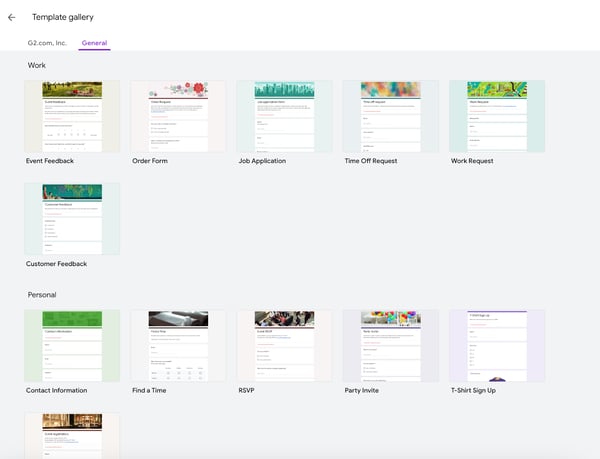
Templates on Google Forms
What’s interesting is that my mom, who’s a teacher, uses Google Forms quite extensively for quizzes, grading, and even collecting feedback from students. She is thoroughly struck by how easy it is to create and distribute quizzes, and the automatic grading feature saves her so much time. It’s a great example of how versatile the tool can be for different professions.
There are a few things to note. Based on reviews on G2, Google Forms is widely appreciated for its simplicity and ease of setup, though users note it’s best suited for straightforward surveys rather than complex research projects. The platform includes essential branding options, like colors, logos, and images, but keeps customization intentionally simple to maintain consistency and ease of use.
Also, users observe that its logic and branching features are effective for basic conditional questions but may feel limited for surveys requiring extensive multi-path logic. Still, this streamlined structure is exactly what makes Google Forms dependable for educators, small teams, and anyone who values quick setup and easy data sharing.
On a scale of 1 to 10, I’d confidently rate it a solid nine just for the exceptional value it offers as a free tool. And you don’t have to take just my words for it. Users on G2 rate it 4.6 out of 5 and recognize it as a reliable, user-friendly platform that simplifies feedback gathering and everyday data collection.
What I like about Google Forms:
- The most significant aspect for me is how easy it is to set up surveys and collect responses. The integration with Google Sheets makes it a breeze to analyze data, and the variety of question types means I can customize surveys to fit almost any situation.
- Another highlight for me is the simplicity of sharing forms. Whether I’m emailing a link, embedding a form on a website, or letting people fill it out on their phones, it’s all incredibly convenient and user-friendly.
What G2 users like about Google Forms:
“Google Form is something that lets you create a questionnaire/survey form/a small organized form, which helped me a lot. Yes/No radio buttons are a cherry on the cake. It is very easy to handle and modify the forms as required. Text Field/Strictly Numeric Field keeps the integrity of the forms. The best thing is I can create an MCQ set out of these forms.”
– Google Forms Review, Prashant P.
What I dislike about Google Forms:
- Based on G2 reviews, users find Google Forms’ design options simple and functional: ideal for quick branding with colors, logos, or images, but minimal for faster setup.
- According to G2 users, Google Forms handles straightforward surveys well, though conditional logic is best suited for basic branching rather than multi-layered survey paths.
What G2 users dislike about Google Forms:
“They are not great at design and don’t offer many integration options and scripts (mathematics) as the other tools. It also lacks options to make different (modern) ways to make a question.”
– Google Forms Review, Rafael P.
2. SurveyMonkey: Best overall
There’s one tool I’ve consistently relied on for surveys besides Google Forms; it’s SurveyMonkey. I’ve been using it for a long time, and I feel it strikes a great balance between user-friendliness and advanced features.
SurveyMonkey’s true potential only becomes evident when you move beyond the free plan. While the free plan is generous with access to templates and basic functionality, it’s limited to just 10 questions per form and 25 responses.
I remember it offering up to 100 responses and fewer restrictions on questions back in college. It was perfect for my college projects, such as surveys, classroom exercises, and informal polling. These days, though, the limitations of the free plan make it suitable for very small-scale use.
Nonetheless, since I have upgraded for my professional needs now, I know how powerful SurveyMonkey can be with its paid features. What impressed me about SurveyMonkey is how flexible it is for different types of surveys. Its template library is much more expansive than Google Forms, with over 400 templates.
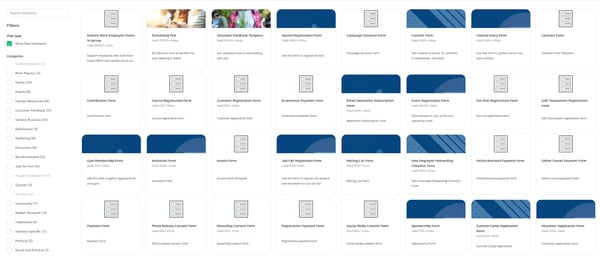
Extensive templates on SurveyMonkey
Now, even if there isn’t something in the templates that I could use, SurveyMonkey has the option to create surveys with AI powered by OpenAI. I sometimes use it to brainstorm my questions, too.
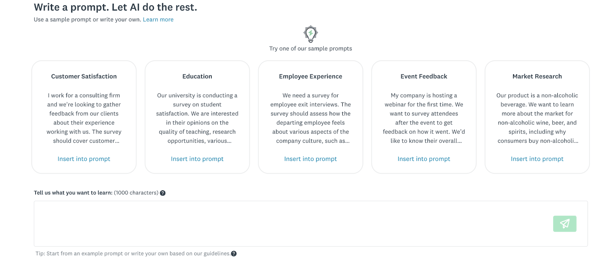
Building surveys with AI on SurveyMonkey
Another feature that stands out to me is its branching logic and skip logic capabilities. These allow me to create dynamic surveys in which respondents only see questions relevant to their previous answers.
The feature I truly dig for is the A/B testing we can do within surveys. As someone who’s always testing and tweaking things, I’ve used this feature to experiment with different questions or layouts when trying to understand what resonates best with respondents. Whether I’m testing product ideas or refining my messaging to gather feedback, it’s been incredibly helpful for making data-driven decisions.
Once I set up my survey, I liked the little nugget of information it provided about how long it would take the respondents to complete it. I usually look at it to optimize if it’s too long.
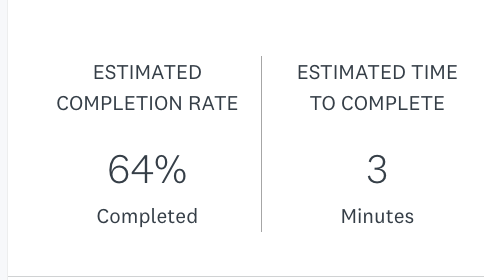
SurveyMonkey displays details on the Estimated Time to complete my survey
What really stands out, though, is SurveyMonkey’s Audience feature. This allows me to purchase targeted respondents from their global panel, which has been a lifesaver when I need feedback from a specific demographic or professional group.
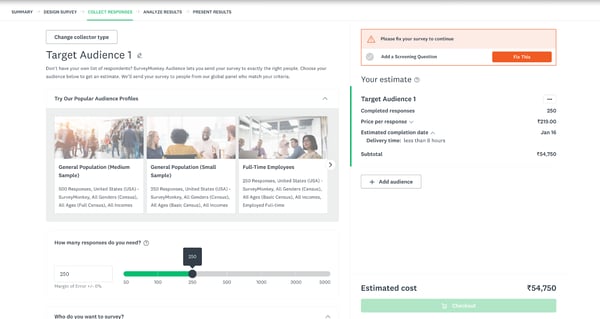
SurveyMonkey Audience feature to get targeted audience
Instead of having to liaise with a separate market research firm to find respondents, I like how this feature makes the process so much faster, simpler, and more efficient. So, despite the added cost, I think the convenience it offers makes it well worth the investment for focused research projects.
From what I saw on G2 reviews, SurveyMonkey is highly regarded for its robust question logic, analytics, and wide range of templates that make professional surveys easy to create and distribute. But many of its advanced capabilities, like custom branding, data exports, and integrations, are available in higher-tier plans, which users note is worth reviewing in advance to ensure the right feature fit for each team’s needs.
Also, the interface remains intuitive overall, though navigating advanced analytics or filtering large data sets can take some getting used to. Still, the platform’s breadth of features and reliability continue to make it a top choice for organizations running detailed feedback programs or research studies.
With an overall G2 rating of 4.4 out of 5, SurveyMonkey stands out as a versatile, data-driven platform built for teams seeking depth, structure, and proven survey performance.
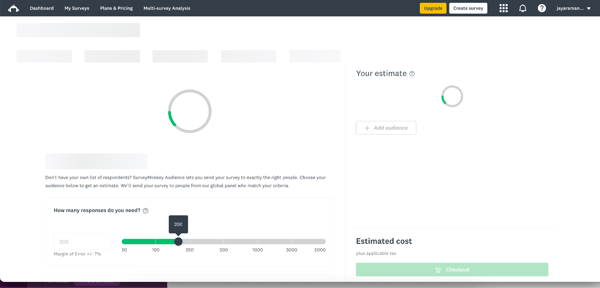 SurveyMonkey is lagging as I click through a few options
Overall, I’d recommend SurveyMonkey for businesses, educators, and researchers who need something more robust than Google Forms but don’t want to spend as much on premium tools like Qualtrics.
Personally, I find it to be an excellent middle ground for professional surveys, offering enough flexibility and power to meet a variety of needs.
What I like about SurveyMonkey:
- I highly value how easy it is to create surveys with a professional touch. The extensive template library, branching logic, and A/B testing capabilities make it incredibly versatile for different use cases, from customer feedback to employee engagement.
- The SurveyMonkey Audience feature is a standout for me. It saves so much time by letting me purchase targeted respondents from their global panel, especially when I need insights from a specific demographic.
What G2 users like about SurveyMonkey:
“I like the variety of options to ask questions and get the right answers. I love the options to review and analyze data, and I like how each question can be personalized in a way that makes it user-friendly. Lastly, I like how easy it is to use the advanced logic.”
– SurveyMonkey Review, Miriam F.
What I dislike about SurveyMonkey:
- Based on G2 reviews, some users mention that advanced options, like integrations and export formats, are available on higher-tier plans, so checking plan details in advance helps ensure the right fit.
- The interface is generally intuitive and reliable, though occasional slowdowns may occur when switching views or loading analytics.
What G2 users dislike about SurveyMonkey:
“When I designed my survey, I didn’t realize some features required a subscription. I spent a lot of time creating it, and then I found out that very basic features needed to be purchased, so I sort of had no choice but to purchase the subscription in order to complete my project. A couple of years ago, the purchase of a subscription wasn’t even required in order to do a basic survey.”
– SurveyMonkey Review, Christy M.
3. Jotform: Best for robust customization and data collection
When it comes to survey and form-building tools, Jotform immediately gave me the impression of being tailored for small and medium businesses. Its extensive template collection, even at first glance, seems thoughtfully designed to cater to their needs, unlike Google Forms, which I find more general-purpose, or SurveyMonkey, which focuses heavily on different survey types.
Now, I have found Jotform to be a full-fledged form builder that supports advanced use cases like collecting payments, signing contracts, and creating automated workflows. It feels like it’s designed to handle anything from customer surveys to payment collections —all within one system.
For me, the tool is incredibly straightforward to use. Everything feels intuitive, from dragging and dropping elements to customizing forms, so I can get things done quickly without needing a lot of technical know-how.
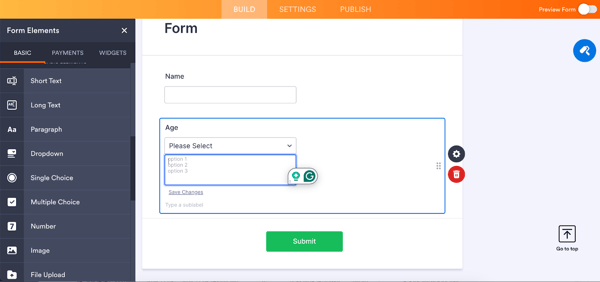
Adding questions on Jotform with the drag-and-drop interface
A core strength of JotForm is the template library, if you ask me. With over 2,000 templates, it’s the largest collection I’ve seen in an online form builder. There’s even a dedicated category for Salesforce forms.
Another distinctive feature of Jotform that amazed me was its widgets section. Whether I need to add a signature field, create dynamic checklists, or calculate totals within the form, the widgets make it all possible. For instance, I’ve used the Terms & Conditions widget to ensure users acknowledge specific policies. It’s this level of customization that sets Jotform apart from tools like Google Forms or SurveyMonkey.