

Spearphishing is a sliver of all e mail exploits, however the extent to which it succeeds is revealed in a brand new research from cybersecurity agency Barracuda Community, which analyzed 50 billion emails throughout 3.5 million mailboxes in 2022, unearthing round 30 million spearphishing emails. These findings are within the firm’s new report about Spear-Phishing Traits.
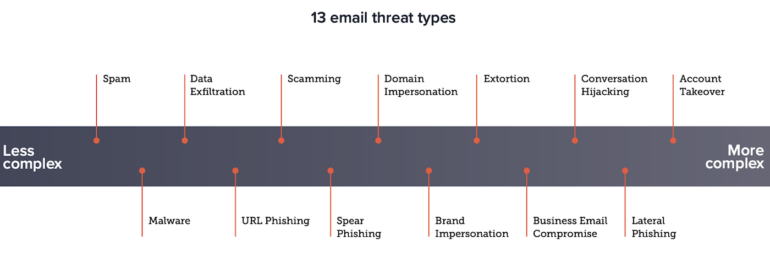
Whereas that proportion represents lower than a tenth of a p.c of all emails, half of the organizations the agency examined within the research, which incorporates findings from a survey of greater than 1,000 firms, had been victimized by spearphishing final 12 months. 1 / 4 had at the least one e mail account compromised via an account takeover (Determine A).
Determine A
Soar to:
Identification theft and model impersonation lead spearphishing exploits
Barracuda Networks’ research remoted the 5 most prevalent spearphishing exploits.
- Scamming: 47% of spearphishing assaults tricked victims into disclosing info so as to defraud them and/or steal their id.
- Model impersonation: 42% of spearphishing assaults mimicked a model acquainted to the sufferer to reap credentials.
- Enterprise e mail compromise: 8% of spearphishing exploits impersonated an worker, companion, vendor or one other trusted particular person to compel victims to make wire transfers or present info from finance departments.
- Extortion: 3% of spearphishing emails used threats of the revelation of private materials.
- Dialog hijacking: 0.3% of assaults concerned the hijacking of current conversations.
The corporate additionally discovered that Gmail customers had been extra more likely to be spearphishing victims than customers of Microsoft 365 (57% versus 41%, respectively).
Harm to machines, knowledge exfiltration high penalties
The report detailed the outcomes of a Barracuda-commissioned survey performed by the impartial researcher Vanson Bourne, who polled 1,350 organizations with 100 to 2,500 workers throughout a spread of industries within the U.S., EMEA and APAC international locations.
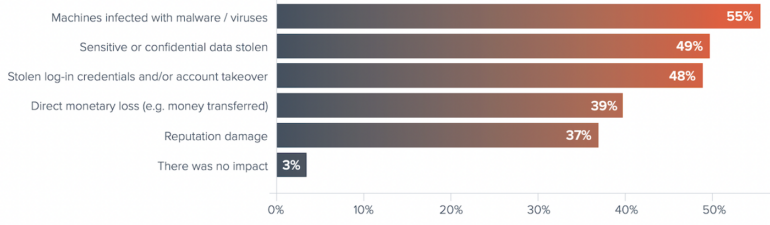
The survey queried firms about damages they skilled because of e mail assaults. Over half stated machines had been contaminated with malware, and roughly half reported theft of confidential info (Determine B).
Determine B
The upper the combination of distant employees, the higher the vulnerability
Distant work is rising dangers: Customers at firms with greater than a 50% distant workforce report greater ranges of suspicious emails — 12 per day on common, in comparison with 9 per day for these with lower than a 50% distant workforce. Firms favoring distant work additionally reported that it took longer to detect and reply to e mail safety incidents — 55 hours to detect and 63 hours to reply and mitigate, in comparison with a median of 36 hours and 51 hours, respectively, for organizations with fewer distant employees.
On common, 10 suspicious emails had been reported to IT on a typical workday, with customers in India having reported the best common variety of suspicious every day emails — 15 per day, which is 50% above the worldwide common. In contrast, the U.S. common was 9 suspicious every day emails (Determine C).
Determine C
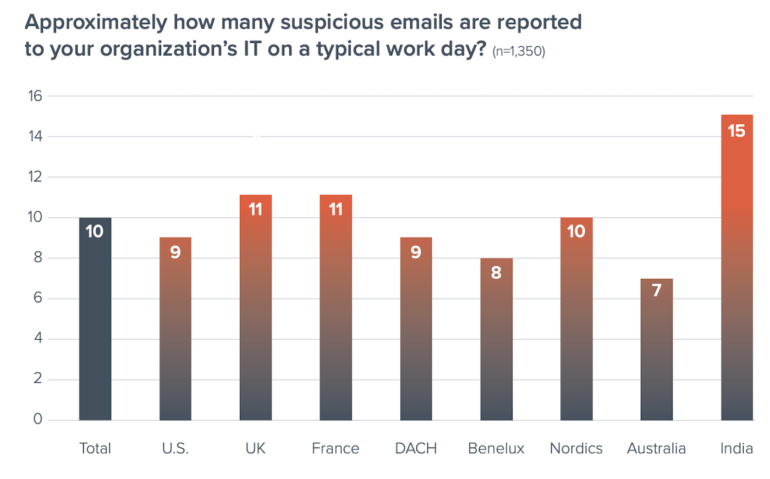
In keeping with the report, the comparatively excessive variety of reported incidents in India could also be proof that organizations there are struggling to stop e mail assaults or that organizations in India are putting greater deal with suspicious emails.
The typical group acquired roughly 5 emails per day that had been recognized as spearphishing exploits, and these assaults garnered a median 11% clickthrough price, based on the report.
Firms gradual to determine and reply to e mail assaults
From its survey of enterprises, Barracuda discovered that on common it takes almost two days for organizations to detect an e mail safety incident. On common, the enterprises polled by Barracuda took almost 100 hours in complete to determine, reply to and remediate an e mail exploit. They took 56 hours to reply and remediate after the assault was detected.
In keeping with the report, from the respondents that skilled a spearphishing assault:
- 55% reported their machines had been contaminated with malware or viruses.
- 49% reported having delicate knowledge stolen.
- 48% reported having stolen login credentials.
- 39% reported direct financial loss.
Fleming Shi, the chief know-how officer of Barracuda, stated e mail remains to be very a lot the primary assault vector used in opposition to enterprises, even small to medium-sized companies, with menace actors who go after giant firms typically looking for prizes above and past what may be filched from a single hit.
Shi stated, “They may be going after an individual, a model, knowledge exfiltration or something going past simply the primary ransom assault, attending to the purpose the place they will maintain an enterprise ransom for a number of years or a number of payouts,” he stated. “On the finish of the day, financially motivated assaults are nonetheless going to be quite a few, however we additionally must be careful for nation-state or politically-driven cyberattacks that attempt to affect or change opinion and perhaps even influence the 2024 election. These are additionally doable as a result of all they must do is tweak the weapon to have a special influence.”
Gradual tempo of response retains door open to cybertheft
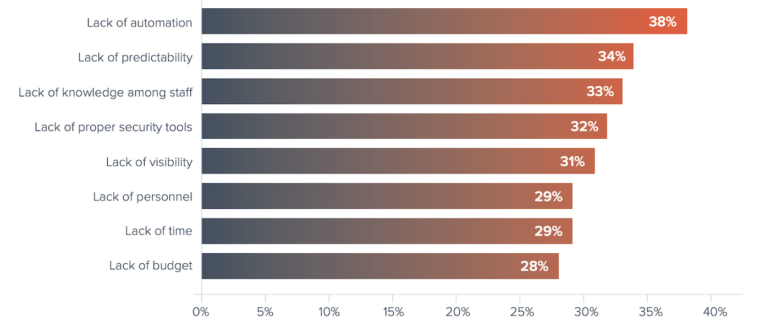
The survey discovered that for 20% of organizations, it takes longer than 24 hours to determine an e mail assault. In keeping with the research, the lengthy interval means customers have time to click on on a malicious hyperlink or reply to an e mail. Thirty-eight p.c of respondents reported taking greater than 24 hours to reply to and remediate assaults. Obstacles cited embody lack of automation, predictability and information amongst workers hampering the invention course of. (Determine D).
Determine D
“Although spearphishing is low quantity, with its focused and social engineering techniques, the approach results in a disproportionate variety of profitable breaches, and the influence of only one profitable assault may be devastating,” stated Shi. “To assist keep forward of those extremely efficient assaults, companies should put money into account takeover safety options with synthetic intelligence capabilities. Such instruments could have far higher efficacy than rule-based detection mechanisms. Improved efficacy in detection will assist cease spearphishing with decreased response wanted throughout an assault.”
Organizations victimized by spearphishing had been extra more likely to say the prices related to an e mail safety breach elevated within the final 12 months: $1.1 million versus about $760,880 for individuals who had been victims of other forms of e mail assaults, based on the report.
Automation and AI speed up response occasions
In keeping with Barracuda Networks, 36% of organizations within the U.S. use automated incident response instruments, and 45% use computer-based safety consciousness coaching. Each teams report quicker response occasions on common, which implies they’re utilizing fewer IT sources, and people sources can deal with different duties.
Bigger organizations cite lack of automation because the more than likely impediment stopping a speedy response to an incident — 41% for organizations with greater than 250 workers, in comparison with 28% for organizations with 100–249 workers. The smaller firms cite extra causes virtually equally, together with:
- Lack of predictability (29%)
- Data amongst workers (32%)
- Correct safety instruments (32%)
The spearphishing development to proceed in 2023
Shi stated it’s seemingly that spearphishing, notably associated to dialog hijacking and enterprise e mail compromise, will proceed to prevail this 12 months, with dialog hijacking constructing on previous knowledge breaches, mainly the place emails had been stolen.
“The instance I’ll use is ProxyLogon, which was a vulnerability alternate by Microsoft the place attackers took not solely credentials however previous e mail conversations that allowed them to reiterate and mainly recreate a weapon primarily based on earlier interactions,” he stated. “So, it makes it a lot simpler to bypass all of the guardrails, particularly the human degree consciousness that we’ve.”
He additionally stated that these assaults will likely be more durable to dam as a result of not all of them are going to have hyperlinks and attachments. “Typically it’s simply an interplay to realize belief, after which it probably results in additional entry to the setting,” he stated.
BECs drive spearphishing and vice versa
Shi sees the connection between BECs and spearphishing as “intimate and symbiotic” as a result of BECs can result in extra phishing assaults, and phishing can result in BECs.
“The primary distinction is that the majority BECs do not need hyperlinks or attachments. It’s an interplay, a dialog that finally results in one thing unhealthy occurring. As a way to get there, nevertheless, any person has to compromise the setting. That weapon might be the preliminary spearphishing sort of assault the place credentials get stolen.”
Then, he added, with stolen credentials, actors can entry the setting to determine communication patterns that proceed the assault. “They considerably camouflage themselves into the setting as a result of as soon as belief is constructed, an attacker can begin activating new weapons that may be evasive to detection mechanisms.”
AI fashions can flag uncommon e mail communication patterns
Barracuda Networks prompt machine studying is a great tool for figuring out anomalous emails via the institution of regular communication patterns. And, that AI may be deployed to routinely acknowledge when accounts have been compromised.
The agency additionally suggests:
- Utilizing know-how to determine logins from unknown accounts.
- Monitoring emails for inbox guidelines which might be malicious.
- Utilizing multifactor authentication.
- Implementing DMARC authentication and reporting.
- Automating incident réponse.
- Coaching workers to acknowledge and report assaults.

