



WhatsApp now plays a central role in how customers engage with brands, and that shift raises entirely new operational requirements for marketing and support teams. As message volumes grow, teams quickly feel the strain, missed follow-ups, fragmented conversations, and manual processes that don’t keep pace with customer expectations. Early-stage tools often work for simple outreach, but they break down once teams need structured automation, unified data, and reliable delivery at scale.
WhatsApp marketing platforms have evolved in response. Instead of one-off broadcasts, businesses are moving toward automated journeys, triggered workflows, and revenue-focused conversational experiences. Adoption has accelerated across ecommerce, SaaS, D2C, and service brands, with companies looking to connect WhatsApp to their broader engagement ecosystem, email, SMS, push, CRM, and customer data, rather than treat it as a standalone channel.
To understand which tools actually help businesses scale WhatsApp effectively (not add more operational chaos), I evaluated 20+ WhatsApp marketing software using G2 Data, feature breakdowns, and real user feedback. Some tools excel at simple automation and team inbox management for small businesses. Others deliver advanced segmentation, AI-driven journeys, and multi-channel orchestration built for fast-growing or enterprise teams.
No matter your size, these are the WhatsApp marketing tools that can help you automate smarter, convert faster, and deliver personalized experiences at scale.
7 best WhatsApp marketing software: My picks
- Insider: Best for AI-driven, personalized customer journeys
Delivers advanced AI segmentation and automated WhatsApp flows across multiple digital channels to boost engagement and conversions. (Custom pricing) - Wati: Best WhatsApp marketing tool for SMB automation
Offers easy WhatsApp Business API access, automated replies, broadcasts, and team support tools designed for small and midsize businesses. (Pricing from ~$49/mo) - ActiveCampaign: Best for multi-channel automation with WhatsApp
Integrates WhatsApp messaging directly into CRM workflows, email automation, and complex marketing journeys for unified communication. (Pricing from $15/mo; WhatsApp add-on varies) - WebEngage: Best for enterprise WhatsApp and omnichannel marketing
Provides deep segmentation, analytics, and multi-channel automation to help large brands deliver highly targeted WhatsApp campaigns at scale. (Custom pricing) - WhatsApp Business Platform: Best official API for scalable messaging
The direct WhatsApp API offering secure, reliable, and high-volume messaging, ideal for businesses needing custom workflows and global reach. (Usage-based pricing via providers) - respond.io: Best shared inbox for WhatsApp and multi-channel support
Centralizes customer conversations from WhatsApp and other channels with workflow automation, routing, and team collaboration. (Pricing from $29/mo) - MoEngage: Best AI-powered personalization for WhatsApp campaigns
Uses predictive insights and AI to deliver hyper-personalized WhatsApp messages integrated with push, email, SMS, and in-app engagement. (Custom pricing)
*These best WhatsApp marketing software are picked based on G2’s Fall 2025 Grid Report. I’ve added their standout features for easier comparison.
Best WhatsApp marketing software I recommend
Running customer communication on WhatsApp requires speed, consistency, and a lot of coordination. You’re handling inquiries, sales conversations, follow-ups, and support needs — all in real time. When message volume grows, doing this manually quickly becomes unmanageable.
And that volume isn’t slowing down. By Q4 2024, WhatsApp Business reached 764.38 million monthly active users, up more than 6% from roughly 907 million MAU at the start of the year. This shows just how rapidly customers are shifting to WhatsApp to interact with brands.
That’s why the best WhatsApp marketing software makes such a difference. Great platforms automate repetitive tasks, follow-ups, routing, segmentation, and triggered replies, so your team can focus on high-value conversations instead of scrambling to keep up. They reduce errors, speed up response times, and help you deliver a more consistent experience across every customer touchpoint.
How did I find and evaluate the best WhatsApp marketing software?
To build this list, I started with G2’s Grid® Report WhatsApp marketing software to create a shortlist, using a mix of user satisfaction scores and market presence as my guide. My shortlist was based on a mix of user satisfaction scores and market presence, ensuring a balance between usability and adoption.
From there, I evaluated each tool based on how effectively it supports messaging automation, audience segmentation, conversational workflows, customer support, campaign management, analytics, and integrations with the broader marketing tech stack.
I also used AI to analyze hundreds of verified G2 reviews, paying close attention to what marketing and support teams praised most, where they ran into friction, and which tools reliably delivered measurable improvements in engagement and conversions.
The screenshots featured in this article come from G2 vendor listings and publicly available product documentation.
What makes the best WhatsApp marketing software: My criteria
After digging into G2 Data and evaluating how modern marketing and support teams use WhatsApp, several themes consistently stood out. Here’s what I focused on when evaluating the best WhatsApp marketing software:
- Messaging automation and workflows: I looked for platforms that make it easy to build automated WhatsApp flows, welcome messages, follow-ups, reminders, cart recovery, re-engagement, and more. The best tools eliminate manual tasks and ensure customers get timely, relevant messages without relying on humans to keep the process going.
- Audience segmentation and personalization: Relevance drives conversions, so I prioritized tools that offer deep segmentation, behavioral targeting, and personalized messaging. Top platforms allow brands to tailor messages based on user actions, purchase behavior, lifecycle stage, and real-time events.
- Centralized inbox and team collaboration: For teams handling high-volume conversations, a shared inbox is essential. I evaluated how each platform supports multi-agent collaboration, assignment rules, internal notes, routing, and SLA-friendly response workflows to keep conversations organized and efficient.
- Multi-channel orchestration: WhatsApp rarely operates in isolation, so I looked for tools that connect WhatsApp with email, SMS, push notifications, live chat, and CRM data. The strongest platforms help brands build consistent journeys across channels, not manage WhatsApp in a silo.
- Analytics and performance tracking: Great WhatsApp marketing software goes beyond sending messages. I focused on tools that provide clear analytics, including delivery rates, read rates, response times, conversions, campaign performance, and customer journey insights. Transparent reporting helps teams optimize quickly.
- Integration with existing tools: Teams need WhatsApp to work seamlessly with their current stack. I prioritized platforms that offer strong integrations with CRMs, ecommerce platforms, marketing automation systems, support tools, and data platforms, reducing reliance on messy workarounds.
- Scalability and compliance: As message volume grows, reliability becomes critical. I looked for solutions that use the official WhatsApp Business API, follow Meta’s compliance rules, and support high-volume sends, automation, and global customer reach without service interruptions.
The list below contains genuine user reviews from the WhatsApp Marketing Software category page. To be included in this category, a solution must:
- Reach mobile users through business-led WhatsApp messaging
- Provide an opt-in opportunity for new WhatsApp subscribers
- Provide conversational, promotional, or transactional messaging capabilities
- Provide analytics or insights into WhatsApp marketing efforts
*This data was pulled from G2 in 2025. Some reviews may have been edited for clarity.
1. Insider: Best for AI-driven, personalized customer journeys
Insider has earned a reputation as one of the most advanced customer engagement platforms on the market, especially for brands looking to elevate their WhatsApp marketing.
Rated 4.8/5 on G2 and often praised by users for its powerful personalization engine and cross-channel orchestration, Insider stands out as a platform built for teams that take data-driven marketing seriously. With hundreds of G2 reviews highlighting its AI capabilities, segmentation depth, and strong customer success team, it consistently ranks among the top choices for enterprise marketers who need sophistication without losing flexibility.
Insider shines in targeted messaging and lifecycle automation. Reviewers consistently point to its ability to create highly personalized WhatsApp journeys that adapt to user behavior, preferences, and purchase intent. Many highlight how easy it is to combine WhatsApp with email, push, web personalization, and in-app messaging, all from the same engine. This multi-channel cohesion is helpful when coordinating real-time engagement across several touchpoints.
Another major theme in user reviews is the strength of Insider’s automation and journey builder. Marketers appreciate how they can design sophisticated workflows, connect triggers across channels, and launch deeply segmented campaigns without needing heavy development support.
Insider excels in how it builds targeted, behavior-driven journeys. Reviewers highlight its ability to tailor WhatsApp messaging based on user actions, preferences, and intent, making communication feel timely and relevant rather than generic.
Customer support is also a standout differentiator. Dozens of reviewers point to Insider’s success team as proactive, strategic, and deeply involved in helping optimize campaigns. This level of partnership is especially valued by global brands managing high-volume personalization or executing advanced WhatsApp journeys.
Integration capabilities further enhance Insider’s appeal. Users note how smoothly it connects with e-commerce platforms, CRMs, analytics tools, and consent systems. This makes it easy for teams to unify data and deliver more relevant WhatsApp messaging across the customer lifecycle. Many reviewers describe Insider as a platform that fits naturally into a sophisticated tech stack.

Some users mention that the platform can feel dense at first because of how much capability is built in. That depth is the same reason it works well for teams needing advanced segmentation, personalized journeys, and multi-channel orchestration. For organizations running sophisticated engagement programs, the feature volume becomes an advantage rather than something to overcome.
Others note that highly specialized or custom setups may require developer support. This reflects the level of flexibility Insider is designed to offer; brands with more intricate personalization requirements often value the ability to fine-tune journeys at a deeper technical level.
All in all, Insider leans toward power and precision — designed for marketers who want fine-grained control over personalization and multi-channel automation. It’s built for teams that rely on real-time data, adaptive journeys, and omnichannel coordination rather than basic message broadcasts.
What I like about Insider:
- Its advanced personalization engine and multi-channel orchestration help brands design targeted WhatsApp journeys that respond to real customer behavior and lifecycle stages.
- Reviewers consistently highlight the strength of its automation, AI-driven segmentation, and highly supportive customer success team, making complex execution feel more manageable.
What G2 users like about Insider:
“We really liked the simplicity of Insider’s platform. Before working with Insider, we were having trouble with analyzing the data from our customers and applying that to improve our communication channels. Insider’s tools helped us collect data on our communication efforts, understand what was working, and strategize to increase our engagement. Now, we are able to generate more successful email and mobile app campaigns with less effort.”
– Insider review, Hue B.
What I dislike about Insider:
- G2 reviewers note that Insider’s extensive feature set can feel dense at first, a natural reflection of its focus on enterprise-grade personalization and cross-channel depth.
- Some users mention that highly specialized setups may require technical involvement, which aligns well with teams that need detailed, data-rich workflows rather than simple plug-and-play messaging.
What G2 users dislike about Insider:
“There are a few areas that could be improved, mainly related to reporting and some usability details. Certain reporting views could be more flexible or easier to customize. Also, small process improvements would make the overall experience even faster and smoother.”
– Insider review, Patricia L.
If you’re also evaluating channels beyond WhatsApp, explore the top email marketing software to strengthen your multi-touch engagement strategy.
2. Wati: Best WhatsApp marketing tool for SMB automation
Wati has become a go-to WhatsApp marketing and support platform for small and midsize businesses that want simplicity, speed, and reliable access to the WhatsApp Business API.
Rated 4.6/5 on G2 across hundreds of reviews, users describe it as intuitive, fast to set up, and easy to manage — especially for teams that want dependable access to the WhatsApp Business API paired with straightforward automation.
A major theme across reviews is Wati’s ease of adoption. Users consistently mention how quickly they can launch automated replies, build broadcast campaigns, and connect WhatsApp to their website, CRM, or support tools. For SMBs that don’t have dedicated technical resources, Wati’s streamlined setup is one of the reasons it becomes a go-to platform.
Messaging reliability is another standout theme. Users consistently highlight how smoothly Wati manages high-volume sends, API-triggered messages, and real-time support conversations. Many note that WhatsApp becomes a reliably dependable channel once routed through Wati, thanks to its stable, responsive infrastructure. This level of reliability is especially valuable for teams that depend on WhatsApp for lead nurturing, onboarding, and ongoing customer communication.
Wati’s integrations also stand out in user feedback. The platform connects easily with Shopify, WooCommerce, HubSpot, Zapier, and other tools that SMBs commonly rely on. This makes it simple to trigger WhatsApp messages based on purchases, inquiries, or support tickets without heavy configuration.
Customer support is frequently mentioned as another key strength. Many reviewers note that Wati’s support team is responsive, knowledgeable, and committed to quick resolutions. Whether users are integrating new systems, troubleshooting automation, or setting up templates, support interactions are described as efficient and helpful. For teams with limited technical bandwidth, this level of guidance is a meaningful advantage.
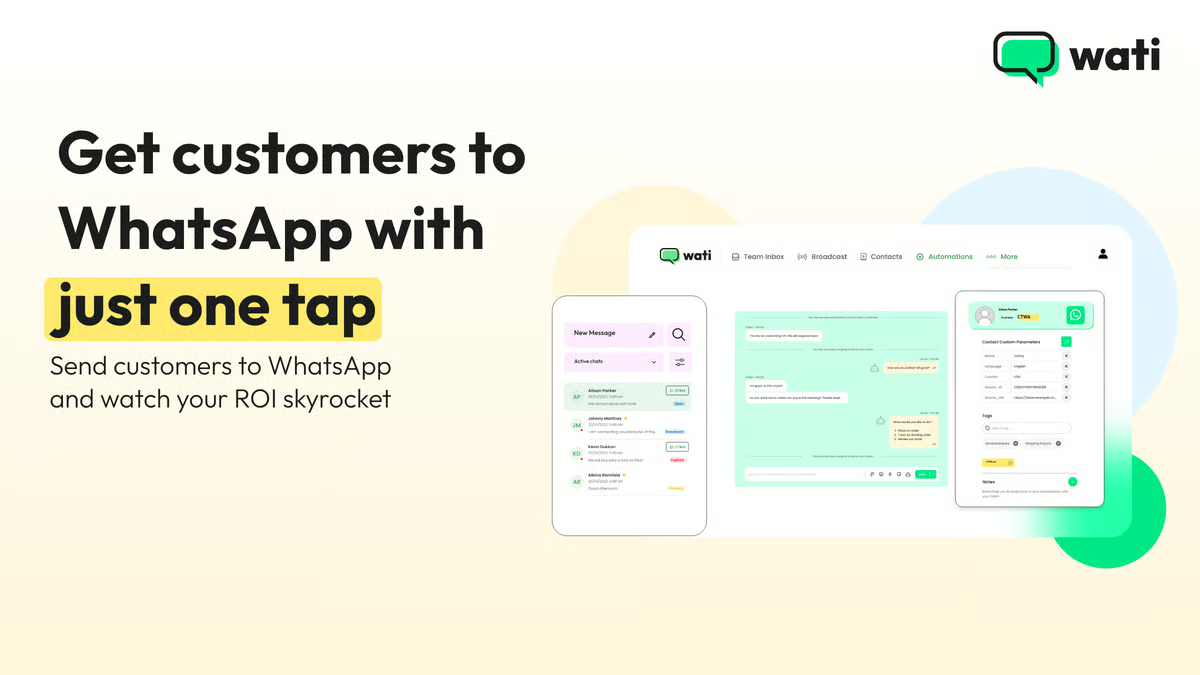
Reviewers also highlight a few considerations that come from the way Wati is designed. Pricing comes up often, especially as message volume increases. This is less a complaint and more a reflection of what Wati is built for: stable API delivery, automation, and large-scale messaging. Teams that rely heavily on WhatsApp as a primary communication channel tend to view the cost as part of accessing that level of reliability and infrastructure.
Some users note that Wati’s reporting feels more basic compared to enterprise analytics suites. For teams that need deep attribution models or multi-layer dashboards, the analytics may feel light. But many also point out that Wati’s simplicity is a strength for their organization — it’s optimized for fast execution and straightforward workflows rather than complex data analysis, making it well-suited for teams that prioritize speed and day-to-day productivity.
Overall, Wati leans toward clarity and simplicity, reflecting exactly what it’s designed to do: make WhatsApp automation accessible for everyday business operations.
What I like about Wati:
- Its simplicity and fast onboarding make WhatsApp automation accessible for SMBs, with reviewers praising how easy it is to set up broadcasts, automated replies, and key integrations.
- Reliable performance and strong customer support help teams run high-volume messaging and real-time conversations confidently without relying on technical expertise.
What G2 users like about Wati:
“Wati is one of the most efficient platforms I have ever used. The system is intuitive, fast, and offers an excellent solution for all our automation needs on WhatsApp. Technical support is always available, patient in their explanations, and helpful in resolving any issues. I highly recommend WATI to anyone seeking a blend of professionalism, innovation, and personal attention.”
– Wati review, Yossi S.
What I dislike about Wati:
- G2 reviewers note that pricing can increase as messaging volume scales, a natural reflection of Wati’s infrastructure focus and its ability to support stable, high-volume WhatsApp delivery.
- Some users mention that reporting is more streamlined compared to enterprise platforms, making it better suited for teams that prioritize speed and execution over advanced analytics.
What G2 users dislike about Wati:
“I find the reporting capabilities of Wati lacking. The reporting suite could be more comprehensive, ideally with the ability to create custom KPIs. Additionally, it would be beneficial to have an automatic cut-off feature for abandoned chats.”
– Wati review, Emiliano L.
Looking to expand into mobile engagement? Compare leading push notification software to deliver timely, high-converting messages at scale.
3. ActiveCampaign: Best for multi-channel automation with WhatsApp
ActiveCampaign is often described by users as the central hub of their automation strategy, a platform that brings email, WhatsApp, SMS, and CRM functionality into one cohesive system. Across hundreds of G2 reviews, it earns consistent praise for giving teams the power to build behavior-driven WhatsApp workflows without the complexity typically associated with enterprise-level automation tools.
96% of users rate it 4 or 5 stars, demonstrating broad confidence in its capabilities. And 83% of users believe ActiveCampaign is heading in the right direction, reinforcing its positive product trajectory.
Automation is the feature users highlight most often. Reviewers repeatedly note how intuitive it is to create WhatsApp sequences triggered by behavior, tags, or lifecycle stage. The ability to personalize messages and coordinate them with email and SMS makes ActiveCampaign especially appealing to teams ready to move beyond one-off broadcasts and into structured, multi-step journeys.
Multichannel orchestration is another major strength. Users appreciate how ActiveCampaign unifies segments, customer data, and communication channels. Many mention that it helps them maintain consistent messaging across WhatsApp, email, and other touchpoints, a key advantage for teams that want their WhatsApp outreach to be part of a larger engagement strategy rather than isolated campaigns.
The platform’s CRM and contact management features also get a lot of positive attention. Users appreciate how easy it is to track interactions, apply tags, and view a contact’s full history across campaigns. That context makes WhatsApp outreach feel more relevant, teams can see where someone came from, what they’ve engaged with, and what should happen next. Many reviewers also call out deliverability and overall reliability as strong points, especially for high-volume outreach.
Support and onboarding often show up as strengths in the reviews. Users frequently praise the helpfulness and responsiveness of the ActiveCampaign team, mentioning 1:1 guidance, training, and a strong library of resources. For businesses that are new to automation or expanding into channels like WhatsApp, that level of support can make the difference between a tool they dabble with and a platform they build their strategy around.

Reviewers also call out a few considerations that stem from the platform’s capabilities rather than shortcomings. Pricing comes up most often, especially as contact lists expand and automation becomes more sophisticated. This aligns with what ActiveCampaign is built for: enterprise-level automation, multichannel execution, and strong deliverability. Smaller teams may find the higher tiers more than they need, while organizations running advanced workflows tend to view the cost as part of accessing that level of power.
Some reviewers point out that ActiveCampaign can feel busy in areas like automation setup or reporting, which aligns with its role as a system built for detailed segmentation and multi-step logic. For teams that want to shape complex journeys, that depth is a strength. But for teams prioritizing quick deployment over customization, the platform’s structure may feel heavier compared to simpler tools.
ActiveCampaign’s design reflects a balance between capability and accessibility. It’s built for marketers who want powerful automation and cross-channel orchestration without needing a full technical team to implement it. For companies that see WhatsApp as part of a broader engagement ecosystem, it offers a level of cohesiveness that simpler tools don’t match.
What I like about ActiveCampaign:
- Strong automation and multichannel orchestration make it easy to design behavior-driven WhatsApp workflows, unify segments, and maintain consistent messaging across email, SMS, and CRM.
- Reviewers consistently praise its CRM visibility, tagging system, reliability, and supportive onboarding experience, which help teams adopt WhatsApp automation with confidence.
What G2 users like about ActiveCampaign:
“Love that ActiveCampaign makes it easy to email my contacts, no matter what part of the sales process they are in. It connects to my other tech easily, and it was easy to implement and set up. I use it on a regular basis, and have been able to outsource some of my ActiveCampaign tasks, and I love that it was easy to grant my team access as needed. I haven’t needed to access Customer Support at this stage.”
– ActiveCampaign review, Deb R.
What I dislike about ActiveCampaign:
- G2 reviewers note that pricing can rise as contact lists and automation complexity grow, which aligns with ActiveCampaign’s emphasis on robust, scalable execution rather than basic messaging.
- Some users mention that the platform can feel dense during initial setup, a natural result of offering granular controls and detailed automation options suited for advanced users.
What G2 users dislike about ActiveCampaign:
“The platform can feel overly ;complex’ at times, especially when setting up advanced automations or integrating with external tools. The UI isn’t always as intuitive as it could be. I think this is a shared feeling among AC users, as far as I know from other startup founders in my network. It takes a learning curve to unlock its full potential. Additionally, reporting and analytics could be more robust. For a data-driven marketing team like ours, we often find ourselves exporting data or relying on external tools to get deeper insights into campaign performance and user behavior.“
– ActiveCampaign review, Jose Manuel R.
4. WebEngage: Best for enterprise WhatsApp and omnichannel marketing
WebEngage is widely regarded as one of the most sophisticated engagement platforms for brands that rely on advanced segmentation, lifecycle automation, and multi-channel coordination. Across hundreds of G2 reviews, users consistently highlight WebEngage’s strength in building detailed customer journeys and delivering high-volume WhatsApp messaging with precision, making it a top choice for mid-market and enterprise organizations.
WebEngage holds a 4.5 out of 5 rating across 702 G2 reviews, reflecting strong, consistent customer satisfaction. Users give WebEngage 90% for ease of use and 90% for ease of admin, reinforcing its balance between depth and manageability.
Much of the praise centers on WebEngage’s journey builder. Reviewers repeatedly note how easy it is to map complex flows, trigger WhatsApp messages based on behavior, and build multi-step campaigns that adapt to a customer’s lifecycle stage. Many describe the journey builder as powerful and intuitive, especially for teams managing retention, reactivation, and multi-touch engagement programs.
Segmentation and personalization are standout strengths as well. Users appreciate how granularly they can define audiences, combining behavioral triggers, lifecycle data, and event attributes to refine who receives each WhatsApp message.
The platform’s UI and dashboard experience earn frequent positive mentions. Many reviewers say WebEngage feels intuitive and user-friendly once they understand the structure, highlighting how cleanly it presents campaign performance, customer funnels, and real-time metrics. Teams especially value how quickly they can scan reports, identify what’s working, and optimize messaging without juggling multiple tools.
WebEngage also receives strong feedback for its omnichannel reliability. Users note that the platform handles high delivery volumes smoothly and keeps channels, WhatsApp, email, SMS, push, coordinated from a single place. This is particularly appreciated by businesses that run integrated messaging strategies or operate at large scale, where consistency and delivery reliability matter as much as creativity.
Support quality shows up consistently across reviews. Many users describe WebEngage’s customer success team as responsive, knowledgeable, and invested in solving problems quickly. From setup guidance to strategy recommendations, reviewers mention feeling well-supported, especially during onboarding or when configuring complex journeys.
Some reviewers note that segment refresh times can be slower when working with very large datasets or real-time audiences. This tends to reflect the type of segmentation WebEngage is designed for, highly detailed, behavior-driven criteria rather than simple static lists. Teams that prioritize precise targeting often see this depth as part of the platform’s value rather than something that slows them down.

A few users also mention that certain features feel more optimized for specific setups, with performance varying depending on system configurations or the nature of the behavior being tracked. This is generally viewed as a result of WebEngage’s focus on structured workflows and data accuracy, which naturally favors rigor over ultra-light, shortcut-style execution.
WebEngage is built for depth and control, and reviewers’ comments reflect that. It’s designed for organizations that want real behavioral intelligence, orchestration across channels, and a centralized engagement engine.
What I like about WebEngage:
- A powerful journey builder and advanced segmentation capabilities, with reviewers praising how easily they can design multi-step, behavior-based WhatsApp flows that increase relevance and conversions.
- Clean dashboards, reliable high-volume delivery, and strong customer success support allow teams to manage omnichannel campaigns confidently and optimize performance across WhatsApp and beyond.
What G2 users like about WebEngage:
“WebEngage makes it really easy to manage multi-channel campaigns from a single platform. The segmentation and automation features are strong, and the ability to personalize messages based on user behavior helps improve engagement. The customer success team is also very supportive and quick to resolve queries, which makes campaign execution smoother.”
– WebEngage review, Sandesh C.
What I dislike about WebEngage:
- Several reviewers mention that certain features perform better in specific environments, with variations tied to system configurations or the behaviors being processed.
- Some users mention slower segment refresh times for very large datasets, a natural trade-off for teams that prioritize detailed behavioral criteria and precision targeting.
What G2 users dislike about WebEngage:
“I would’ve loved to have sample case studies that I can refer to for creating journeys and campaigns with WebEgage. There isn’t much content out there to help me do this. Also, as a non-technical person, it was slightly difficult for me to integrate webengage with our website.”
– WebEngage review, Vivek R.
5. WhatsApp Business Platform: Best official API for scalable messaging
WhatsApp Business Platform is often described by users as the most reliable and scalable way for businesses to communicate with customers on WhatsApp. Unlike prebuilt marketing tools, the platform functions as a secure.
It has a flexible API layer that allows companies to build their own WhatsApp experiences or integrate messaging directly into their CRM, support system, or automation stack. The WhatsApp Business Platform holds a 4.7 out of 5 rating on G2, making it one of the highest-rated messaging infrastructure tools on the site, and 99% of users rate it 4 or 5 stars, showing exceptionally strong satisfaction.
Across G2 reviews, users consistently highlight its stability, global reach, and trust factor, positioning it as the foundation many brands depend on for high-volume, mission-critical communication.
One of the most praised strengths is its ability to streamline direct customer interactions. Reviewers frequently note that the platform helps teams deliver updates, confirmations, and support messages quickly, with WhatsApp often becoming the fastest way to respond to customer needs. Many emphasize how naturally the channel supports personalized, real-time conversations in regions where messaging is the preferred mode of communication.
Security is another standout theme. Users repeatedly mention that the platform feels safer and more compliant, particularly when handling sensitive conversations or regulated data. For organizations operating in privacy-conscious markets, this built-in trust factor becomes a core advantage.
Reliability also appears prominently across reviews. The platform is described as stable, consistent, and capable of supporting large-scale messaging without interruption. Businesses that rely on WhatsApp for authentication, order tracking, or customer support say this dependability is essential for maintaining smooth operations.
Users also appreciate its flexibility. Because the platform is API-based, teams can design custom WhatsApp experiences tailored to their operational needs—whether that means integrating with existing systems, building unique workflows, or creating specialized customer journeys.
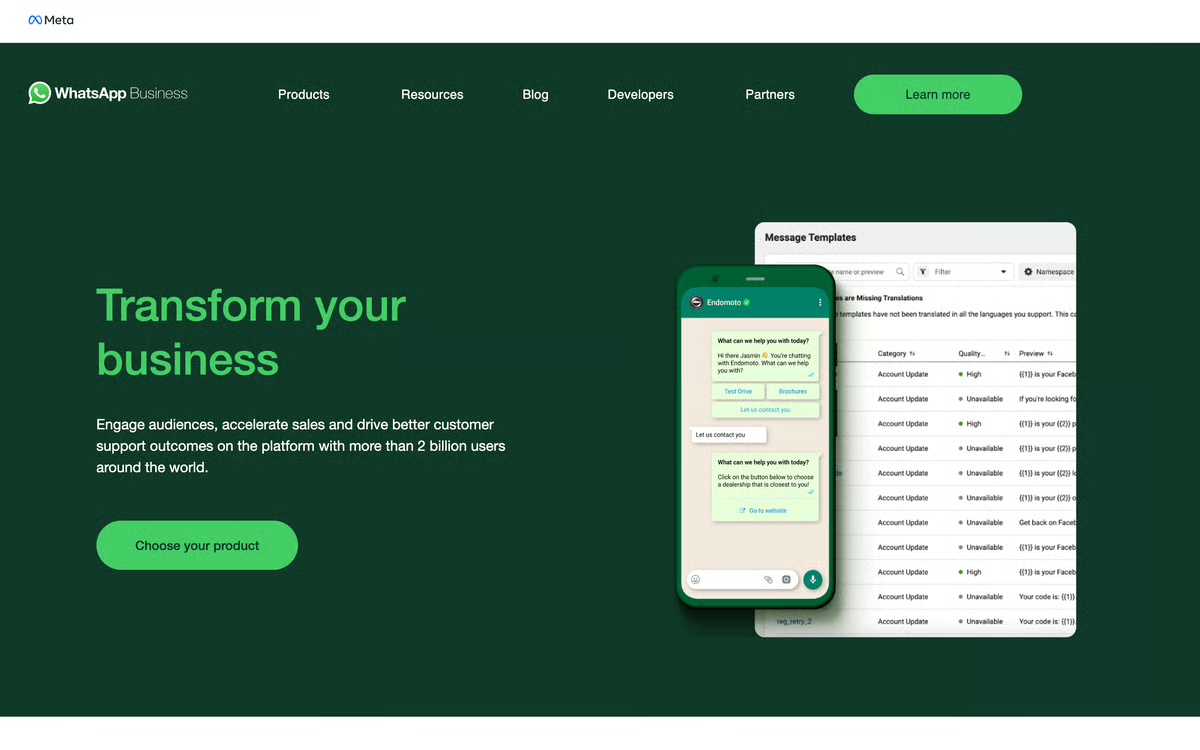
Users point out a few considerations that come from the platform’s API-first design. Verification and setup can take time, which makes sense given WhatsApp’s emphasis on compliance and security. Teams that value strict policy alignment tend to see this as part of working with an official, trusted infrastructure, while those looking for instant activation may feel the process is more structured than expected.
A number of users also observe that the platform doesn’t include built-in analytics, dashboards, or marketing features. This minimalism acts as a foundational messaging layer meant to be integrated with CRMs, automation tools, or engagement platforms that offer richer capabilities. Teams that prefer assembling their own best-of-breed stack tend to appreciate this flexibility.
Overall, WhatsApp Business Platform is intentionally built for reliability, compliance, and flexibility. Reviewers’ comments reflect that distinction clearly: organizations that choose it are usually looking for control, scalability, and long-term stability across global messaging.
What I like about WhatsApp Business Platform:
- Highly secure, stable, and scalable messaging infrastructure, with reviewers praising its reliability for real-time transactional updates, support conversations, and high-volume communication across regions.
- Flexible, customizable API foundation that allows teams to design their own workflows, integrate with existing systems, and deliver messaging that feels direct, personal, and trusted.
What G2 users like about WhatsApp Business Platform:
“The best part is how it helps us stay close to our clients in a natural and familiar way. Since most of our elderly users’ families already use WhatsApp, it’s incredibly easy to build trust and offer quick support. Having an official verified business profile with our Cuidado24 logo, website link, and catalog gives a professional image that helps customers feel safe when we reach out. I also appreciate how simple it is to share documents, installation guides, and videos directly through chats. It makes communication fast and personal.”
– WhatsApp Business Platform review, Miguel R.
What I dislike about WhatsApp Business Platform:
- G2 reviewers note that verification and setup can take time, which reflects WhatsApp’s emphasis on compliance and long-term trust, ideal for brands that prioritize governance over immediate deployment.
- Some users mention that the platform offers minimal built-in analytics or marketing features, a natural trade-off for an API-focused infrastructure designed to be paired with external CRMs or engagement tools.
What G2 users dislike about WhatsApp Business Platform:
“I would love to see more advanced analytics and reporting tools within the WhatsApp Business Platform for tracking customer engagement better. Additionally, enhancing bulk messaging options and offering deeper integration with other business software to automate tasks would be incredibly beneficial. These improvements could make the platform even more powerful for growing businesses.”
– WhatsApp Business Platform review, Jyoti T.
6. respond.io: Best shared inbox for WhatsApp and multi-channel support
respond.io has become a favorite among teams that handle a high volume of customer conversations across WhatsApp and multiple messaging channels. Rated 4.8/5 on G2, across hundreds of G2 reviews, users consistently describe it as a centralized, intuitive hub that helps support, sales, and operations teams stay organized, especially when handling large conversation volumes or collaborating across multiple agents.
The platform’s unified inbox is one of its biggest strengths. Reviewers repeatedly highlight how convenient, organized, and intuitive the interface feels, especially when managing conversations across WhatsApp, Facebook Messenger, Instagram, live chat, and more. Many note that respond.io makes it easy to assign chats, track interactions, and ensure customers aren’t left waiting, a major improvement for teams that previously juggled multiple apps or browser tabs.
Automation and workflow rules are another highly praised feature. Reviewers describe how simple it is to set up auto-routing, build follow-up flows, categorize inquiries, and streamline repetitive tasks. This automation significantly reduces manual workload, helping teams maintain consistently fast response times even during peak hours.
Data retention and customer history also earn