


Most LinkedIn post templates offer frameworks, like:
- What’s a failure story and what did you learn?
- What’s your blueprint for (specific process)?
- What are your top three tips for (specific pain point)?
These frameworks are still effective, but I still find them limiting for a few reasons:
- They aren’t the only frameworks that work – and they often cater to a professional (and somewhat generic) tone of voice.
- The success of the post still depends on the topic of content you place in that framework.
- Frameworks are great, but you still have to come up with your own creative hook.
To solve these problems, we studied the top performing posts of 50 LinkedIn influencers and broke down each of their posts into LinkedIn post templates.
I’ll also explain why I think the LinkedIn post performed so well (e.g., was there something unique about the topic selected?) and what you can learn about that topic.
Therefore, these post templates not only give you very specific hook and copywriting ideas, but they also hopefully inspire you to look beyond the most commonly mentioned LinkedIn post frameworks.
50 LinkedIn Post Templates
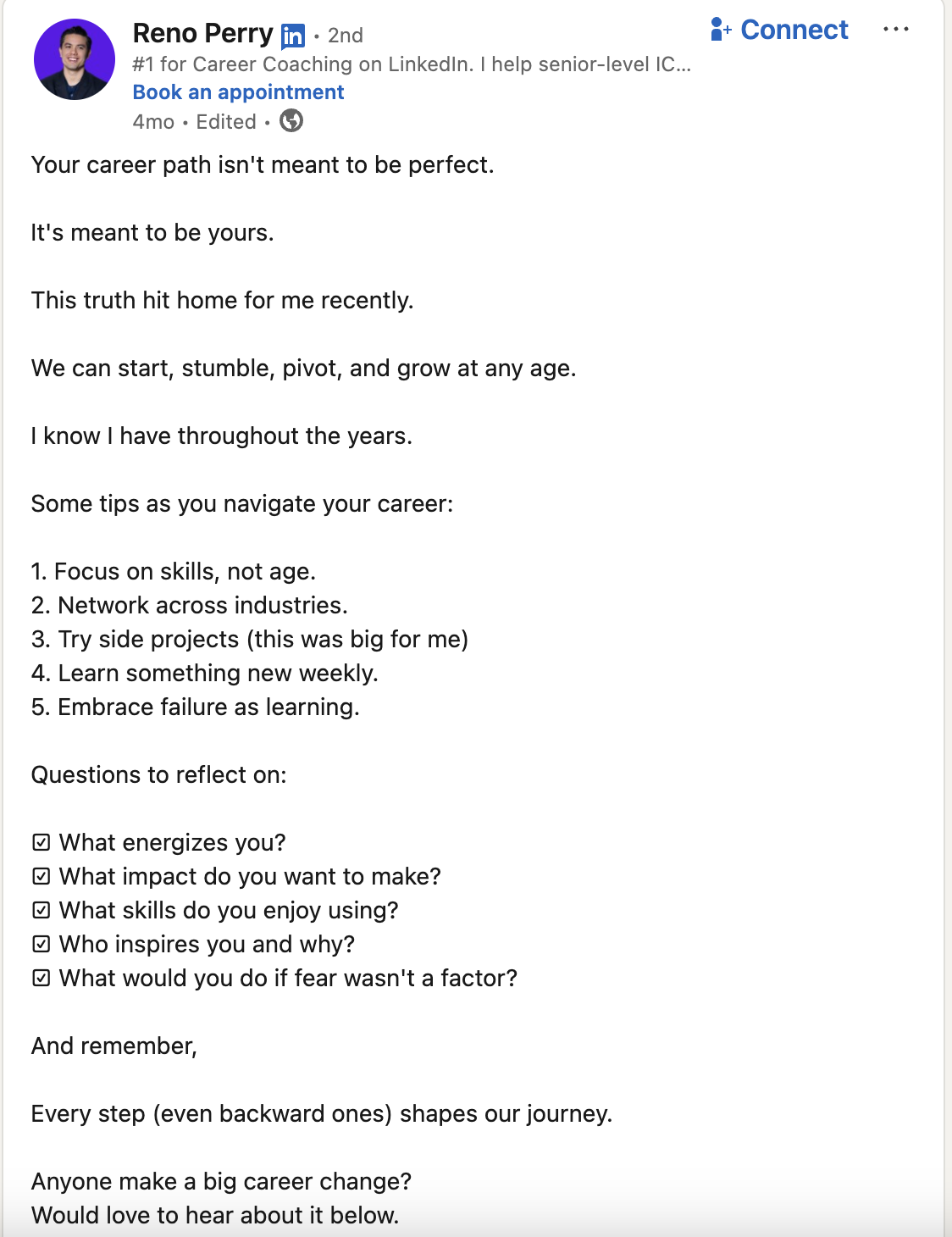
Template #1: Reno Perry
This is an image and text based post that likely performed well because of the message in the image. Plenty of people on LinkedIn are doomscrolling or struggling to find a job, so publishing a post that’s relatable is
Template:
What’s a struggle you went through that your audience can relate to?
5 Tips that helped you navigate the challenge
- Tip #1
- Tip #2
- Tip #3
- Tip #4
- Tip #5
5 Questions to reflect on as you navigate the challenge.
- Question #1
- Question #2
- Question #3
- Question #4
- Question #5
Reshare ♻ to help someone in your network.
And give me a follow for more posts like this.
📌 Need help with (Problem)? Each month, I help a select number of professionals (accomplish dream outcome). DM me or check the link in my bio.
See full template here.
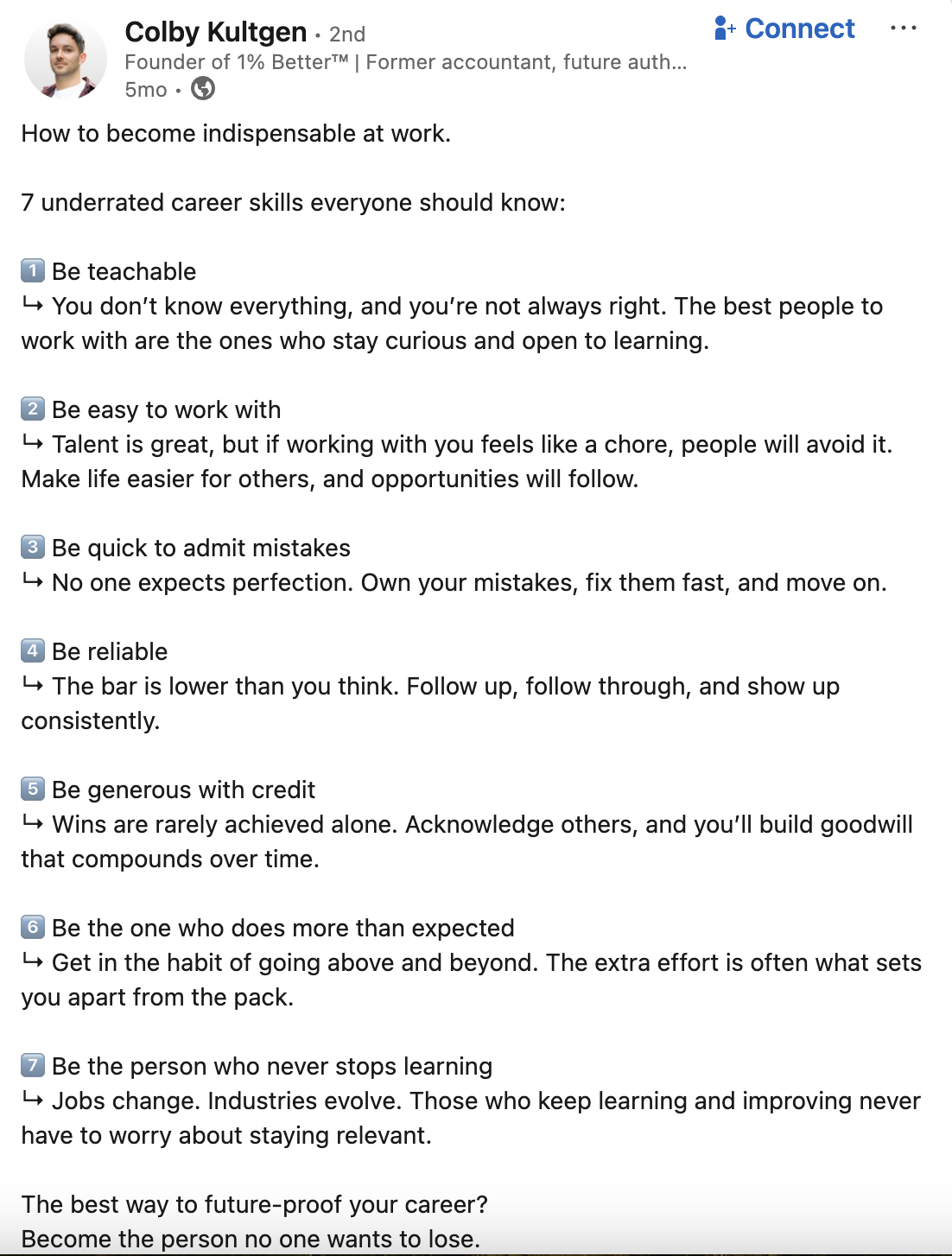
Template #2: Colby Kultger
The “X Skills for Y” framework is fairly common, but this LinkedIn post likely earned a lot of engagement simply because it was framed with a quote that resonates with a wide audience.
If you target a wider audience, you have a much higher chance of increasing engagement, though keep in mind that not all engagement is equally valuable.
If your goal is to earn the attention of CMOs and convince them that you’re the authority they need to work with, this post probably isn’t the best post to accomplish that goal.
Template:
How to become indispensable at (X).
7 underrated (X) skills everyone should know:
↳ 2 explanatory sentences
↳ 2 explanatory sentences
↳ 2 explanatory sentences
↳ 2 explanatory sentences
↳ 2 explanatory sentences
↳ 2 explanatory sentences
↳ 2 explanatory sentences
The best way to (accomplish X)?
Become (Y).
♻️ Repost this if it resonated.
See full post here.
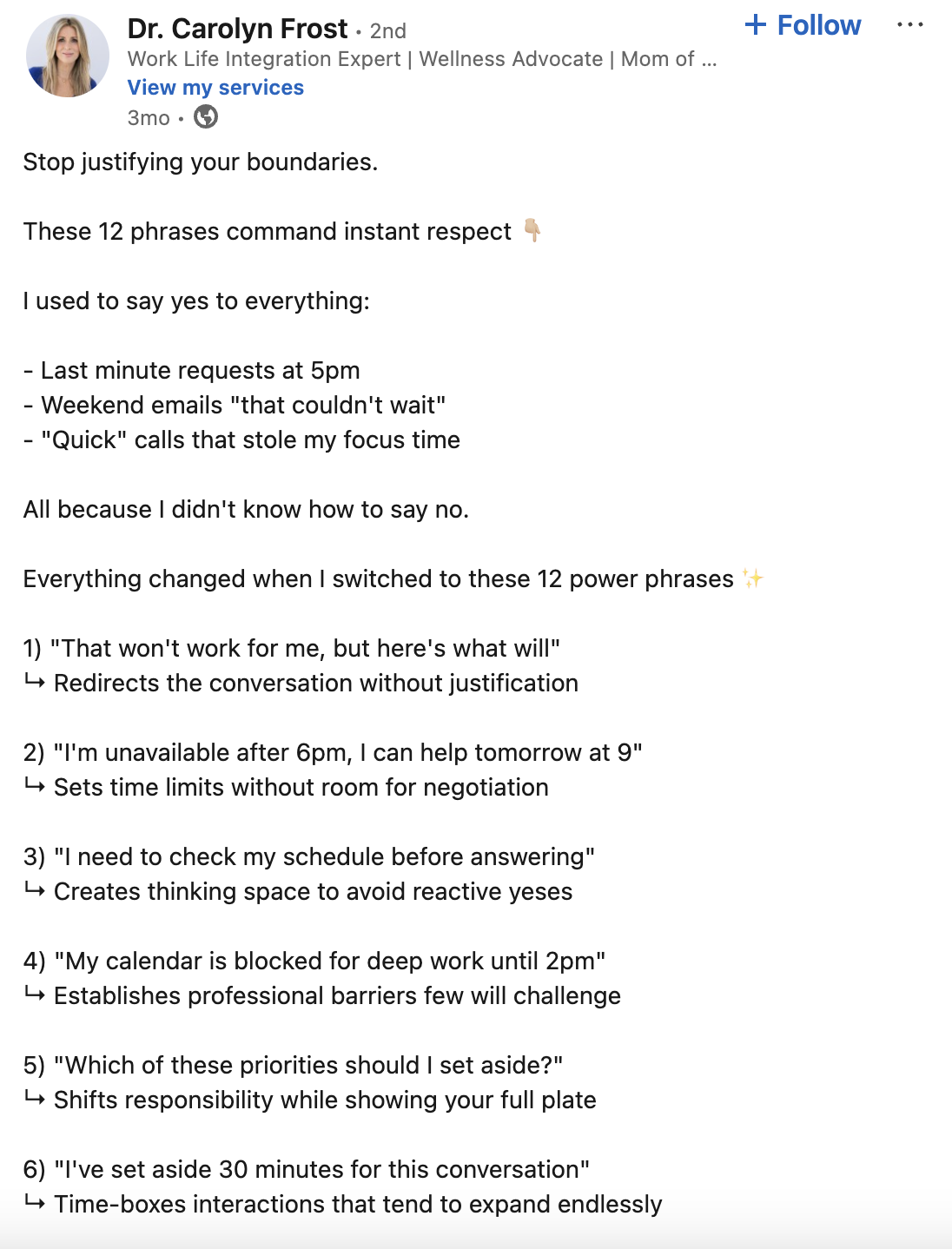
Template #3: Dr. Carolyn Frost
This template also targets a wide audience, and each statement highlights an uncomfortable truth that most people have likely felt.
Yet this framework is fundamentally 12 different ways to solve a problem with a single explanation of why it works.
For example, you could apply this same framework to SEO.
In this scenario, the problem may be that traditional link building by spamming guest posts doesn’t work. Instead, you introduce 12 alternative link building techniques and include a one liner of why they work.
Template:
Stop (painful action that doesn’t work anyway).
These 12 (solutions) that (deliver desired outcome) 👇🏼
I used to (do the thing that doesn’t work):
– Example #1
– Example #2
– Example #3
Everything changed when I switched to these 12 (solutions)
1) Solution #1
↳ Why it works
2) Solution #2
↳ Why it works
3) Solution #3
↳ Why it works
4) Solution #4
↳ Why it works
5) Solution #5
↳ Why it works
6) Solution #6
↳ Why it works
7) Solution #7
↳ Why it works
8) Solution #8
↳ Why it works
9) Solution #9
↳ Why it works
10) Solution #10
↳ Why it works
11) Solution #11
↳ Why it works
12) Solution #12
↳ Why it works
♻️ Repost to help your network protect their time and energy
🔔 Follow me (name) for more strategies to succeed with confidence.
See full post here.
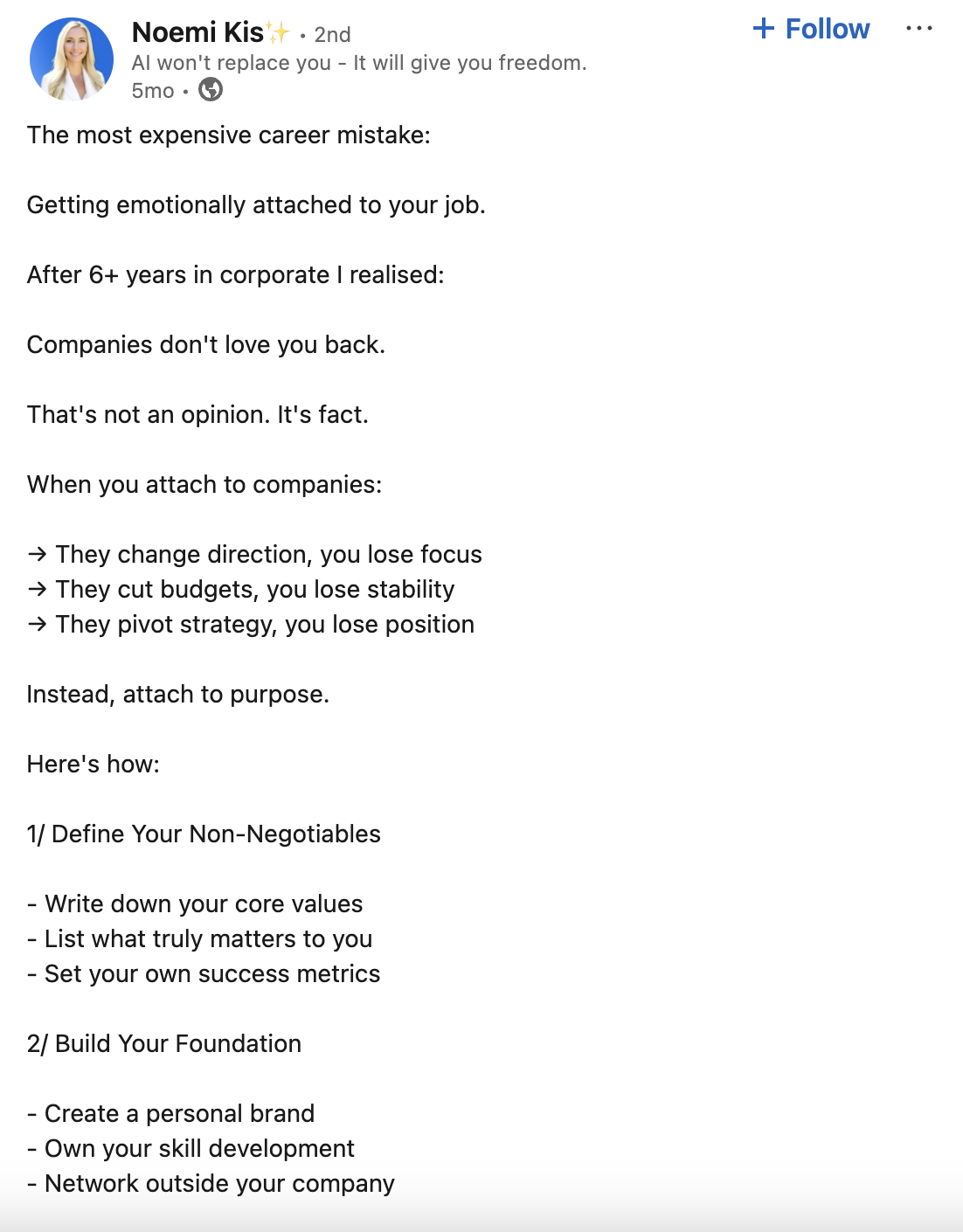
Template #4: Noemi Kis
This is another quote that resonates with a wide audience, and similar to some of the other posts, it also has a “self care” message.
I’ve noticed these “self care” messages tend to perform very well, because they resonate with any person. It’s also structured in a “mistake to avoid” framework.
You can use this mistake framework for any type of content.
Template:
The most expensive (industry) mistake:
(one liner of that mistake)
After X+ years in (industry) I realised:
(Harsh realization)
That’s not an opinion. It’s fact.
When you (make X mistake):
→ X happens, Y negative impact on you
→ X happens, Y negative impact on you
→ X happens, Y negative impact on you
Instead, (solution).
Here’s how:
1/ First Tip of The Solution
– Relevant action item
– Relevant action item
– Relevant action item
2/ Second Tip of The Solution
– Relevant action item
– Relevant action item
– Relevant action item
3/ Third Tip of The Solution
– Relevant action item
– Relevant action item
– Relevant action item
♻️ Repost to spread the message!
Follow (your name) for more.
See full post here.
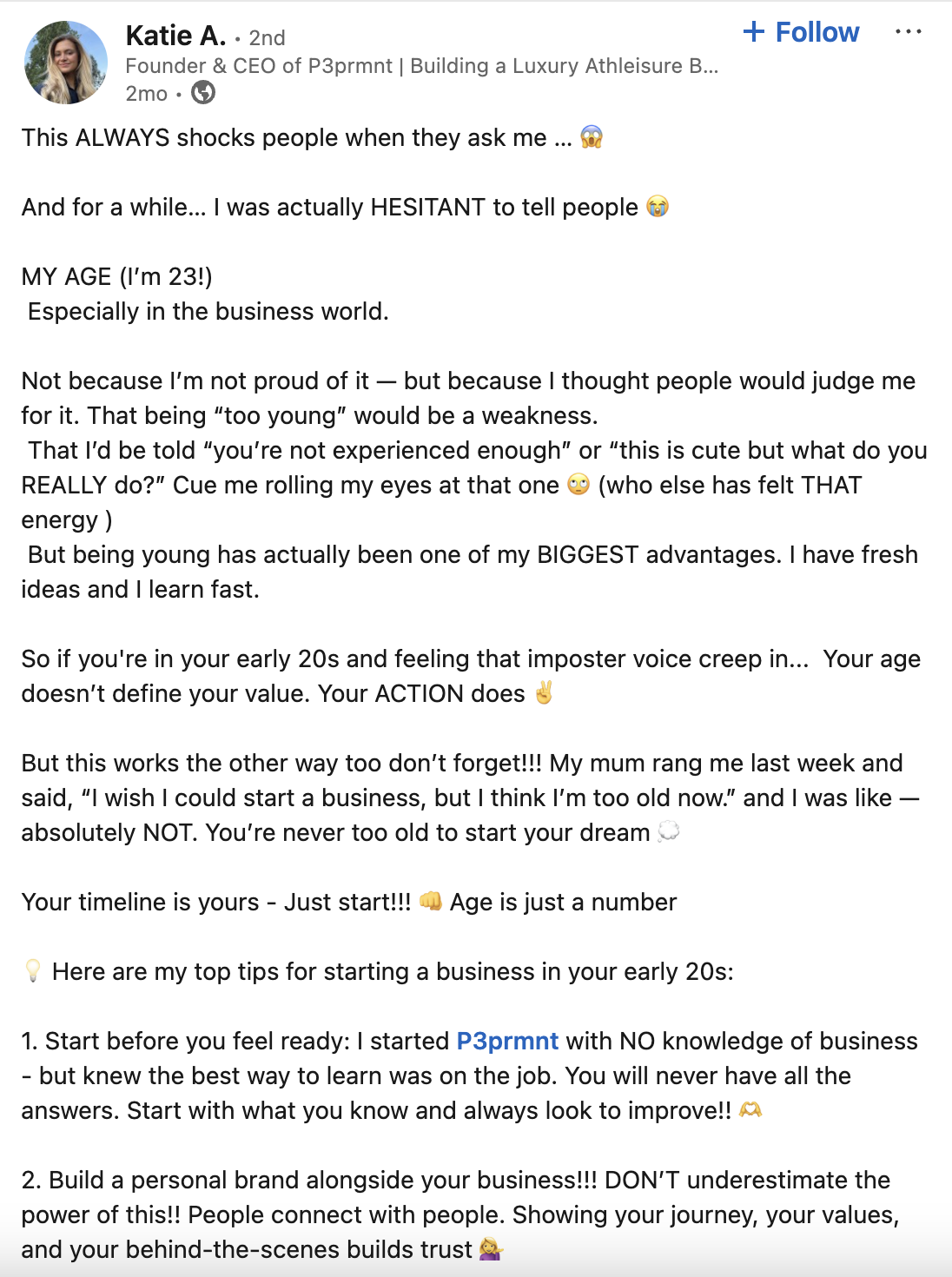
Template #5: Katie A.
This post is a departure from the more traditional, professional LinkedIn content style and takes a more casual tone you might expect on other social media platforms like Instagram or Facebook.
It’s an excellent example that each person has their own tone and style.
It might not be the right tone or style for you, but it proves that you can adopt just about any style to work on LinkedIn.
Template:
How do people react when you tell people about this attribute?
(This ALWAYS shocks people when they ask me … 😱
And for a while… I was actually HESITANT to tell people 😭)
Set Up: What’s the one attribute you’re self conscious about?
Solution: Why is it a strength rather than a weakness?
Here are my top tips for (solution to negative attribute):
1. Solution #1: How you did it/explanation
2. Solution #2: How you did it/explanation
3. Solution #3: How you did it/explanation
4. Solution #4: How you did it/explanation
5. Solution #5: How you did it/explanation
6. Solution #6: How you did it/explanation
7. Solution #7: How you did it/explanation
Do you agree that (attribute) should never be a limiting factor? Let me know in the comments.
And make sure to REPOST to share this message!!! ♻️
See full post here.
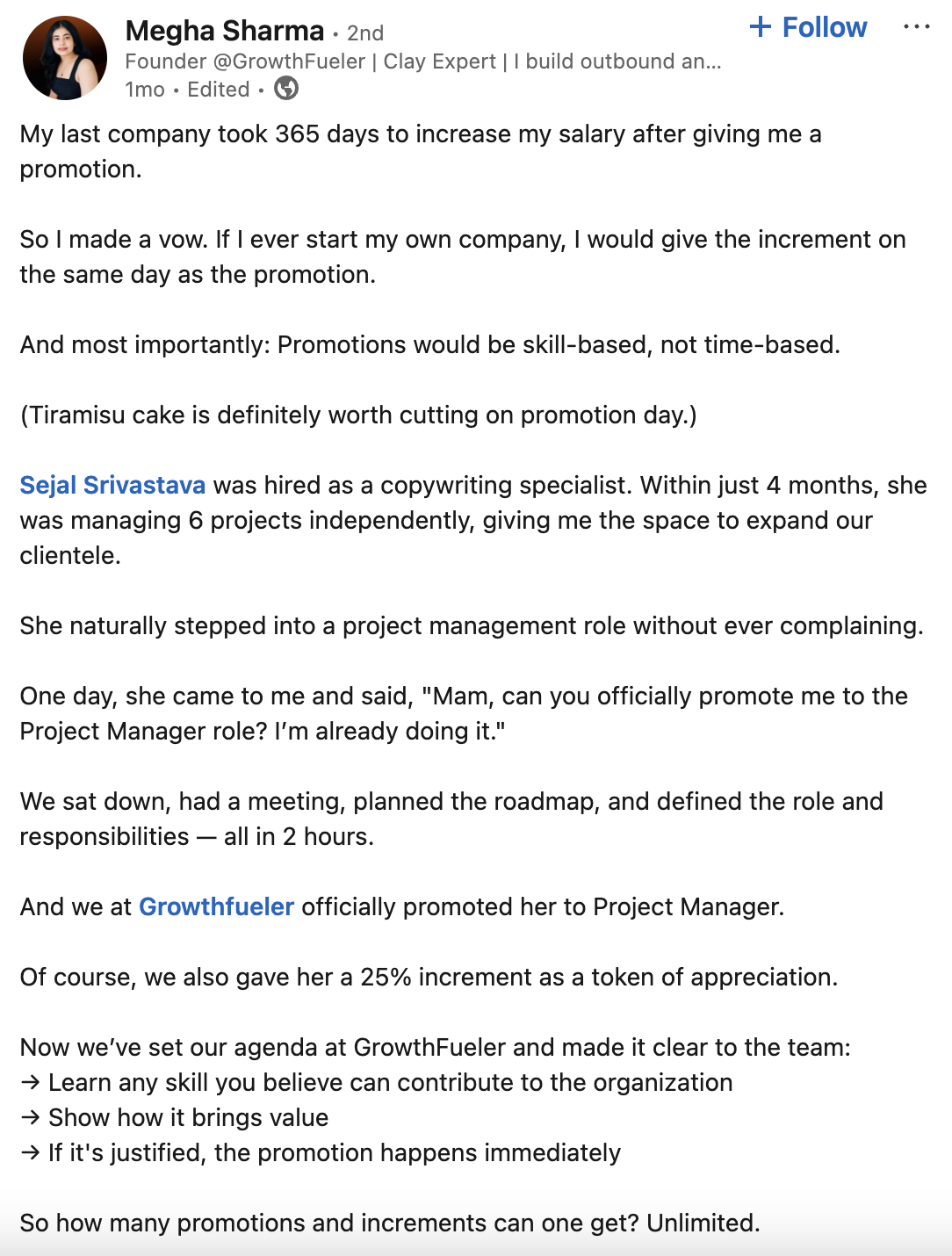
Template #6: Megha Sharma
This post template is designed to illustrate a story of a process you use in your business.
Personal experience posts are excellent because they show not only how you think as a thought leader, but they’re also more engaging because they illustrate the principle.
Also, this post adds personal pictures from the team. Whenever you can capture real pictures of people, it can help.
Template:
What’s one thing you do in your company that you learned from experience?
Case Study:
- How did a similar situation arise in your company?
- How did the events unfold? (The conversation, the conflict, etc.)
Solution: “Now at (company) we live by X”
→ Step 1
→ Step 2
→ Step 3
Results and Why?
How has this impacted the company and why do you believe this is important?
See full post here.
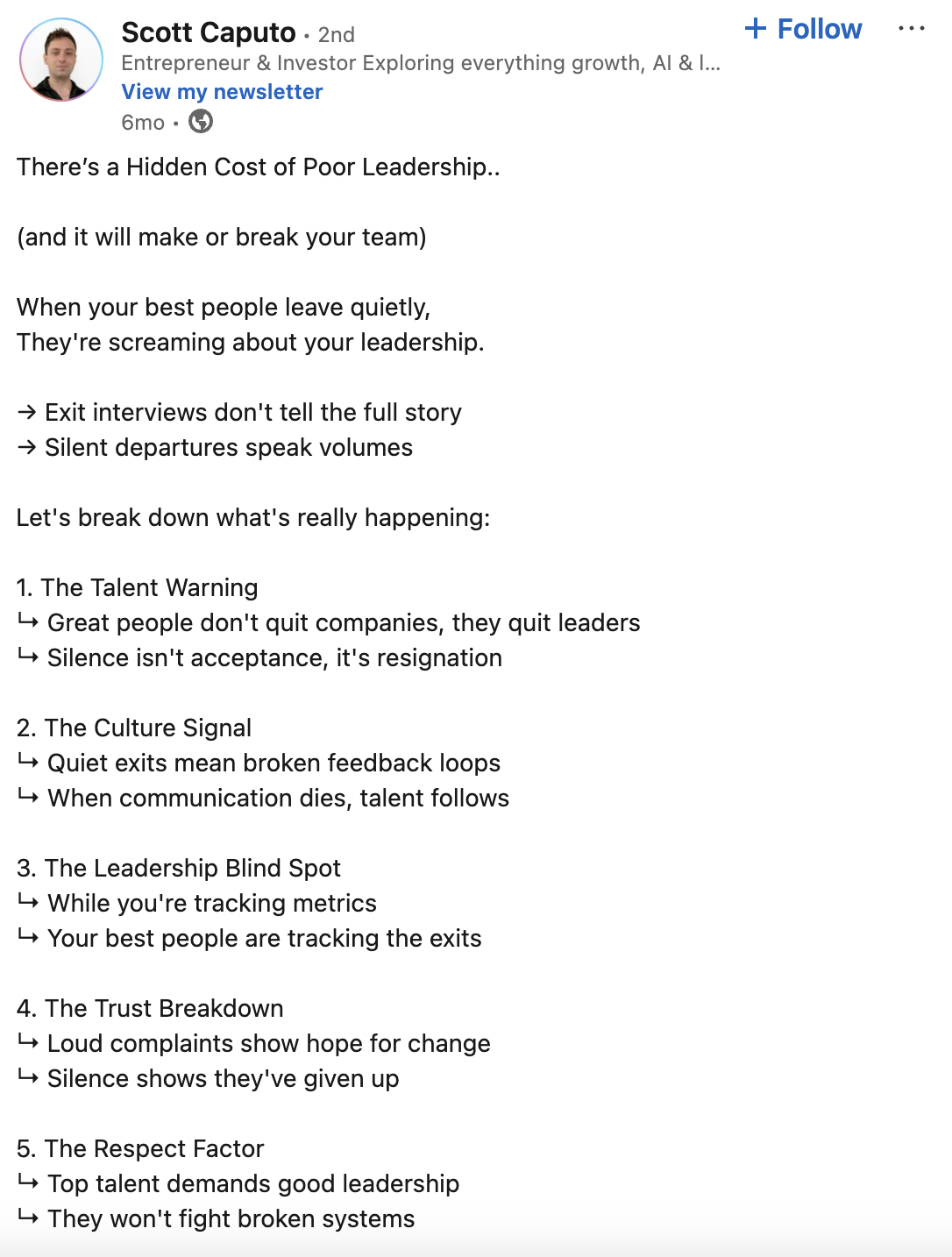
Template #7: Scott Caputo
This framework is designed to help you identify a mistake that isn’t always immediately apparent.
Then, it breaks down the step by step process of how each event unfolds. The goal of this post isn’t necessarily to provide a solution, but rather make people aware of how a negative event occurs.
And, if you can accurately articulate a pain point that’s hard to pin down, people tend to engage.
Template:
There’s a Hidden Cost of (X mistake).
(and it will make or break X)
Pain Point Aggravation:
When (negative result of mistake) happens, it’s an indication of (mistake)
→ (Thing you’re currently doing) doesn’t tell the full story
→ (Negative result) does
A Step by Step Breakdown of How The Negative Even Unfolds:
1. Step 1 of the event
↳ Explanation
↳ Explanation
2. Step 2 of the event
↳ Explanation
↳ Explanation
3. Step 3 of the event
↳ Explanation
↳ Explanation
4. Step 4 of the event
↳ Explanation
↳ Explanation
5. Step 5 of the event
↳ Explanation
↳ Explanation
6. Step 6 of the event
↳ Explanation
↳ Explanation
7. Step 7 of the event
↳ Explanation
↳ Explanation
To learn more:
1. Like this post
2. Follow(your name)
3. Share with your network
4. Join my newsletter: (link)
See full post here.
Template #8: Jade Bonacolta
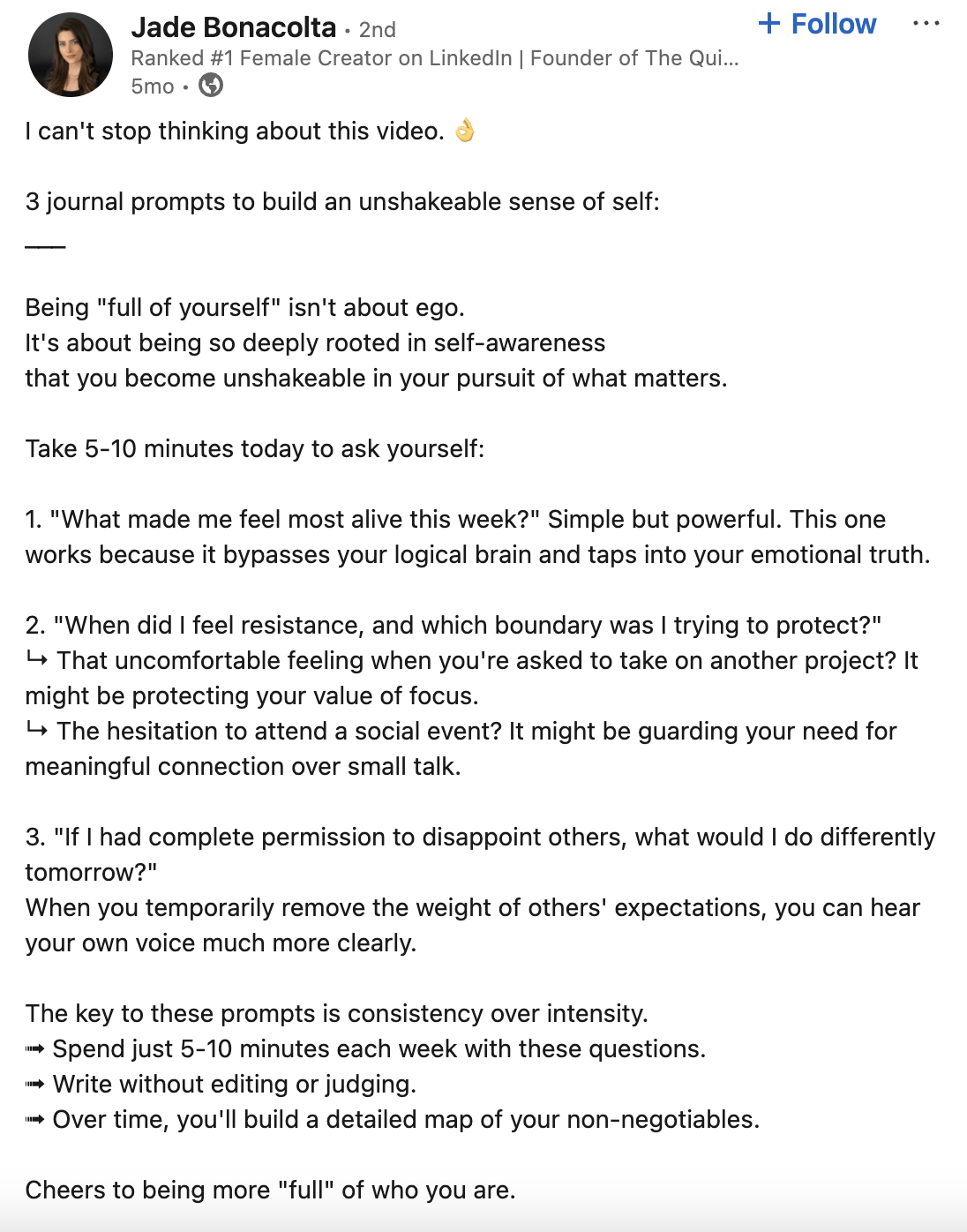
This post includes a video clip from Jesse Itzler, and it’s an excellent example of how you can repurpose your own content or someone else’s content (with their permission) to create a unique LinkedIn post.
Here, Jade took an idea from another influencer and then created an actionable framework around it.
Template:
What’s an interview or quote that has stuck with you?
Here are 3 questions to ask yourself to achieve (goal):
(Explanation of why the goal is important)
Framework:
Take 5-10 minutes today to ask yourself:
1. Question #1 (Explanation of why it’s important)
2. Questions #2 (Explanation of why it’s important)
3. Question #3: (Explanation of why it’s important)
The key to these prompts is consistency over intensity.
➟ Spend just 5-10 minutes each week with these questions.
➟ Write without editing or judging.
➟ Over time, you’ll build a detailed map of (x).
See full post here.
Template #9: Matt Schnuck
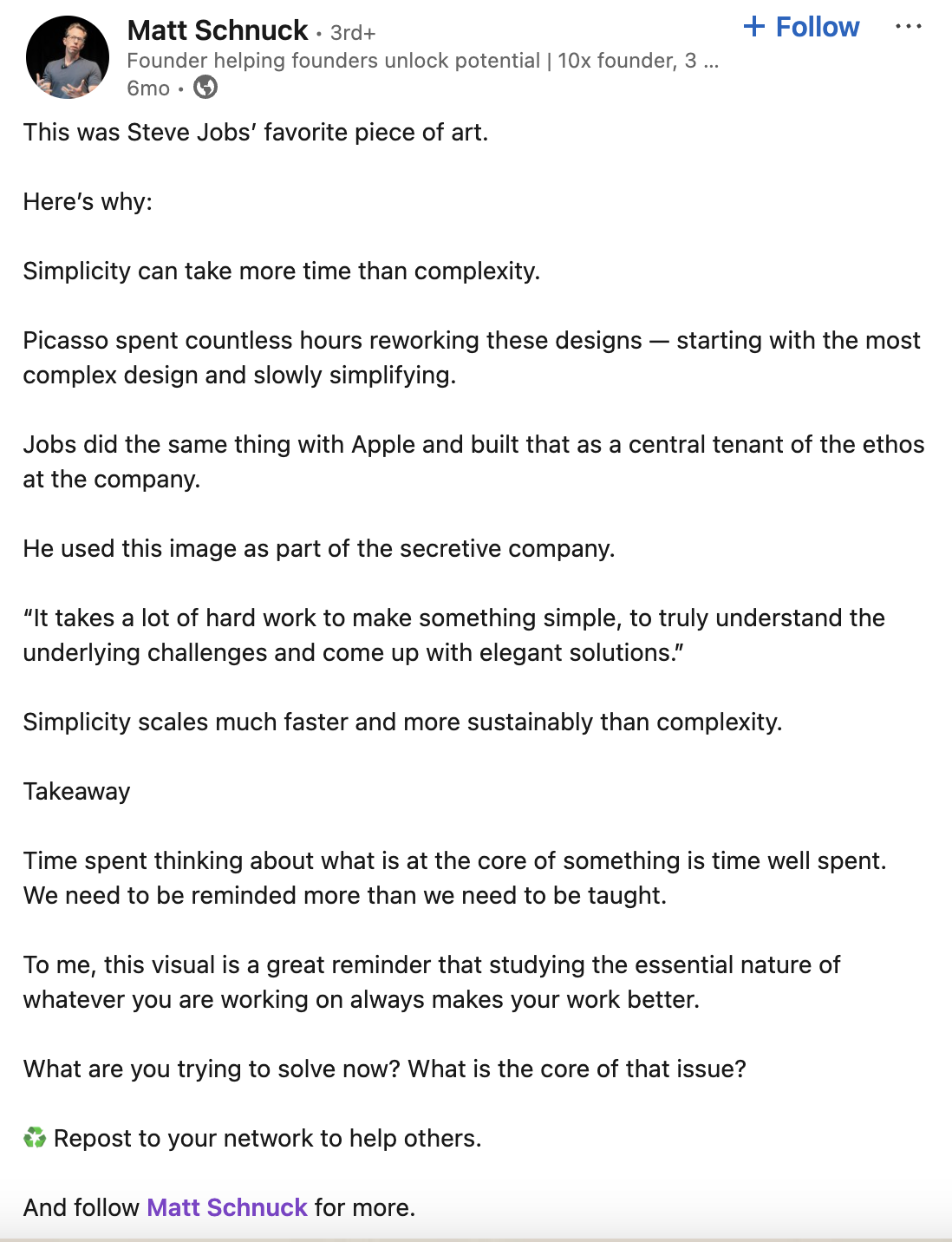
This post features Steve Jobs’ favorite piece of art, and provides an explanation of why and a key takeaway.
You can also look at a famous founder’s favorite book, quote, art, etc., and analyze the takeaway from it.
Template:
This was (famous person’s) favorite (object).
Here’s why:
Explanation of why it was their favorite object and how that principle is reflected in their business/work.
Takeaway
What’s the main takeaway from this story, and how can a reader take action?
What does this story mean to you?
Ask the audience a question of what it means to them and how they’ll take action.
♻ Repost to your network to help others.
And follow (your name) for more.
See full post here.
Template #10: Harish Kumar
This is an actionable LinkedIn carousel that includes a template people can use.
Look at the workflows and processes you use internally and turn them into actionable templates LinkedIn followers can use.
Template:
How to (X Task Your Audience Does Frequently) :
What do most people do wrong when executing this task?
How should they correct it?
Example:
How to execute this task more effectively
(Template #1)
(Template #2)
(Template #3)
Important Notes:
1. Tip
2. Tip
3. Tip
➡️ Follow (your name) for more valuable (information on X)
Template #11: Tom Hunt
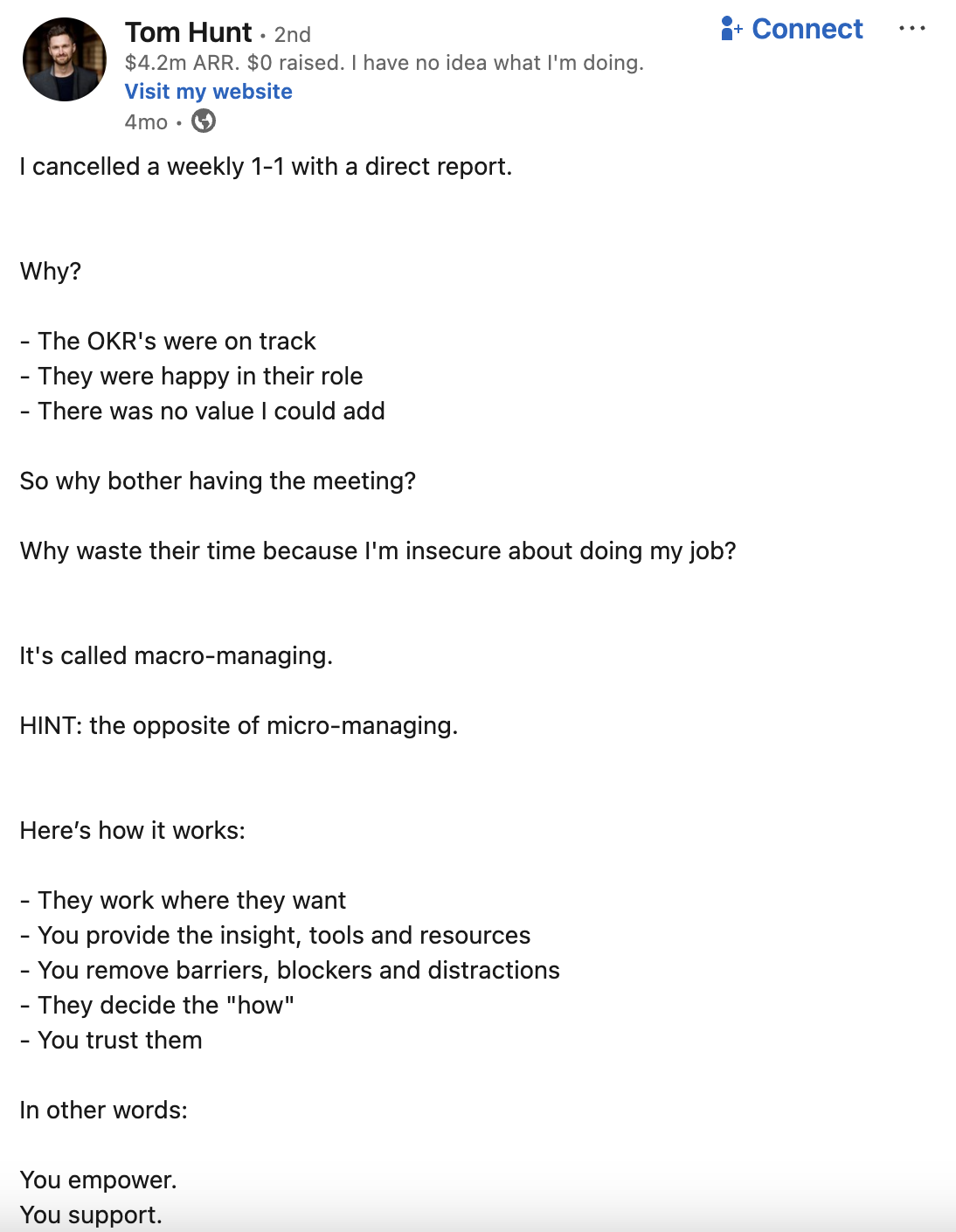
This post is a great framing for a contrarian opinion. Think about a best practice you don’t follow.
Then, create a hook that tells a story illustrating how you don’t follow that best practice advice.
The body of the post is then an explanation of the flaws with that best practice advice and then transition to what you do instead.
Template:
What action did you recently take that illustrates you went against a specific piece of best practice advice?
Why?
- Specific contextual detail justifying the rationality behind your actions
- Specific contextual detail justifying the rationality behind your actions
- Specific contextual detail justifying the rationality behind your actions
Instead, I do (term you coined).
HINT: the opposite of X.
Here’s how it works:
- Detail
- Detail
- Detail
- Detail
- Detail
Agree?
Here’s the full post.
Template #12: Greg Isenburg
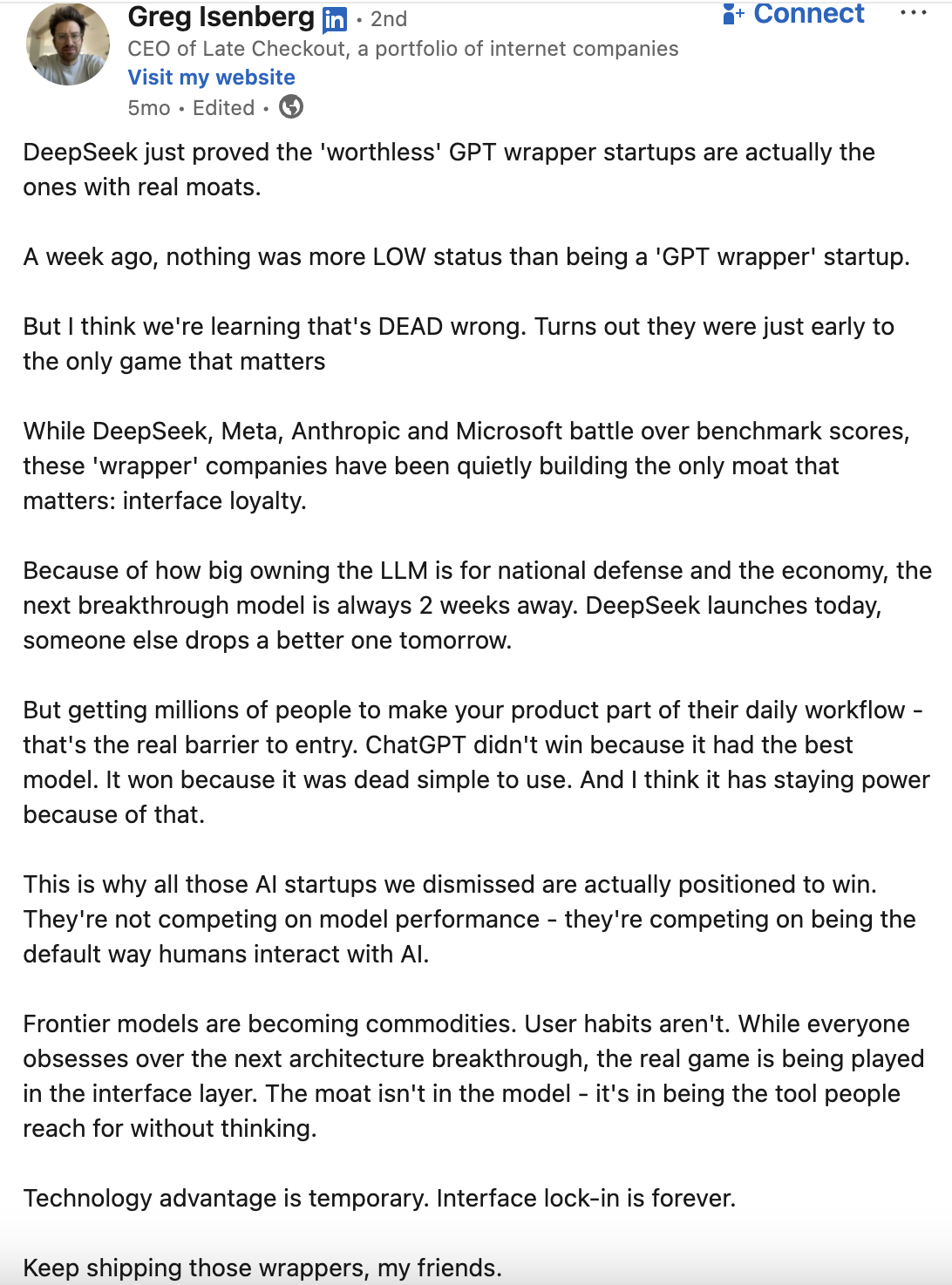
This post from Greg Isenburg mixes newsjacking (Deepseek’s recent success) with a contrarian opinion (GPT wrapper startups are NOT worthless).
Look at recent industry news that defies a popular belief and use it to explain why that belief is wrong.
Template:
(Event) just proved (popular belief is wrong)
State the unpopular belief and why it’s wrong.
Provide evidence from the news justifying why it’s wrong.
Explain your point of view. What do you really believe?
Link to your offer.
Link to a free guide
Link to any other free resources.
Here is the full post.
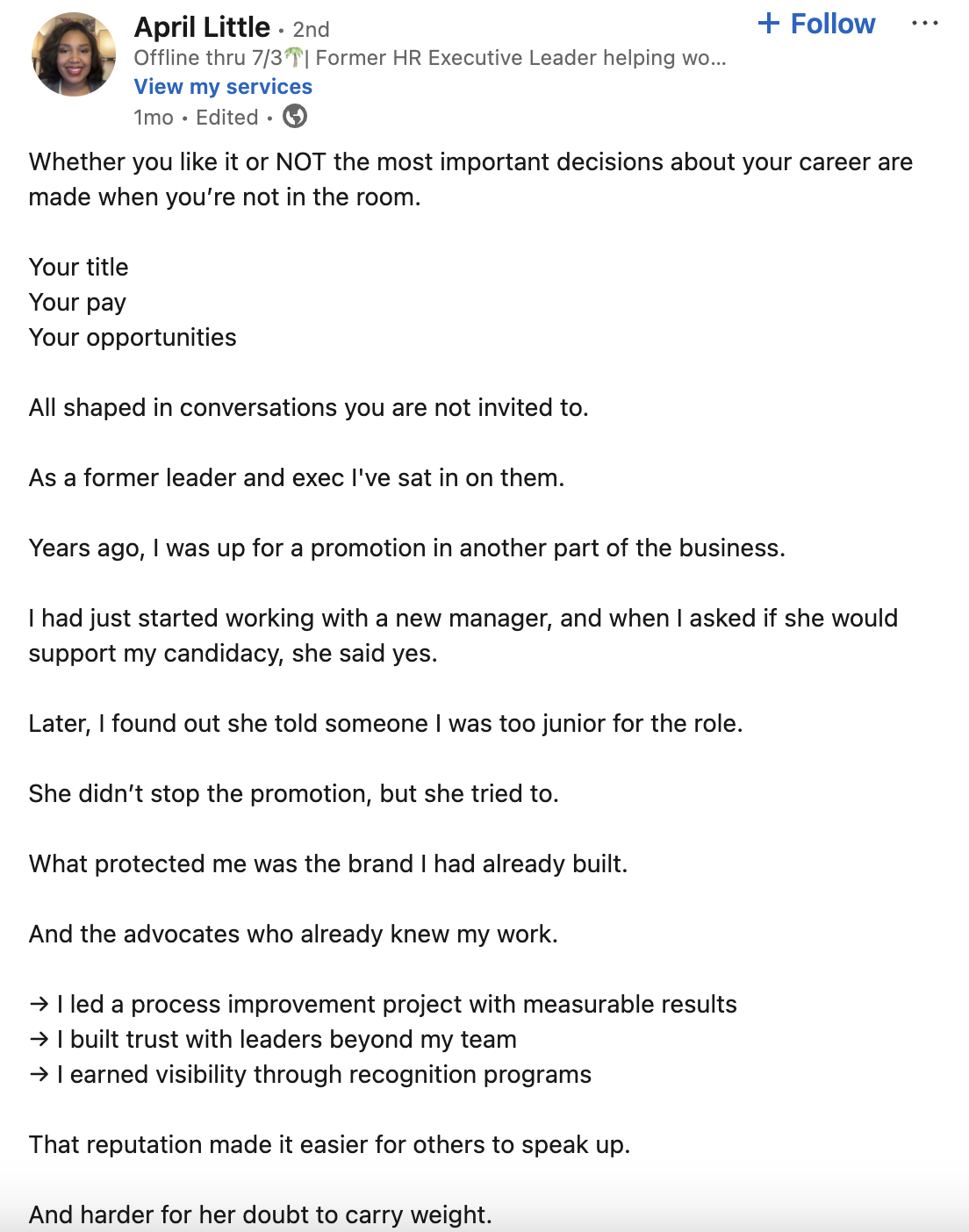
Template #13: April Little
This is another post that likely performed well because of the content of the post.
It’s a unique take on a somewhat sensitive topic (what other people say about you) and is framed in a vulnerable story from personal experience.
Template:
What’s a harsh reality of your industry that impacts outcomes, but isn’t necessarily something you can directly control?
Story: What’s a story where you’ve personally experienced this harsh reality?
Resolution: How did you stop the negative outcome, avoid it, or fix it?
Specifics: What are three specific action items you took that prevented a negative outcome?
Hi, I’m (name), and I specialize in (X).
Here’s the full post.
Template #14 Charlie Hills
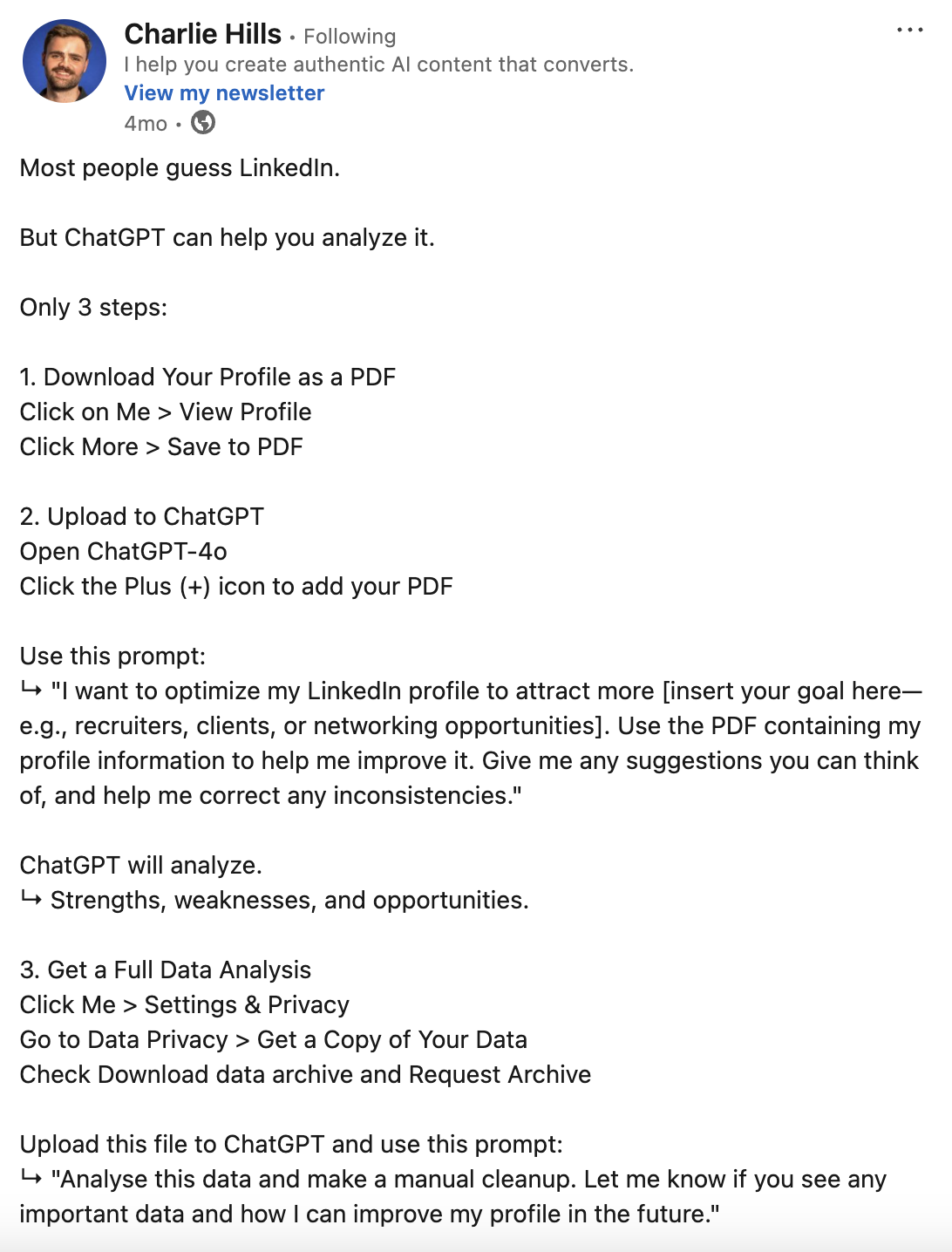
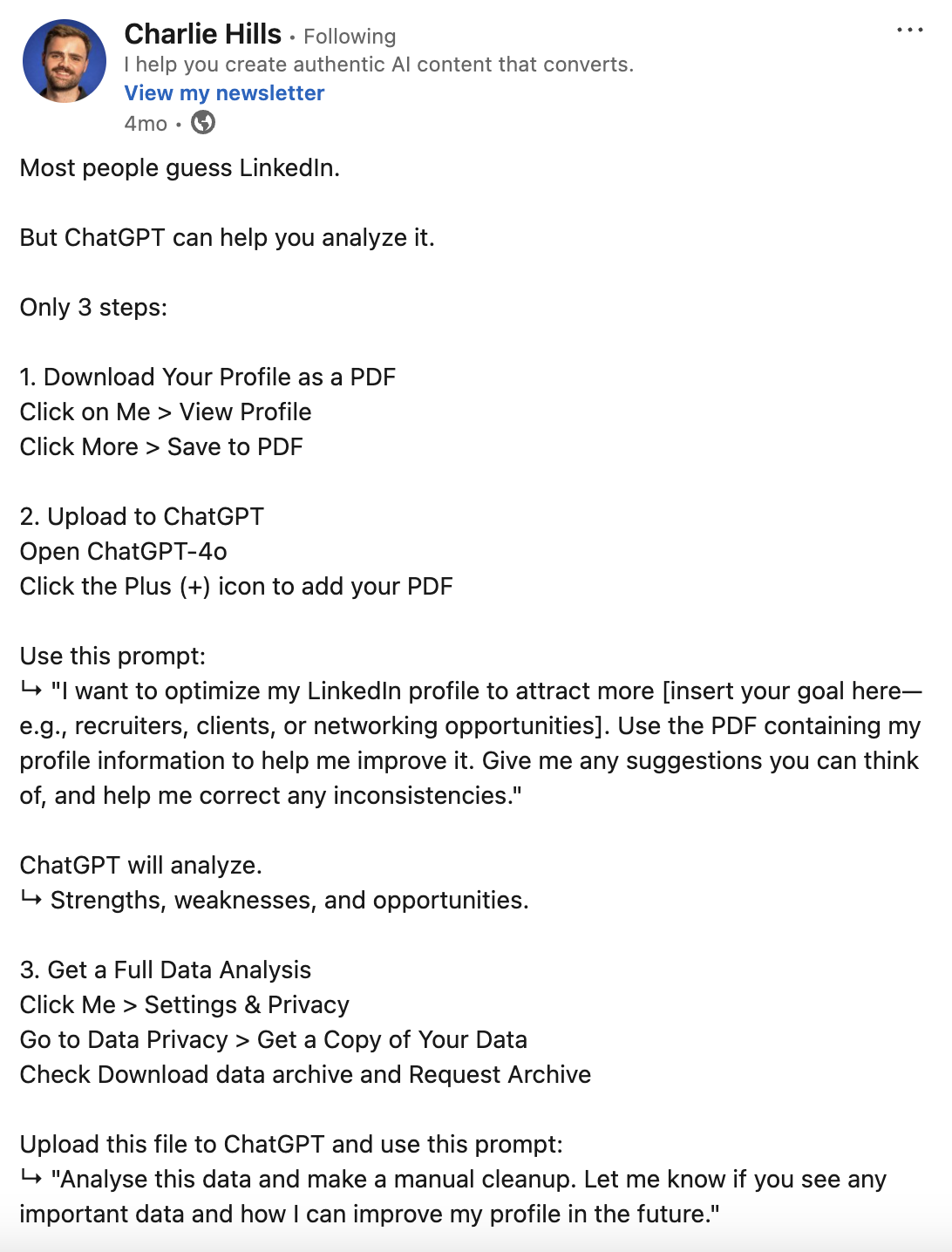
This is an interesting LinkedIn post because it’s actually a collaboration. Two LinkedIn influencers worked together to create a carousel and then both published it on their websites.
Therefore, it’s important to realize that the post format alone may not be what made this post so successful.
However, the content itself still follows an excellent, repeatable framework that anyone can use. Simply share an audit workflow or process that you use (ideally with AI).
Template:
Most people guess (repeatable task people in your industry perform).
But (insert AI tool) can help you analyze it.
Only 3 steps:
1. Step 1
Action item
Action item
2. Step 2
Action item
Action item
3. Step 3
Action item
Action item
(Include any specific prompts used)
Bonus: Visualise your connections’ companies and roles.
With (X AI tool), you get real insights – not just guesses.
Follow (name) + (influencer you collaborated with). Repost to help others.
Here’s the full post.
Template #15: Luke Matthews
Most LinkedIn posts tell people what they need to do, which can feel overwhelming.
This template tells people what they should quit.
You can tailor this template to your own industry. What should industry professionals quit doing? While this particular creator used it from an angle of how he’s dealing with burnout, this template could easily be applied to tactics that only produce subpar results.
Template:
2025 taught me how to quit.
In July, I quit X.
In August, I quit X
In September, I quit X
In October, I quit X
In November, I quit X
In December, I closed X
In 2025, I quit a lot of things.
I did not hit one million dollars in revenue.
↳ but I did not sell my soul for a big bag.
I quit my agency because X.
I quit a new course launch because X.
I quit the growth game X
I’m confident I made the right choice.
Here’s the full post.
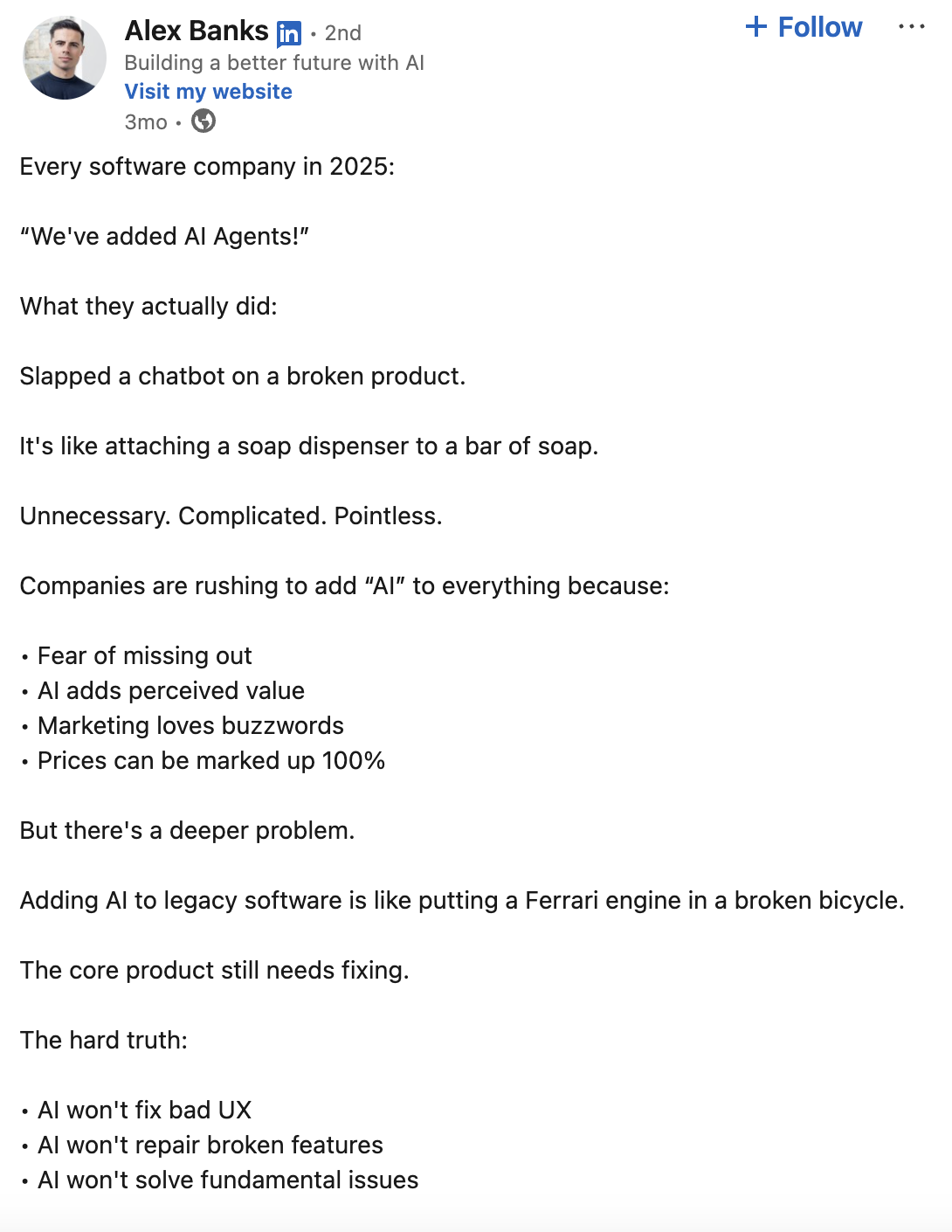
Template #16: Alex Banks
This post takes an overhyped trend and then calls out people who claim to leverage it, but aren’t actually improving results.
This is a great framework you can use for almost any overhyped trend, though it’s particularly effective for AI.
Think about overhyped trends in your industry. Then, you can use this framework to highlight a way many people are leveraging the trend that is ineffective.
Template:
Every (your industry) company in 2025:
“We’ve (how they’ve leveraged the overhyped trend)”
What they actually did:
(Explanation of what they’ve actually done which isn’t very effective)
Companies are rushing to (adopt trend) because:
- Reason 1
- Reason 2
- Reason 3
- Reason 4
- Reason 5
But there’s a deeper problem.
(explanation)
The hard truth:
My take:
(explanation of your take)
Follow me (name) for daily AI highlights and insights.
Want to start leveraging AI?
Subscribe to my newsletter: (link)
See full post here.
Template #17: Dan Go
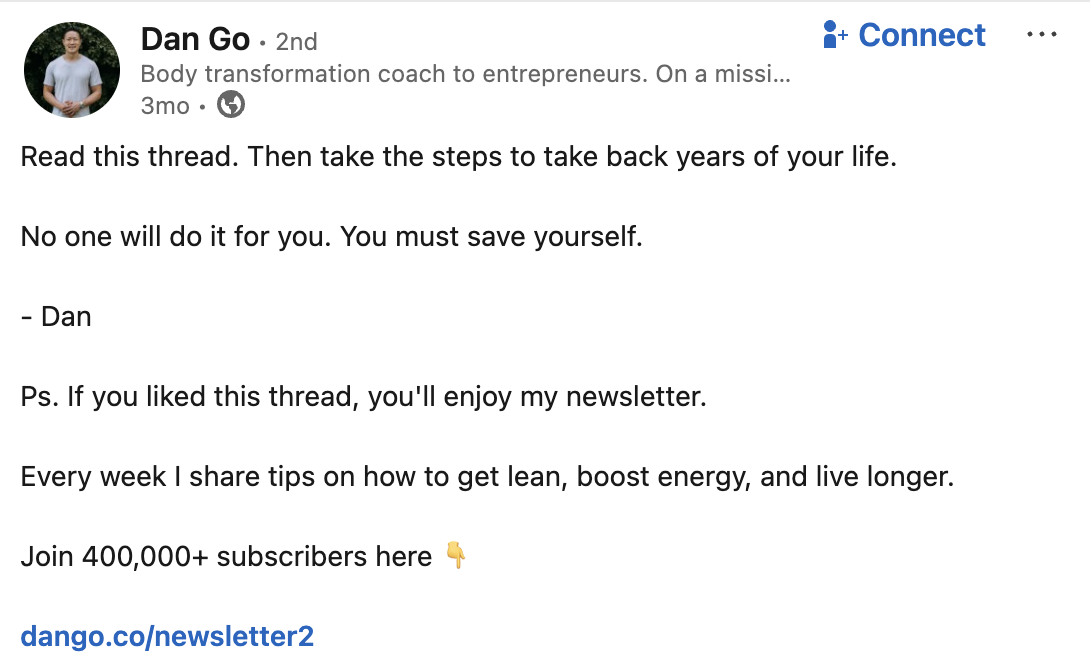
Dan Go has made a name for himself as the “fit founder” expert, and his top performing post is an X thread he repurposed on LinkedIn that discusses the dangers of phone addiction.
This post likely performed well because it touches on a topic everyone is aware and guilty of (chronic phone overuse) and breaks down the negative consequences of it using scientific data.
Then, he lays out a step by step framework to avoid phone overuse.
To duplicate this post, what’s a “bad habit” most people in your industry have? Then, lay out the negative consequences of it using data and provide a step by step solution.
Template:
This 2 minute thread will save you (significant yet real promise)
Intro: The average person (does bad habit)
The Consequence: How much is that bad habit costing that person?
Data: What data proves other negative consequences of that habit?
Additional Dangers of (Bad Habit):
- Danger
- Danger
- Danger
- Danger
- Danger
Symptoms of (Bad Habit)
- Symptom
- Symptom
- Symptom
- Symptom
- Symptom
How to break the habit:
Tip 1 + Explanation
Tip 2 + Explanation
Tip 3 + Explanation
Tip 4 + Explanation
Tip 5 + Explanation
Tip 6 + Explanation
Tip 7 + Explanation
Tip 8 + Explanation
Tip 9 + Explanation
Tip 10 + Explanation
See full post here.
Template #18: Charles Miller
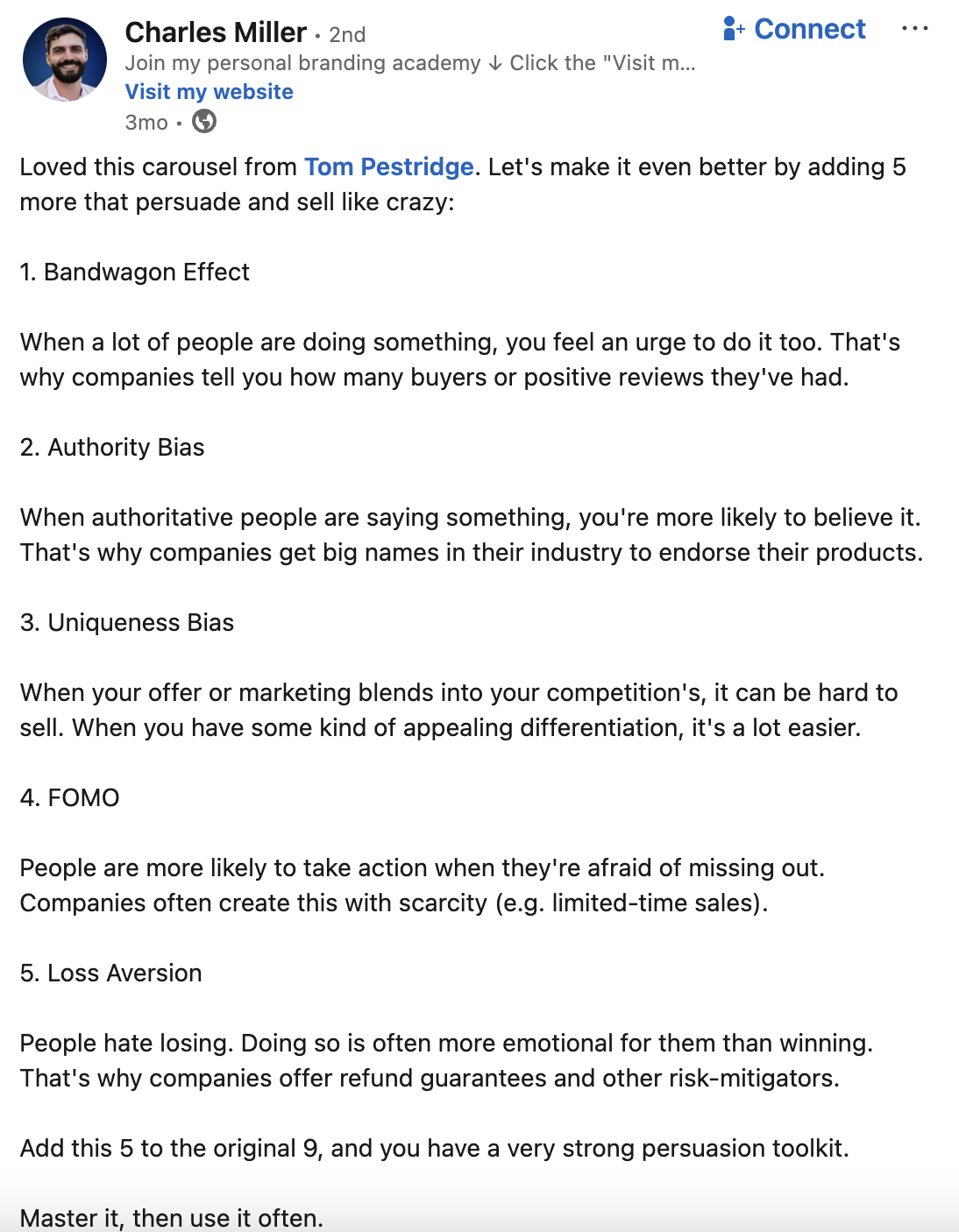
This is the top performing post from my business partner Charles Miller, and it’s actually a post he repurposed (with permission) from a friend and then added several of his own tips.
The post template is a fairly simple framework; eight persuasion frameworks.
However, it likely performed well because it features a well designed carousel that illustrates each persuasion technique. Specifically, they feature side by side scenarios – one scenario leveraging the and another that does not.
The contrast demonstrated with a visual makes it much more effective.
Template:
1. Framework #1
Explanation
2. Framework #1
Explanation
3. Framework #1
Explanation
4. Framework #1
Explanation
5. Framework #1
Explanation
6. Framework #1
Explanation
7. Framework #1
Explanation
8. Framework #1
Explanation
See full post here.
Template #19: Tony Jamous
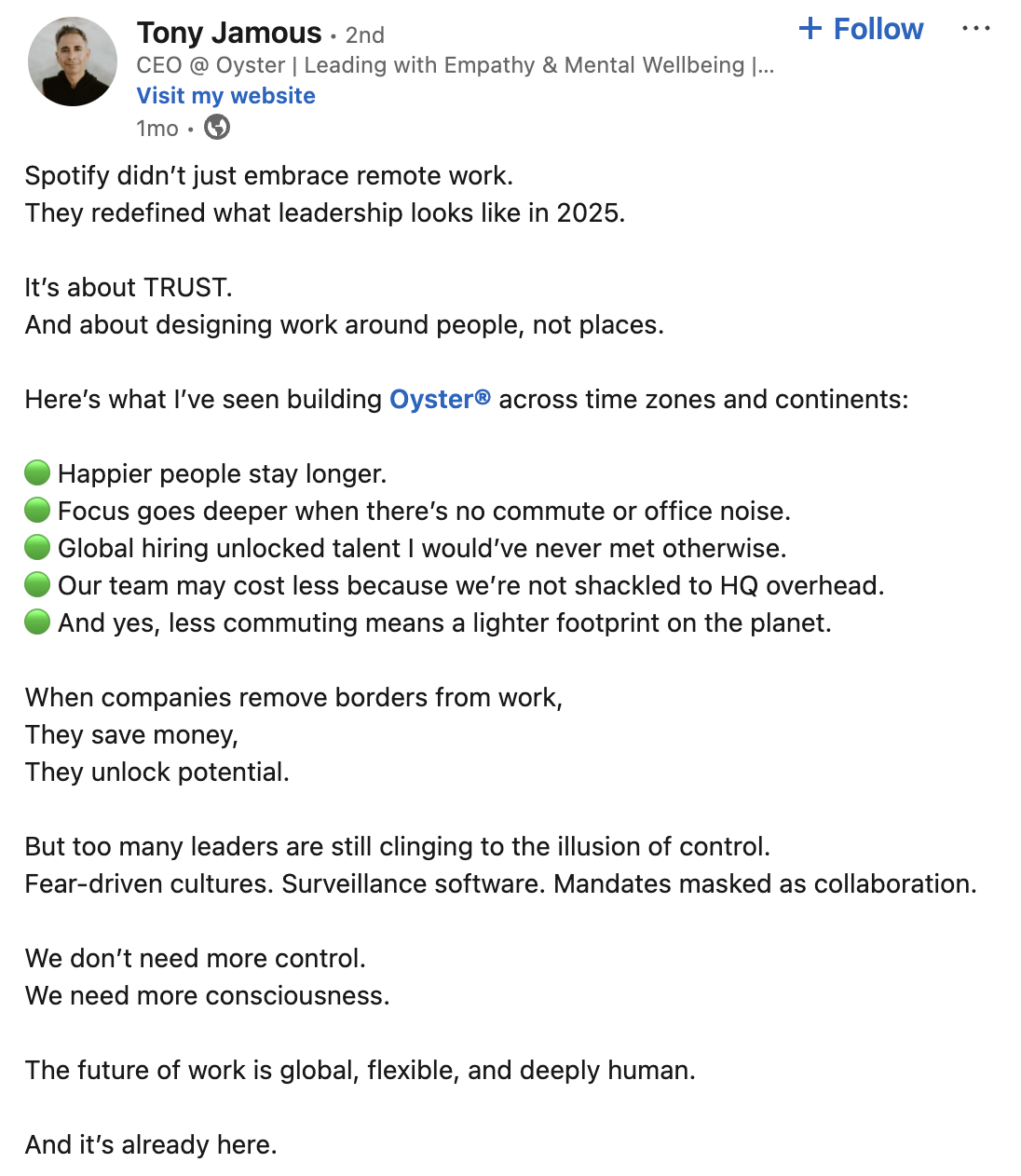
This post template identifies a framework used by a well known organization and then the author (Tony) shows how he uses that framework in his own organization and why it works.
Template:
(Organization) didn’t just (X)
They redefined what (Y) looks like.
It’s about (core philosophy).
Here’s what I’ve seen building (your brand) with a similar philosophy:
- Anecdote
- Anecdote
- Anecdote
- Anecdote
- Anecdote
When companies (execute philosophy):
- Benefit
- Benefit
Yet too many companies are clinging to (opposite of core philosophy).
The future of work is (core philosophy).
And it’s already here.
♻️ Repost if you believe in this shift
🔔 Follow me, (name), for more on (your area of expertise).
Check out the link in the comments for more.
See full post here.
Template #20: Dawn Choo
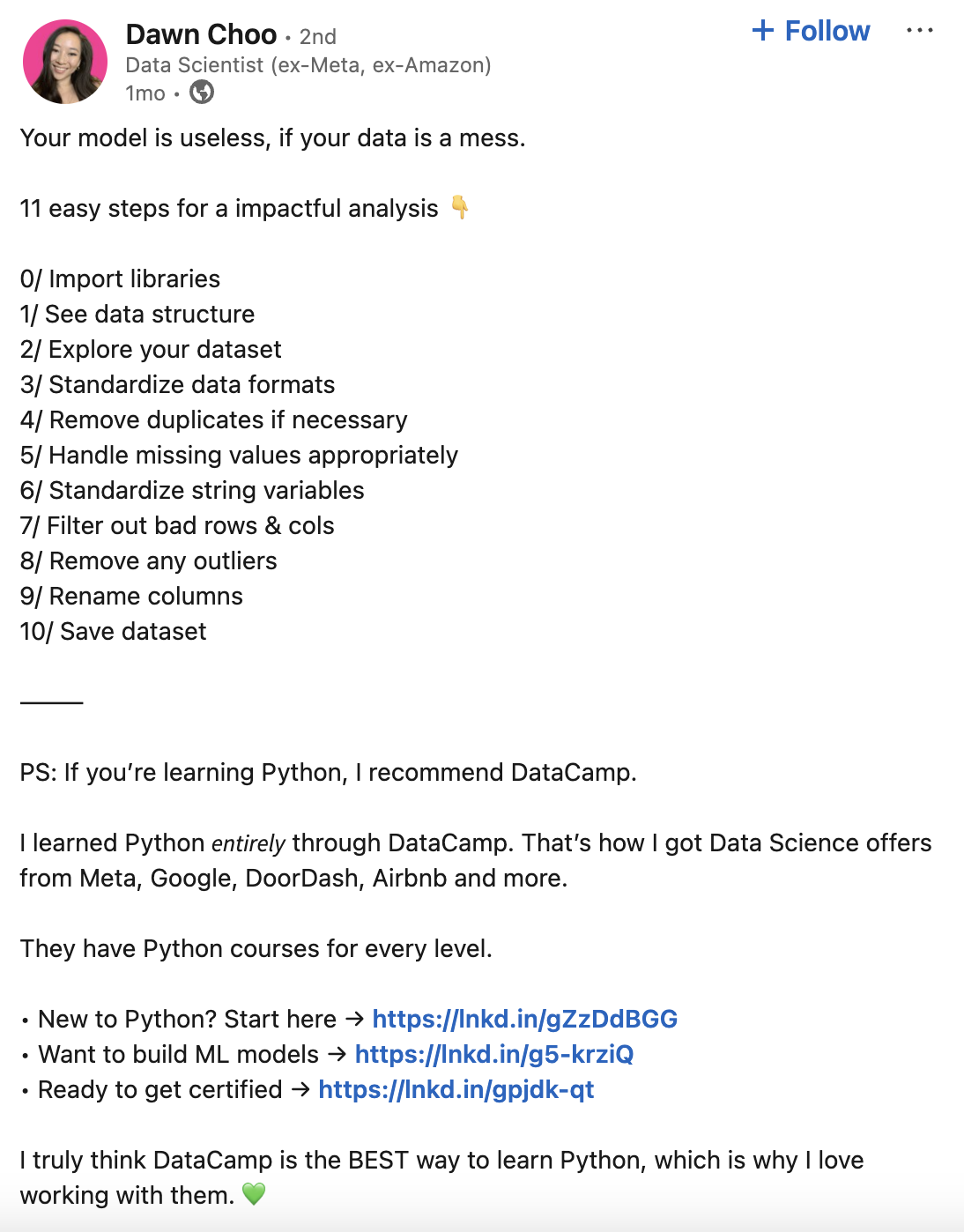
This post template is a cheat sheet and also includes a graphic with a visual representation of the cheat sheet.
The template is relatively straightforward – just identify an audit you execute repeatedly and then create a post that illustrates that process.
The key to succeeding with this particular template is also including a graphic of the audit.
Template:
Your (X) is useless, if your data is a mess.
11 easy steps for an impactful analysis 👇
- Step 1
- Step 2
- Step 3
- Step 4
- Step 5
- Step 6
- Step 7
- Step 8
- Step 9
- Step 10
Pain Point 1? Start here → (link to an offer)
Pain Point 2? Start here → (link to an offer)
Pain Point 3? Start here → (link to an offer)
See full post here.
Template #21: Mariya Valeva
This post template takes a topic that isn’t necessarily controversial, but does have divided opinions – remote work.
Then, Mariya explains her point of view on the topic and explains the benefits of her side of the argument.
To use this template, select a topic where there are divided opinions in your industry and then use your own personal experience to explain your side of the argument.
Template:
“(supportive quote for your side of the argument from an influencer)”
(Anecdote from your personal experience demonstrating that you agree)
Here’s what executing (your side of the argument) looks like:
- Specific detail
- Specific detail
- Specific detail
- Specific detail
- Specific detail
Here’s what happens when (people take your side of the argument):
- Benefit
- Benefit
- Benefit
- Benefit
- Benefit
The truth about (controversial topic):
What (controversial topic) really exposes:
1. Fundamental Principle
↳ Question
↳ Question
↳ Question
2. Fundamental Principle
↳ Question
↳ Question
↳ Question
3. Fundamental Principle
↳ Question
↳ Question
↳ Question
Remember:
X isn’t about Y.
It’s about Z.
The future of work isn’t about location.
It’s about delivering results.
Where do you stand on this?
♻️ Share this with leaders who trust their teams
And follow (name) for more

See full post here.
Template #22: Precious Obo
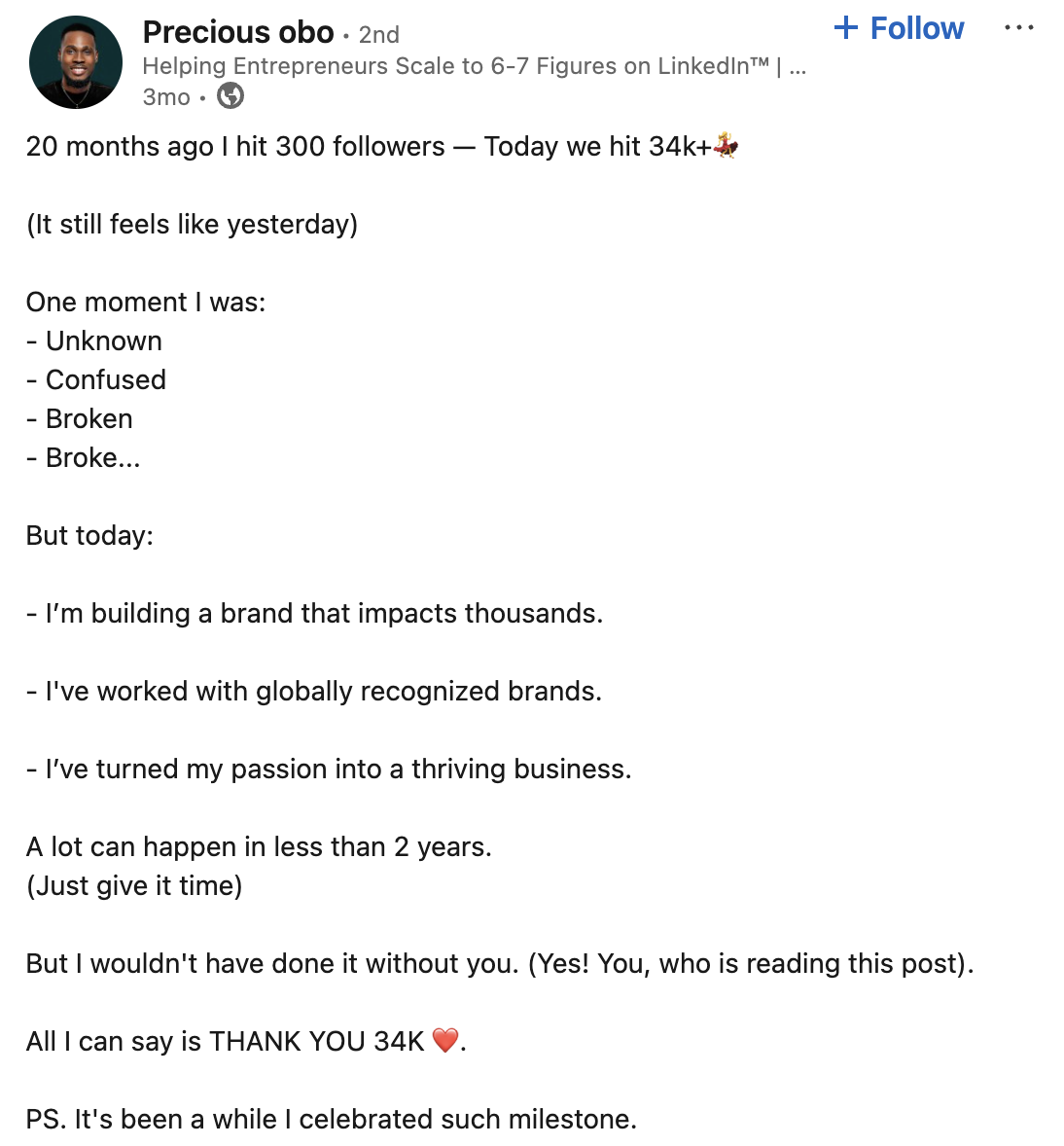
Sometimes the best LinkedIn posts are simply sharing milestones and what you learned from them.
Template:
X (time) ago I was at (number) – Today I hit (new milestone)
Before I felt:
- Emotion
- Emotion
- Emotion
- Emotion
Today:
- I’ve done X
- I’ve done Y
- I’ve done Z
A lot can happen in (timeframe).
(Expressing your gratitude to your followers)
See full post here.
Template #23: Anna York
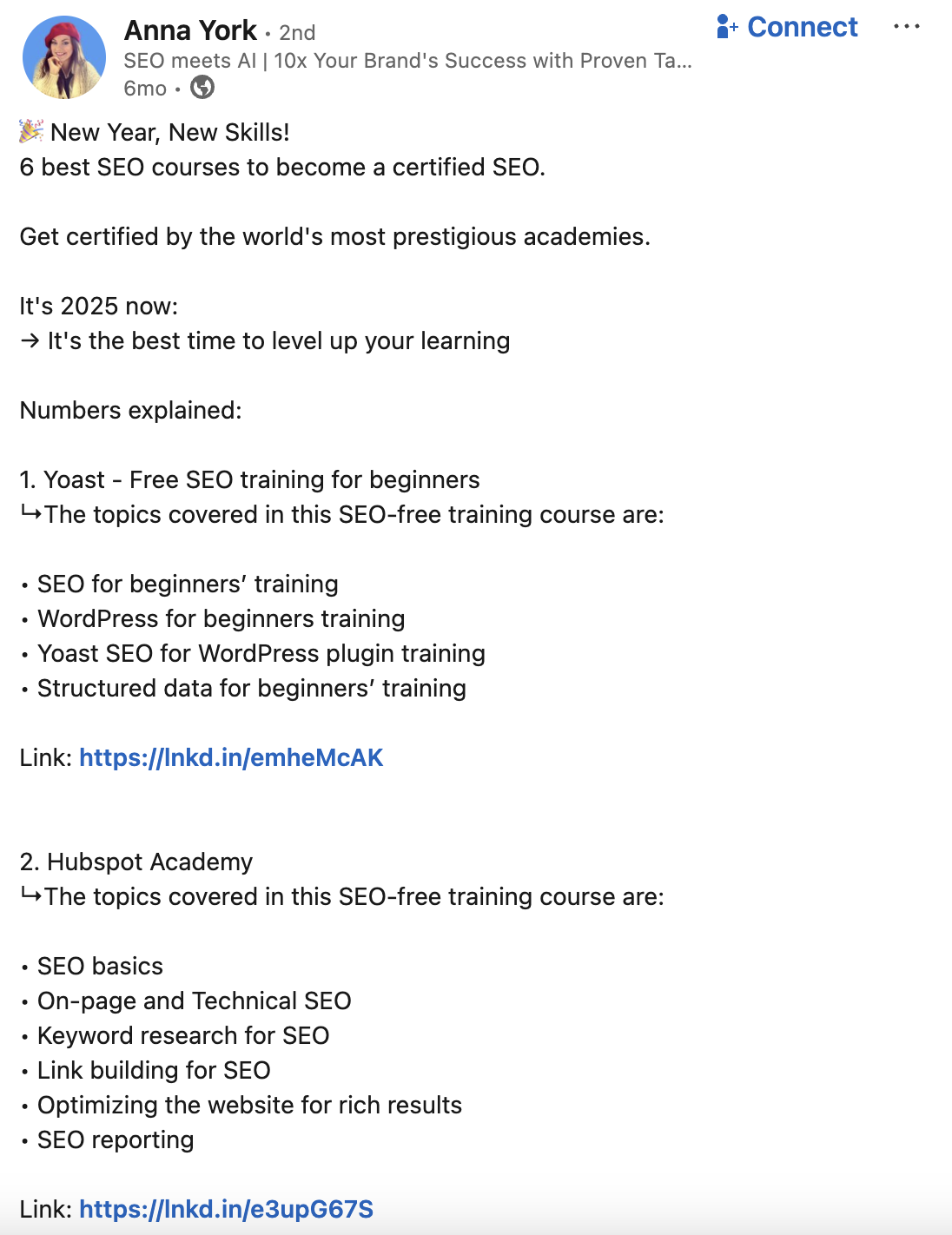
Sometimes the most successful LinkedIn posts simply share a handful of different educational resources. These could be courses, guides, blog posts, templates or really any content that people can use to level up their skillset.
The key is to explain how each course differs from the others and what people can expect to learn.
Template:
6 best (industry) courses to become a certified (professional).
Numbers explained:
1. Course – (1 liner description)
↳The topics covered in this training course are:
Link:
2. Course 2 – (1 liner description)
↳The topics covered in this training course are:
Link:
2. Course 3 – (1 liner description)
↳The topics covered in this training course are:
Link:
2. Course 4 – (1 liner description)
↳The topics covered in this training course are:
Link:
2. Course 5 – (1 liner description)
↳The topics covered in this training course are:
Link:
2. Course 6 – (1 liner description)
↳The topics covered in this training course are:
👉 Get certified and become a (X) expert in 2025.
Happy learning! 🙋♀️
P.S. Follow me, (name), for more content like this.
See full post here.
Template #24: Dan Koe
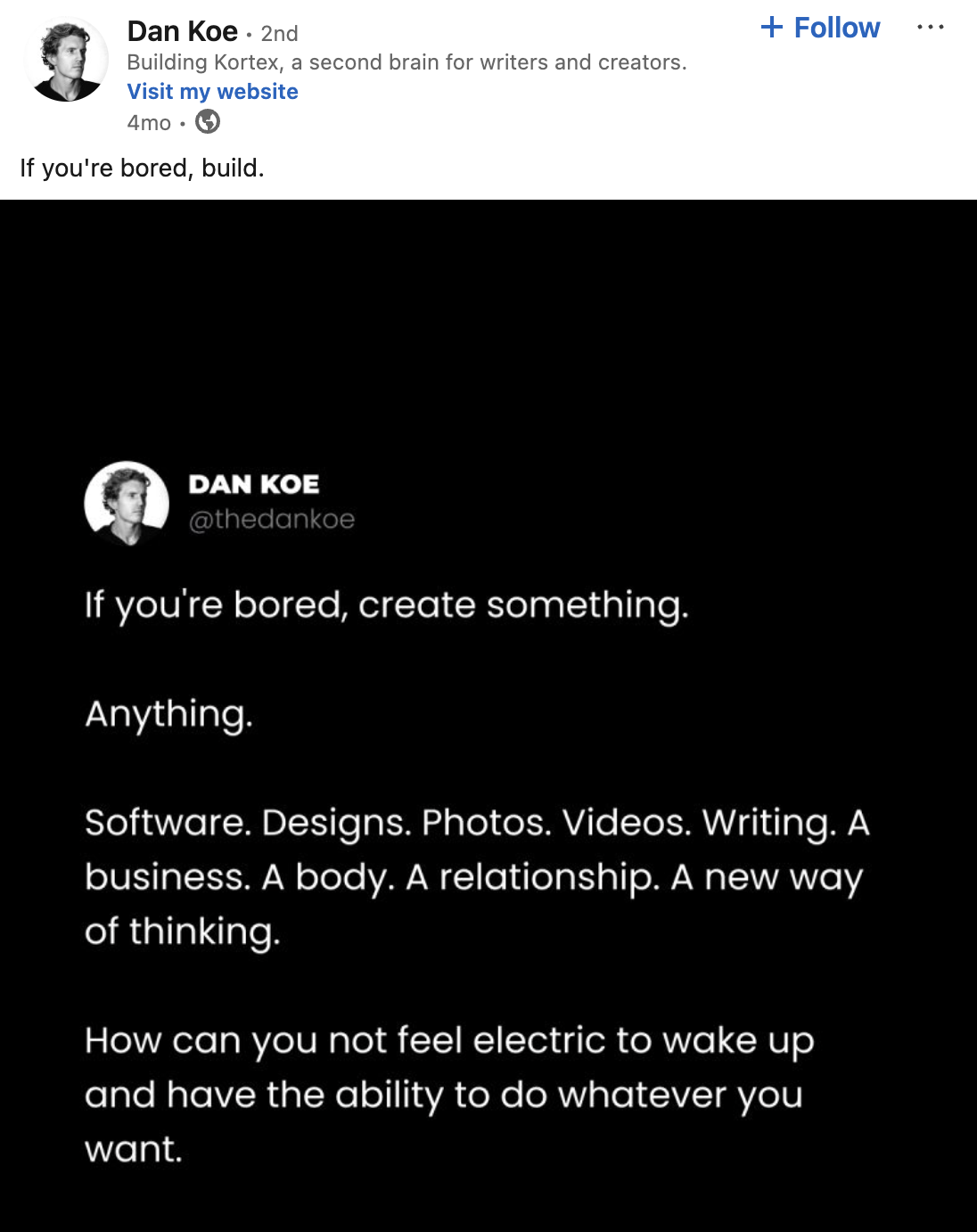
This template is another Tweet that was repurposed into a LinkedIn post.
To implement this template, think of a negative emotion or circumstance that people in your industry experience and then turn it into an action that solves the negative emotion.
Template:
If you’re feeling (negative emotion) do (general action item).
This could be:
- Specific action item
- Specific action item
- Specific action item
- Specific action item
- Specific action item
See full post here.