

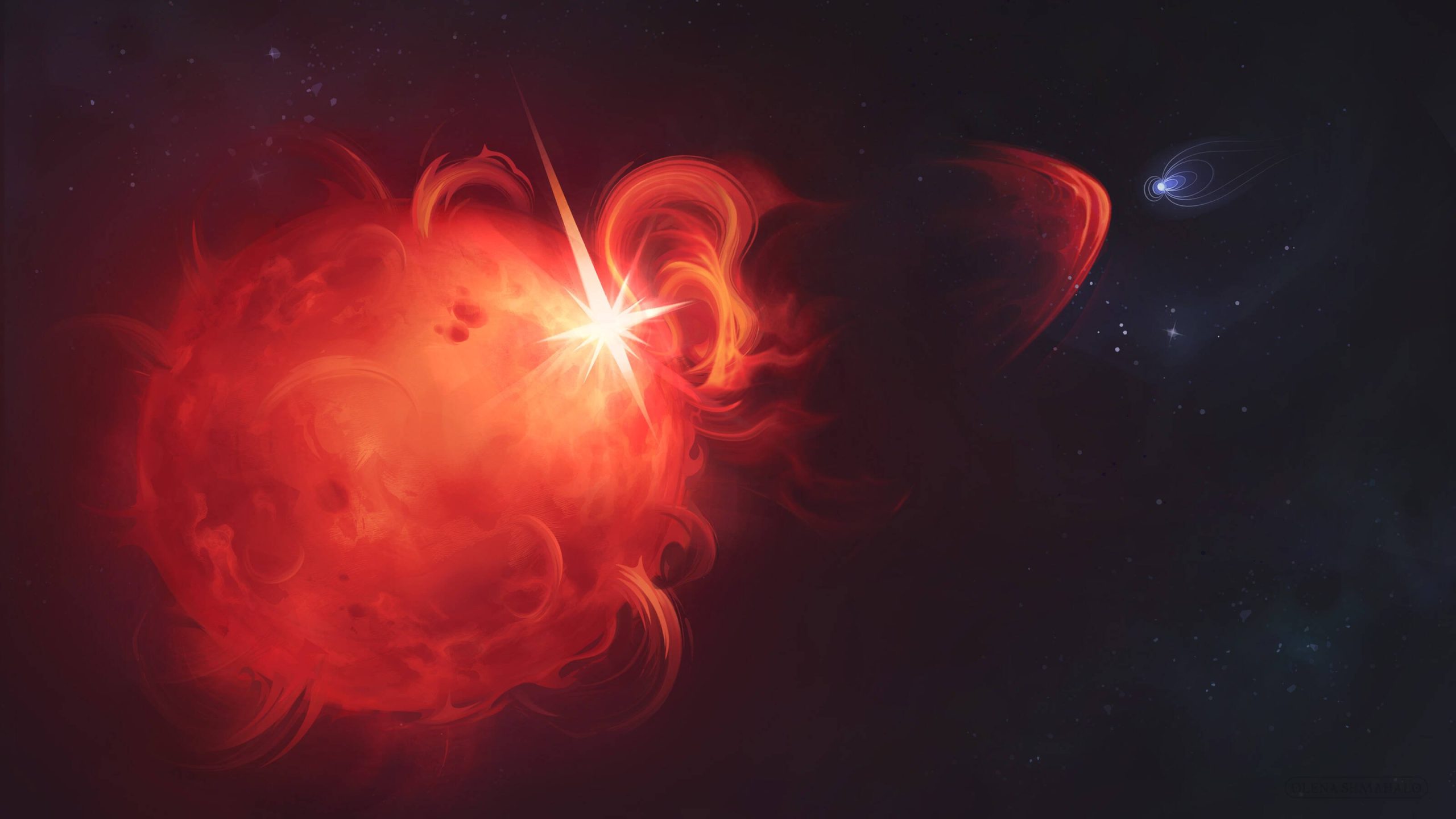
Astronomers have made the first definitive observation of a Coronal Mass Ejection (CME) on a nearby star.
CME events are a regular occurrence at our sun. Massive amounts of material are emitted and flood nearby space. Some can create the dazzling auroras seen in the sky from Earth as they interact with the magnetosphere, but they can also negatively impact space weather and disrupt spacecraft.
CMEs can erode the atmosphere of planets too, but until this observation, researchers had to extrapolate their understanding of the Sun’s CMEs to other stars.
“Previous findings have inferred that they exist, or hinted at their presence,” said Joe Callingham of the Netherlands Institute for Radio Astronomy (ASTRON), author of the new research published in Nature, “but haven’t actually confirmed that material has definitively escaped out into space. We’ve now managed to do this for the first time.”
The CME was determined to be moving at 2,400 km per second – a speed only seen once in every 2,000 CMEs from the Sun – and was both fast and dense enough to completely strip away the atmospheres of any planets closely orbiting the star.
A planet’s habitability for life as it is understood on Earth depends on whether or not it is situated within the star’s ‘habitable zone’ – somewhere where liquid water and an atmosphere can exist. However, if a planet is bombarded with powerful CMEs, it might lose its atmosphere entirely despite its orbit being ‘just right’.
The radio signal generated by the CME was detected by the Low Frequency Array (LOFAR) radio telescope. “This kind of radio signal just wouldn’t exist unless material had completely left the star’s bubble of powerful magnetism,” said Callingham, “In other words: it’s caused by a CME.”
The European Space Agency’s (ESA’s) XMM-Newton telescope was then used to determine the star’s temperature, rotation, and brightness in X-ray light. The report notes, “This was essential to interpret the radio signal and figure out what was actually going on.”
The CME flinger was a red dwarf, as are many stars in the Milky Way that have planets orbiting them. It has roughly half the mass of the Sun, rotates 20 times faster, and has a magnetic field 300 times more powerful. It’s also 130 light years from here.
Henrik Eklund, an ESA research fellow based at the European Space Research and Technology Centre (ESTEC) in Noordwijk, the Netherlands, said, “It seems that intense space weather may be even more extreme around smaller stars – the primary hosts of potentially habitable exoplanets.
“This has important implications for how these planets keep hold of their atmospheres and possibly remain habitable over time.”
ESA’s XMM-Newton x-ray space observatory is one of the agency’s longest-lived missions, launched in 1999 and currently funded through 2026. However, when The Register spoke to the team in 2020, the hope was that the spacecraft could be kept operating into the 2030s.
ESA XMM-Newton Project Scientist Erik Kuulkers said, “XMM-Newton is now helping us discover how CMEs vary by star, something that’s not only interesting in our study of stars and our Sun, but also our hunt for habitable worlds around other stars.
“It also demonstrates the immense power of collaboration, which underpins all successful science. The discovery was a true team effort, and resolves the decades-long search for CMEs beyond the Sun.” ®

