



I have used Google Forms for a range of use cases: internal surveys, quick lead capture, and simple event registrations. It does the job. You set up a form, share the link, collect responses, and move on. That works until the form needs to do more.
Maybe you are a marketer trying to route leads into a CRM. Or an ops team managing approvals across tools. Or you are running an event and need to collect payments without any hassle. That’s where Google Forms starts to feel limited.
That’s also when Jotform enters the picture.
At a surface level, both tools solve the same problem. Moreover, both are ranked #1 in their respective categories of Survey software and Online form builder. However, in practice, they serve different stages of the same problem.
Google Forms fits when speed and simplicity matter more than control. Jotform makes sense when your forms are tied to workflows, payments, or other systems. I have used both across different use cases, from basic surveys to more structured forms. The differences show up fast once your requirements grow.
The G2 Data clearly reflects that split. Google Forms holds a 4.6/5 rating, with 94% for ease of use and 94% for ease of setup, which matches its strength as a fast, familiar tool for simple forms. Jotform has a slightly higher 4.7/5 rating, with 93% for ease of use and 93% for ease of doing business, showing why it appeals to teams that need more flexibility without making form building feel too complex.
In this blog, I’ll share how these two platforms measure up and where each of them stands apart.
Here’s what I found after using both: Google Forms is great when you want to move fast and keep things simple. Jotform works better when your form is part of a workflow.
- Google Forms is built for speed and zero cost. It works well for internal surveys, quick feedback loops, and simple data collection. This lines up with user feedback across G2 reviews, where ease of use and accessibility consistently rank as top strengths. At the same time, users often point out limits around customization, logic, and the lack of native payment support.
- Jotform is built for more involved use cases. Across G2 reviews, there have been strong mentions of flexibility, templates, and features like payments and conditional workflows. That reflects what I saw during testing. It handles more complex requirements without workarounds, but introduces limits on the free plan and a slightly heavier setup.
Google Forms vs. Jotform: At a glance
Here’s a comparative table to bring clarity to the differences between Jotform and Google Forms:
|
Feature |
Google Forms (Google Workspace) |
Jotform |
|
G2 rating |
4.6/5 |
4.7/5 |
|
Best for |
Quick and free survey software |
Business forms, workflows, and payments |
|
Ease of use |
Very easy |
Easy, with a slight learning curve |
|
Setup speed |
Fast for basic forms |
Slightly slower due to more options |
|
Customization |
Basic layout and theme-level customizations |
Extensive customizations, including advanced customization using CSS, JavaScript, and HTML |
|
Templates |
17 basic templates |
20,000+ free templates categorized according to type, profession, and industry |
|
Logic |
Basic branching |
Advanced conditional logic |
|
AI form builder |
Creates structured and complete forms |
Creates functional but basic forms |
|
AI voice support |
Not available |
Available; forms can be created using voice commands |
|
Integrations |
Best within Google Workspace, add-ons like Payable Forms, and automation tools like Zapier |
Strong, third-party 200+ integrations across 20+ categories |
|
Form import |
Not supported |
Migrates forms from Google Forms |
|
Analytics |
Simple AI summaries and charts/graphs
|
More detailed reporting and insights using the report builder |
|
Payments |
Requires add-ons like Payable Forms |
Built-in payment options like Google Pay, Apple Pay, PayPal, Stripe, etc |
|
Notifications |
Basic notification alerts |
Notification alerts (on by default) and custom autoresponders |
|
Mobile features |
Browser-based access |
Mobile app and kiosk mode |
|
Security |
Strong core protections like GDPR compliance, SSL compliance, encryption, HIPAA compliance (with paid Workspace plan), and two-factor authentication |
Strong protections with more advanced options, such as encrypted forms with unique access codes for end-to-end protection, password protection, and HIPAA compliance with Gold+Enterprise plans |
|
Support |
Help center, Workspace resources, online community, and 24/7 online support (only for paid users) |
Help center, academy, 24×7 support, and training resources |
|
Pricing |
Free; can be used with both Google Workspace and a personal Google account
|
Free; can be used with a personal email address as well
Discounts for students, NGOs, educators, and G2 users. |
|
Learning curve |
Minimal |
Moderate |
|
Overall fit |
Better for simple internal forms |
Better for advanced form workflows |
Note: These details are based on the capabilities as of May 2026 and are subject to change with new rollouts.
Google Forms vs. Jotform: What’s different and what’s not?
Both tools let you build forms and collect responses without much effort. They are accessible through a browser, easy to share, and don’t require technical knowledge to get started. That’s where the overlap sits.
What are the key differences between Google Forms and Jotform?
In my experience, Google Forms are extensively used by organizations to collect feedback/opinions. Educational institutions, such as schools, colleges, and coaching centers, heavily rely on Google Forms to create short questionnaires or tests. The reason is simple: ease of use.
However, Jotform is built for the next step: when you require payments, product listings, or time slot selection from the calendar.
Here are some differences I came across while exploring the two software:
- Template library: This is one of the clearest differences between the two products. Google Forms offers 17 templates, which work well for straightforward needs. Jotform, by contrast, provides 20,000+ free templates designed for a wide range of use cases. These templates are organized by type, profession, and industry, making it easier to find options for registrations, applications, lead capture, and more. This broad library reduces the time required to build forms from scratch.
- Form migration: Jotform includes form migration capabilities that allow users to import forms by connecting to tools such as Google Forms. This makes it easier to transfer existing questions and structure into Jotform. Google Forms does not offer a built-in migration feature to import forms from other platforms.
- Customization: Both Google Forms and Jotform offer customization options, but the level of flexibility differs. Google Forms allows users to adjust brand colors and add a header image, but the overall structure remains fixed. Forms follow the same vertical layout, with limited control over field arrangement. Jotform offers more flexibility by allowing users to change layouts, adjust spacing, and create multi-step forms. It also supports advanced customization through CSS, JavaScript, and HTML, giving developers significantly more control than Google Forms’ theme-level options.
- Reporting and analytics: Google Forms includes basic summary charts and graphs for response analysis. Jotform offers more advanced reporting through features such as Form Analytics and Report Builder, making it better suited for more data-heavy or insight-driven use cases.
- Mobile and advanced features: Jotform offers a dedicated mobile app, including kiosk mode for in-person data collection. Google Forms is accessible through mobile browsers, but it does not offer a dedicated mobile app or offline functionality.
- Integrations: Google Forms offers extensive integrations with other Google Workspace products, but falls short in third-party integrations. However, a handful of platforms offer Google Form integration, such as Zapier. Jotform provides integrations across 20 categories, including CRM, data management, email, SSO, and more. Moreover, Jotform also offers integration with ChatGPT to create forms. In my view, a tech-savvy person will enjoy these integrations, especially when organizational needs demand in-depth integration. In terms of scale, Jotform supports 200+ integrations, whereas Google Forms relies heavily on add-ons for extended functionality.
- Payments: With Google Forms, there’s no native way to collect payments, which means you have to rely on external tools or add-ons like Payable Forms. This can disrupt the user experience. Jotform handled payments natively. Setup took a few minutes, and the payment step fit directly into the form flow.
- Security: Both platforms offer strong security features like GDPR compliance, encryption, and two-factor authentication. However, Jotform offers additional options, such as encrypted forms with unique access codes for end-to-end protection, that Google Forms does not.
- Conditional logic: Google Forms supports branching, but only at a basic level. Once I tried building layered conditions, it became harder to manage. There’s no clear way to view all logic paths at once. Jotform uses a rule-based system where conditions stay visible. I could define multiple conditions and shape the flow more naturally. This makes it easier to build and edit forms over time. Additionally, Jotform allows calculations and dynamic value updates within forms, whereas Google Forms only supports section-based navigation logic.
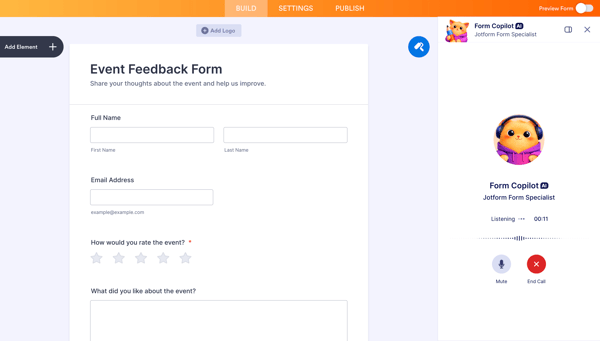
- Voice commands: Jotform supports built-in AI voice agents to assist with form building. I simply had to tell the Copilot AI what kind of form I wanted, and it built it within a minute. Moreover, I found the AI voice agent quite advanced, as the interface was a call, which kept the conversation going. However, Google Forms has yet to introduce this feature.
- Customer support: Although both platforms offer help resources, including documentation, FAQs, and community forums. Jotform goes further with training via Jotform Academy, while Google provides learning through its broader ecosystem and certifications. On top of that, Jotform also has 24/7 customer support, an AI support agent, and dedicated support for enterprise accounts.
What are the key similarities between Google Forms and Jotform?
No matter the differences, the two platforms also share a good number of similarities, such as:
- Core form building: Google Forms and Jotform support a range of question types, including multiple-choice, checkboxes, short-answer, dropdowns, and file uploads within the form template. They include sections to organize questions logically, improving form structure. Both tools also allow importing questions and reusing existing form elements, which helps speed up form creation.
- SaaS-based platform: Both are cloud-based platforms that allow you to create forms and save them within the platform’s cloud. This eliminates the need to download and store the forms on your device. This also ensures automatic updates and accessibility across devices without manual installation.
- Collaboration and sharing: Both platforms support collaboration. Multiple users can edit the forms simultaneously, which works well for teams. Forms can be shared via links, embeds, or email, and both are mobile-optimized for access on any device.
- Response handling: Responses are automatically collected and displayed in real time, with options for summary analytics and export. Both integrate with tools like Zapier for further automation. Both platforms also allow exporting responses to spreadsheets (Google Sheets for Google Forms and Jotform Tables), enabling further data analysis.
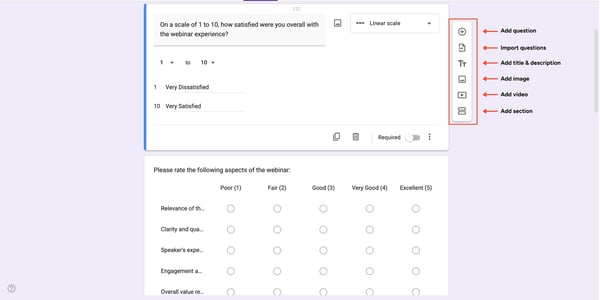
- YouTube video insertion: A peculiar similarity I noticed was the use of YouTube videos. Both Google Forms and Jotform offer options to insert YouTube videos within the form. In Google Forms, you can insert YouTube videos via the “Add video” option. On the other hand, Jotform provides a dedicated YouTube widget within its features to add videos from the platform.
- Notifications and autoresponder emails: Both platforms offer notification emails. The only difference is that it’s a default setting in Jotform, but has to be enabled manually in Google Forms. They also offer autoresponder emails, but Google Forms provides the feature via add-ons or third-party services.
- Automation and form control: Both Google Forms and Jotform support automatic form closure based on submission limits or deadlines.
How I compared Google Forms and Jotform: My evaluation criteria
To compare Google Forms and Jotform fairly, I tested both platforms using real-world scenarios that reflect how people actually use online form builders at work and in everyday life. I used the free versions of these tools first and relied on G2 Data to obtain reliable and trusted information on how these platforms perform for businesses of different sizes.
Tasks I performed:
- Build a simple feedback form
- Use their native AI agents for building a form
- Add elements within the form
- Data export and reporting
- Build a donation form
I evaluated each task based on:
- Accuracy: Did the form behave as expected?
- Ease: How quickly could I build and publish?
- Flexibility: Could the form adapt to different needs?
- Usability: Could I use the output without extra work?
To validate these observations, I cross-checked patterns in user reviews. The Jotform dataset showed strong satisfaction around flexibility and features, while Google Forms feedback leaned heavily on simplicity and speed.
Disclaimer: Feature availability and pricing for both Google Forms and Jotform may vary based on platform, plan tier, device, and recent product updates. The results and observations in this article reflect hands-on testing conducted as of May 2026 and represent an individual opinion. They do not reflect G2’s position on the mentioned software’s likes and dislikes.
Google Forms vs. Jotform: How they actually performed in my tests
This is where the differences become clearer. Each task exposed a different strength or limitation. Being free tools, both are free to use and can be easily evaluated. And that’s exactly what I did. Here is how each of them performed in my tests.
1. Building a quick feedback form
I started with a basic feedback form with five questions to to test how quickly each tool handles simple, everyday use cases, such as internal surveys or quick feedback collection.
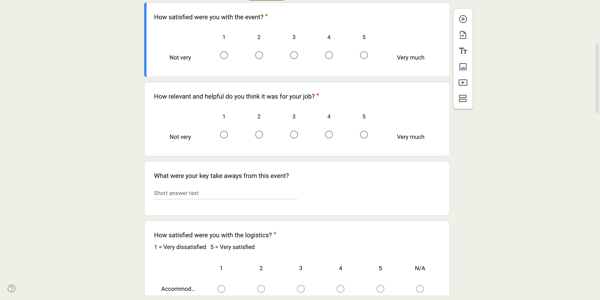
Google Forms handled this almost instantly. I opened it, added questions, and shared the link in under five minutes. The questions were stacked vertically, with simple response options such as linear scales and short-answer options. Adding or editing a question was just a click away, and the toolbar on the right kept everything accessible without clutter. I was able to move quickly from one question to the next without any distractions.
The minimal interface of Google Forms worked in its favor.
Jotform took slightly longer because of more options in the builder. Templates, layouts, and settings slowed me down slightly. The interface was more feature-rich, with a left-hand panel full of elements, including headings, email fields, date pickers, and more. The central canvas was more customizable, and even a simple feedback form included styled rating scales and dropdowns. It wasn’t difficult, but it did require a moment to adjust.
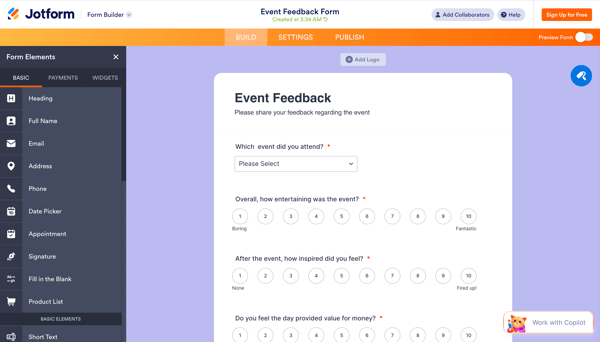
While both worked well, I found Google Forms straightforward and easier to navigate. It was quick, clean, and the sample questions were close to what I had in mind for the feedback form. As for Jotform, I found the interface quite intuitive, but it felt feature-heavy for a first-time user like me.
Winner: Google Forms
2. AI-assisted form creation
For my next test, I decided to test the two platforms’ AI capabilities for form creation. Google Forms, like other Google Workspace products, works with Gemini. On the other hand, Jotform relies on Jotform AI (Copilot AI) for its form-building endeavors.
I gave the same command to the AI: Create a feedback form for an online webinar, “How to utilize AI agents in 2026?“
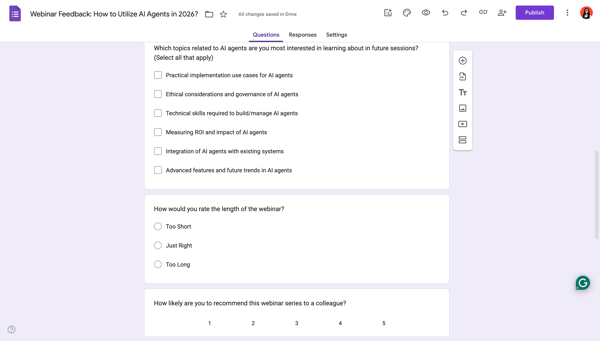
Google Forms created a comprehensive form that covered almost all the aspects an event organizer would want to know. This impressed me.
It included a mix of question types, linear scales, multiple-choice options, and checkbox-based questions, covering areas like satisfaction, content relevance, future interests, and recommendations. What stood out to me was how specific and guided the questions were, making it easier for respondents to answer quickly without needing to type long responses.

But I couldn’t say the same for Jotform. It created a simple form with only 5 questions with essential fields like name, email, ratings, and a few open-ended questions. While the structure was clean and usable, the questions felt broader and more text-heavy. It leaned more toward descriptive answers rather than quick selections, which could increase effort for respondents.
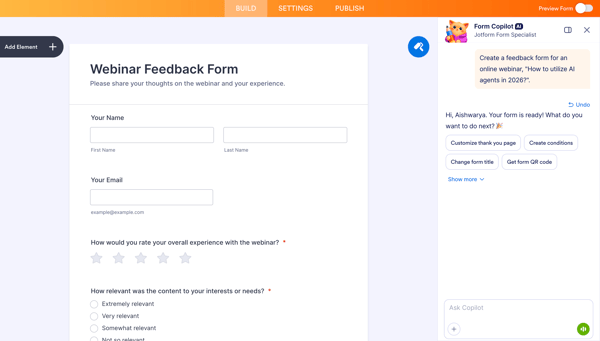
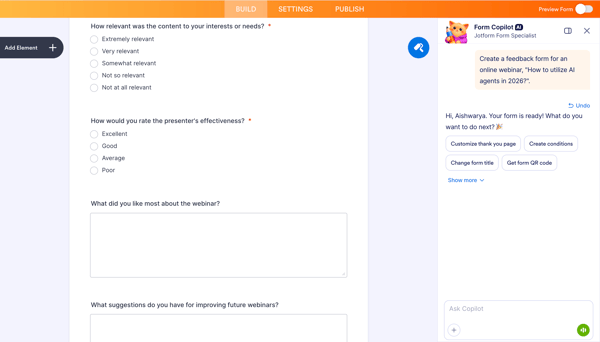
Where Jotform stood out more was in how the AI experience worked. Its Copilot AI felt more interactive, and I was also able to use voice commands to describe the form and make changes conversationally. That made the workflow feel faster and more natural, especially if the goal is to build or revise a form without relying as much on manual drag-and-drop. I could not find a comparable voice-based experience in Google Forms, where the process still felt more text- and click-driven.
In my view, Google Forms, with its thoughtful question framing, was able to generate a well-rounded, ready-to-use feedback form on the first attempt. I also felt that it went a step ahead in understanding how users prefer to answer by keeping questions option-based and specific.
In comparison, the form created by Jotform AI was functional but basic. It required additional tweaks or back-and-forth with the AI to reach the same level of completeness. However, Jotform made the process feel more flexible and conversational, especially with voice input layered into the experience.
Winner: Split; Google Forms created a more complete form on the first pass, while Jotform offered a more interactive AI-assisted building experience.
3. Form elements
Form elements are one of the clearest points of difference between Google Forms and Jotform.
Google Forms’ element set is intentionally narrow. The editor mainly gives you a short vertical toolbar for adding a question, importing questions, inserting a title and description, adding an image or video, and creating a new section. That keeps the interface clean and easy to learn, but it also signals the platform’s limits.
The simplicity works well when the goal is speed. For basic registrations, surveys, quizzes, and feedback forms, Google Forms covers the essentials without overwhelming the user. The limited set of building blocks can actually be an advantage for teams that do not want to spend time exploring advanced features and just need something functional that connects smoothly with Google Sheets.
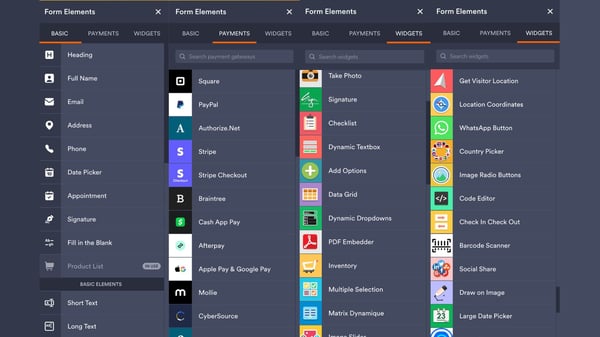
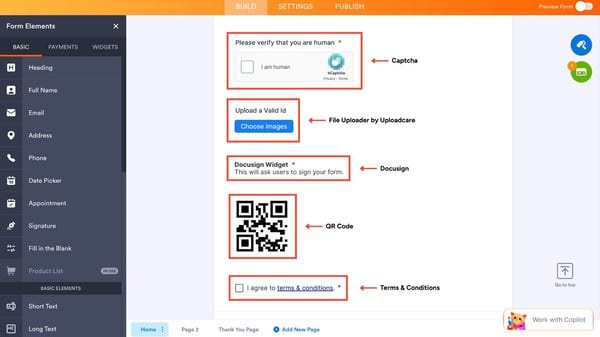
Jotform, on the other hand, felt far more expansive when I explored its form elements. Instead of a small editing toolbar, Jotform opened up entire categories of elements across Basic, Payments, and Widgets. Even the standard field library was broader, and once I moved into Payments and Widgets, the range became much more substantial.
I could see dedicated payment options like Square, PayPal, Authorize.Net, Stripe, Apple Pay, and more, along with widgets such as signature capture, HIPAA test, dynamic text boxes, dropdown tools, PDF embedding, barcode scanning, image radio buttons, social sharing, and location-based tools.
Based on my analysis, keep Google Forms for basic data collection, such as feedback, internal surveys, event RSVPs, and quick quizzes, where the priority is low setup cost, zero licensing fees, and seamless integration with Google Sheets.
Use Jotform to create more complex, mission‑critical workflows, such as lead‑capture forms with conditional logic, payment‑enabled registration and booking forms, and HIPAA‑aligned intake forms, where richer fields, branding, advanced logic, and compliance features justify its paid tiers.
Winner: Jotform
4. Data reporting and analytics
Publishing the form is half the battle won. The most important step is data consolidation, visualization, and reporting. This test was particularly important as it revealed how small differences in form design and tool choice directly impact data quality, completeness, and downstream analysis. Raw responses can only be turned into actionable insights when data is structured, cleaned, and effectively visualized.
After receiving respo