


Introduction
The Tax Cuts and Jobs Act (“TCJA”), handed in December of 2017, enacted an necessary provision that has supplied vital adjustments to the therapy of analysis and experimental (“R&E”) or analysis and developmental (“R&D”) expenditures beneath Inside Income Code (“IRC”) Part 174. Underneath the TCJA, for quantities paid in tax years starting after December 31, 2021, United States-based R&E expenditures should be capitalized and amortized over a 5-year interval, whereas overseas R&E prices, outlined as bills incurred exterior of the U.S. primarily based on the situation the actions befell, should be capitalized and amortized over a 15-year interval.
Previous to the TCJA, taxpayers had the choice to right away expense their R&E expenditures (the default choice), select to ratably deduct R&E expenditures over a 60-month interval, or make an annual election beneath Part 59(e) to amortize R&E prices over a 10-year interval.
IRC Part 174 expenditures outlined
IRC Part 174 bills are prices incurred in reference to a taxpayer’s commerce or enterprise that symbolize analysis and improvement prices within the experimental or laboratory sense. U.S. Treasury rules outline these prices as typically together with all such prices incident to the event or enchancment of a product1.
Discovering info to get rid of uncertainty within the improvement of a product
The rules additional articulate that prices symbolize R&D expenditures if they’re for actions supposed to find info that might get rid of uncertainty pertaining to the event or enchancment of a product, which refers to any pilot mannequin, course of, method, invention, method, patent or comparable property, and consists of merchandise for use by the taxpayer in its commerce or enterprise, in addition to merchandise to be held on the market, lease or license2.
Defining uncertainty
Uncertainty exists if the data accessible to the taxpayer doesn’t set up the aptitude or technique for growing or enhancing the product or the suitable design of the product. Such prices which are incurred and categorized as Part 174 spend could also be incurred after manufacturing begins, however earlier than uncertainty regarding the improvement or enchancment of the product or course of is eradicated.
Figuring out kinds of expenditures included within the scope of Part 174 requiring capitalization
Whereas it’s tough in apply to obviously establish Part 174 prices by the definition supplied by the U.S. Treasury, we do have a definition of what it’s not.
Particularly excluded from Part 174:
- Prices incurred to accumulate land or different property used for mineral exploration.
- Depreciable property (i.e., capital gear, buildings, and many others.) will not be topic to Part 174, however the depreciation expense beneath Part 167 on such property utilized in R&D might be.
- Abnormal testing or inspection of supplies or merchandise for high quality management.
- Effectivity surveys, administration research, client surveys, promoting or promotions.
- Acquisition of a patent, mannequin, manufacturing or course of.
- Analysis in reference to a literary, historic or comparable challenge.
Particularly included for Part 174:
The TCJA amendments to Part 174 stipulate that software program improvement bills paid or incurred in tax years starting after December 31, 2021, will not be deductible beneath Rev. Proc. 2000-50; quite, all software program improvement expenditures might be handled as R&E expenditures beneath Part 174, and due to this fact, should be capitalized.
As a sensible matter, taxpayers would usually use their monetary assertion classification of analysis and improvement prices as the place to begin in figuring out their R&D expenditures for tax functions. Nevertheless, the factors for categorizing typically accepted accounting ideas (GAAP) R&D expense (ASC 730), and software program improvement prices to be capitalized for GAAP (ASC 350-40), should not the identical as figuring out Part 174 R&E prices. Moreover, merely equating GAAP R&D to Part 174 prices might result in vital errors when making an attempt to report the correct quantity of capitalized prices on a tax return.
GAAP – As a normal idea, ASC 730 prices are these which are expensed instantly for e-book functions and are usually “all-encompassing” as a result of administration typically consists of all prices incurred inside complete R&D departments with none granular evaluation. ASC 350-40 prices are designated capitalizable internally developed software program prices strictly for function improvement and enchancment actions. GAAP prices would usually embrace each direct prices (e.g., wages and contractor bills), and allotted overhead prices. As well as, shortcuts could also be employed utilizing a median wage (e.g., product division and engineering division), which is then utilized to the variety of R&D hours spent.
Part 174 in contrast – Underneath the “specified analysis” definition supplied by Part 174, ASC 350-40 prices would typically be capitalized for tax functions, however would solely symbolize a small portion of the full quantity capitalized for tax because the definition of “incidental prices” is far broader than the ASC 350-40 necessities. Nevertheless, Part 174 prices are usually lower than ASC 730 prices, however could embrace prices that exist exterior of R&D e-book expense (e.g., technical assist teams or sure IT capabilities).
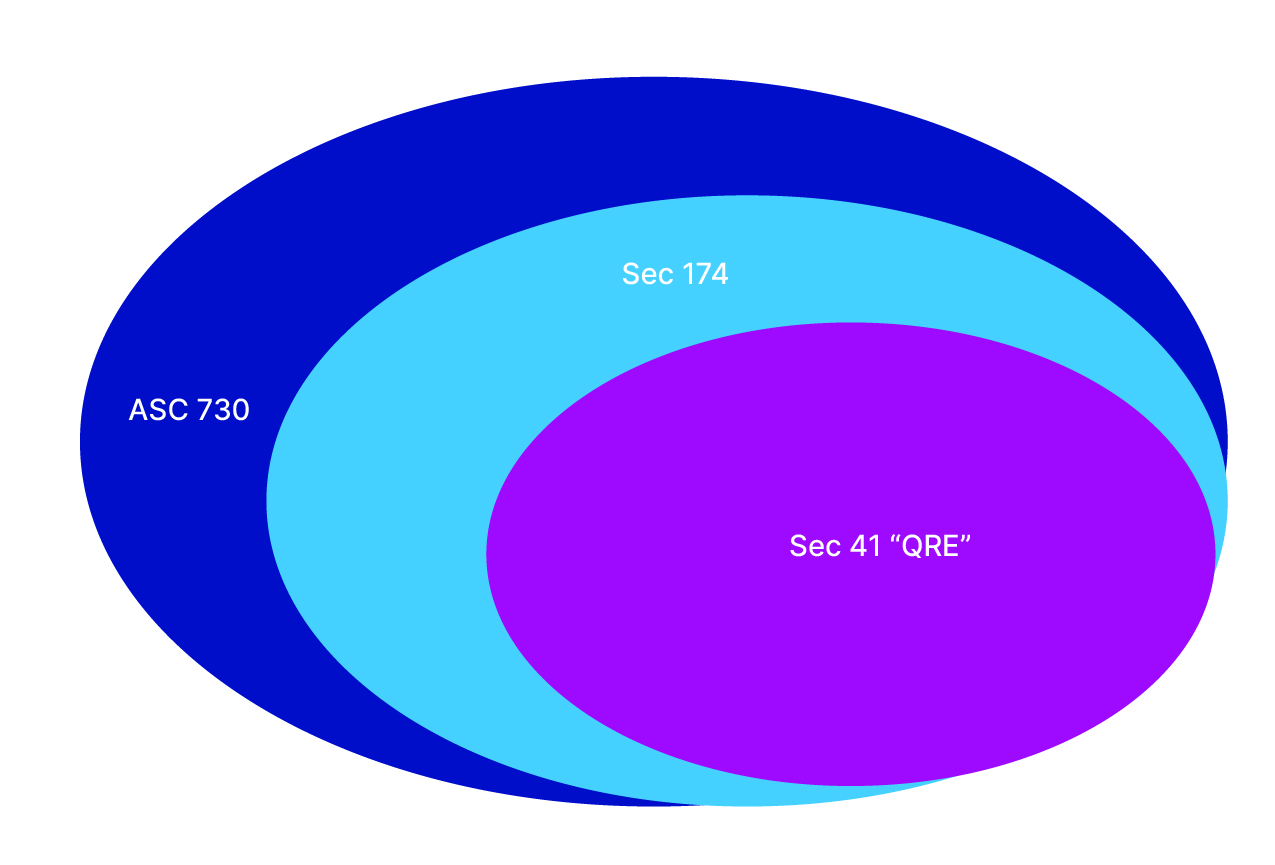
Usually, R&E expenditures embrace all prices incident to the event or enchancment of a product or course of, together with, however not restricted to, the next price classes:
- Wages paid to workers immediately concerned in R&E actions
- Wages paid to workers by the way concerned in R&E actions
- Payroll taxes
- Provides
- Contracted analysis (above the 65% restrict required by Part 41)
- Laptop lease expense
- Licenses
- Lease
- Depreciation
- Utilities and different overhead prices
- Authorized charges
- Journey prices
It needs to be famous that Part 174(d) offers that if capitalized Part 174 prices are disposed of throughout any yr through which amortization is permitted, no deduction of the capitalized prices is allowed throughout that yr, and the prices will proceed to be amortized.
BPM insights:
When confronted with the problem of what to do about capitalizing Part 174 prices, the most effective place to start out is to talk with the taxpayer’s exterior auditor and decide what their expectations are by way of calculation element. If there may be little influence on the monetary statements as a consequence of vital built-up internet working losses, a taxpayer and their auditor could also be snug with a high-level strategy that leverages GAAP R&D or a departmental price inclusion strategy.
Hybrid strategy
The auditor could allow using a “hybrid strategy,” the place the element from an R&D tax credit score examine could possibly be utilized as a place to begin as bills eligible beneath Part 41 for the R&D credit score are probably additionally Part 174 costs3. This offers a attainable shortcut to figuring out the biggest prices, resembling wages, provides, contract analysis and laptop lease bills. One could then look to the trial stability or normal ledger to establish and embrace further required prices, resembling lease, utilities, depreciation, authorized charges, and many others. You will need to observe that if an R&D tax credit score examine is leveraged, overseas analysis prices is not going to be included as “certified analysis” beneath Part 41 and should be acknowledged and captured individually for capitalization functions. As well as, it needs to be famous that solely 65% of contract analysis prices are included for the needs of an R&D credit score examine. Part 174 requires 100% of related contract prices to be capitalized.
Taxpayers who wouldn’t have audited monetary statements or R&D tax credit score research for the present or prior years could must discover a sensible strategy. This typically means beginning with the corporate’s trial stability and figuring out something that could be coded as R&D earlier than performing further analysis.
Sensible strategy
If a taxpayer doesn’t have detailed GAAP R&D prices and as a substitute has normal and administrative (G&A) prices and R&D prices comingled collectively, then there needs to be a sensible strategy undertaken to separate the mixed prices between Part 174 prices and in any other case non-capitalized prices. As famous, Part 174 price classes typically embrace wages, payroll, provides, contracted analysis, overhead, IT, software program licenses, and many others. To discover a sensible answer, it could be essential to allocate such prices on a headcount foundation (e.g., a ratio of R&D workers to complete workers) or use another ratio that may be documented and supported to provide an affordable reply. With out additional steerage from the Inside
Income Service (IRS), documenting the strategy taken might be of the utmost significance to guard the taxpayers’ place within the case of an IRS examination.
Enterprise part strategy
There’s additionally a chance to be very granular with the evaluation and overview the Part 174 prices from a “enterprise part” perspective to totally vet whether or not the complete enterprise part meets the Part 174 standards of demonstrating “actions supposed to find info that might get rid of uncertainty” and making use of a “shrink again” to the Part 174 prices of the component4. This could possibly be a chance for sure taxpayers to mitigate the quantity for Part 174 prices that require capitalization. It’s value noting that making use of the so-called “shrink again” evaluation to software program improvement prices could show far more tough as a result of plain language5 of Part 174 beneath the TCJA.
Funded analysis
One other necessary difficulty which will come up is with respect to “funded analysis.” Funded analysis actions are performed by the taxpayer on behalf of a 3rd get together. In situations the place the taxpayer doesn’t have an “financial danger of failure” (which means the taxpayer being funded is not going to need to repay the funding get together if the outcomes of the analysis efforts should not fruitful), there could possibly be an argument that the actions they’re performing for the third get together are service-related and will not be thought of as Part 174 prices. These prices could as a substitute be categorized as Part 162 and maybe shouldn’t be capitalized. This isn’t a definitive place and needs to be evaluated with the help of a technical professional.
Industries affected
Firms resembling these within the life science, product innovation, plane and laptop industries, that are historically R&E heavy, are clearly affected by the capitalization necessities as mentioned above. As are these firms that seemingly don’t historically have R&D spend (e.g., service business, actual property, retailers, hospitality and building) however should still have capitalization necessities in the event that they develop their very own software program. All firms want to start out with the query: Does any of their spending have a component of uncertainty?
Different ideas
So far, the IRS has but to offer particular steerage for a way practitioners are supposed to establish and capitalize Part 174 prices; as such, the hassle to take action could possibly be seen as an estimate for functions of economic assertion reporting. The ASC 740 FIN 48 monetary assertion influence and disclosure thereof would should be evaluated. R&D credit claimed, and any ensuing FIN 48 quantities related thereof, needs to be in contrast and contrasted to the Part 174 capitalized quantities on an annual foundation.
BPM has invested in depth sources in growing sure metrics that can be utilized as a foundation for an estimate or benchmark. These metrics measure the outcomes of analyses that evaluate a Part 41 examine to GAAP prices in arriving at Part 174 capitalization.
Overseas analysis implications
U.S. multinational firms typically conduct R&E actions of their managed overseas firms (“CFC”) to enhance U.S.-owned mental property (IP), compensating them on a cost-plus foundation. In these conditions, the U.S. multinational should typically capitalize the Part 174 quantities paid to the overseas company (which can symbolize the complete cost-plus fee) over a 15-year interval, primarily based on the efficiency of those actions exterior of the U.S. Usually, the place the CFC doesn’t personal the IP, however is merely performing the R&E actions or “funded analysis” on behalf of the U.S. dad or mum firm (if the dad or mum owns the IP), the CFC wouldn’t usually be required to capitalize the R&E bills incurred.
Nevertheless, when a CFC owns the IP, any Part 174 prices incurred by the overseas company (for R&E carried out exterior of the U.S.) associated to that IP should be capitalized by the CFC and amortized over a 15-year interval. In situations the place the overseas company owns the IP, however pays the U.S. for R&E actions, the overseas company would capitalize these bills and amortize over 5 years (for R&E carried out within the U.S.), however the U.S. company wouldn’t be required to capitalize the R&E bills incurred. The U.S. company could, nonetheless, be entitled to R&D credit. Word that the place a cost-share settlement (“CSA”), outlined beneath Part 1.482-7, is in place, every get together to the CSA possesses some rights within the IP. Consequently, the respective events would capitalize the proportionate share of the R&E price as decided primarily based on the fairly anticipated advantages (“RAB” share).
Conclusion
Navigating the Part 174 capitalization guidelines is difficult, particularly for these new to this code part. The foundations are advanced and require an intensive understanding of each tax legislation and the particular R&E actions being performed by the enterprise. BPM’s Nationwide Tax group and Specialised Tax Companies group can be found to assist. We’ve devoted specialists at present working with our purchasers to navigate these sophisticated guidelines and assist their calculations. Contact us for extra info.
1 Treasury Regulation 1.174-2(a)(1)
2 Treasury Regulation 1.174-2(a)(1) and (3)
3 IRC Part 41(d)(1)(A) – the time period “certified analysis” means analysis with respect to which expenditures could also be handled as specified analysis or experimental expenditures beneath part 174.
4 Treasury Regulation 1.174-1(a)(2) Utility of part 174 to elements of a product. If the necessities of paragraph (a)(1) of this part should not met on the stage of a product (as outlined in paragraph (a)(3) of this part), then whether or not expenditures symbolize analysis and improvement prices is decided on the stage of the part or subcomponent of the product. The presence of uncertainty regarding the improvement or enchancment of sure elements of a product doesn’t essentially point out the presence of uncertainty regarding the improvement or enchancment of different elements of the product or the product as a complete. The rule on this paragraph (a)(5) will not be itself utilized as a motive to exclude analysis or experimental expenditures from part 174 eligibility. 5 Part 174(c)(3)

