

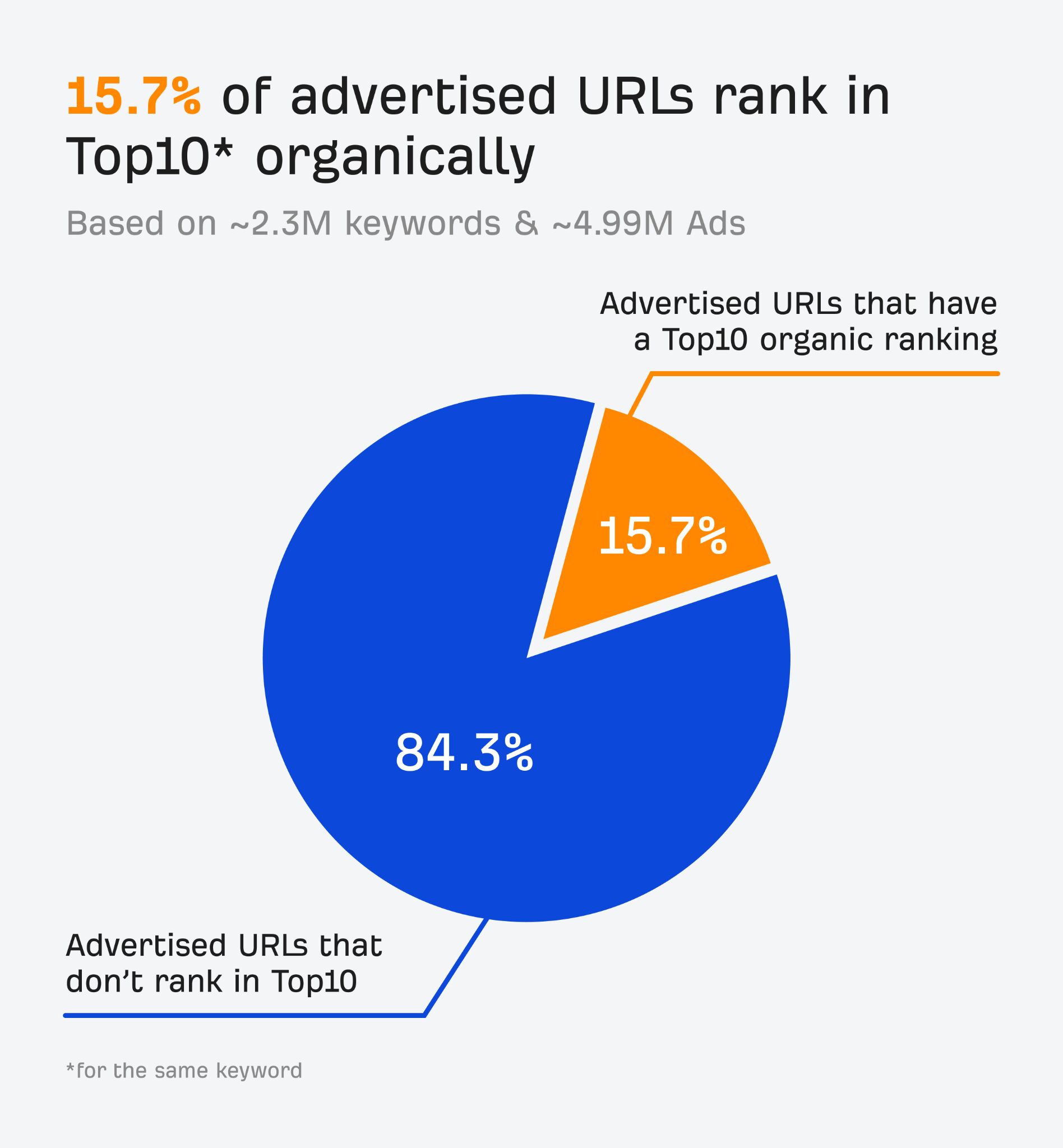
We analyzed ~2.3 million keywords with ~4.99 million top ads to see how frequently businesses advertise on keywords where they already have an organic ranking in the top 10 positions.
Here are some of the key statistics:
37.9% of advertised websites already rank in the top 10 organically for the same keyword. This indicates that a significant portion of businesses are paying for ads when they already have visibility for that term.

When looking at specific pages rather than entire websites, 15.7% of advertised URLs have an organic ranking in the top 10. This shows that, even at the page level, ads are often run on already high-ranking content.
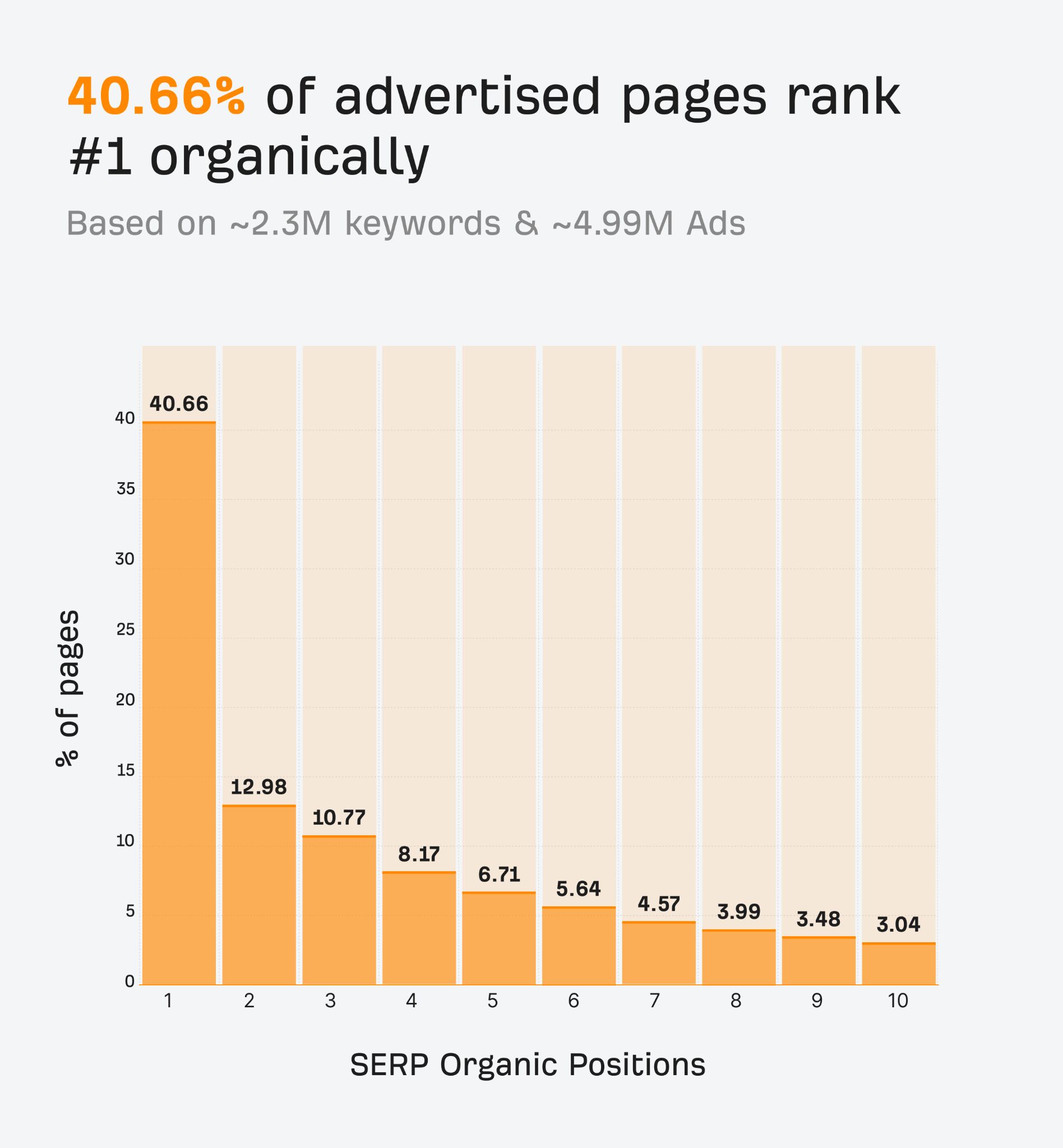
Shockingly, 40.66% of pages that are advertised rank #1 organically. Essentially, these businesses are paying for the top ad placement on Google when they already rank in the number one organic position.
Another surprising insight from our research is that in 51.09% of cases, businesses advertise a page that ranks in the top 10, even when there are no competing ads present.
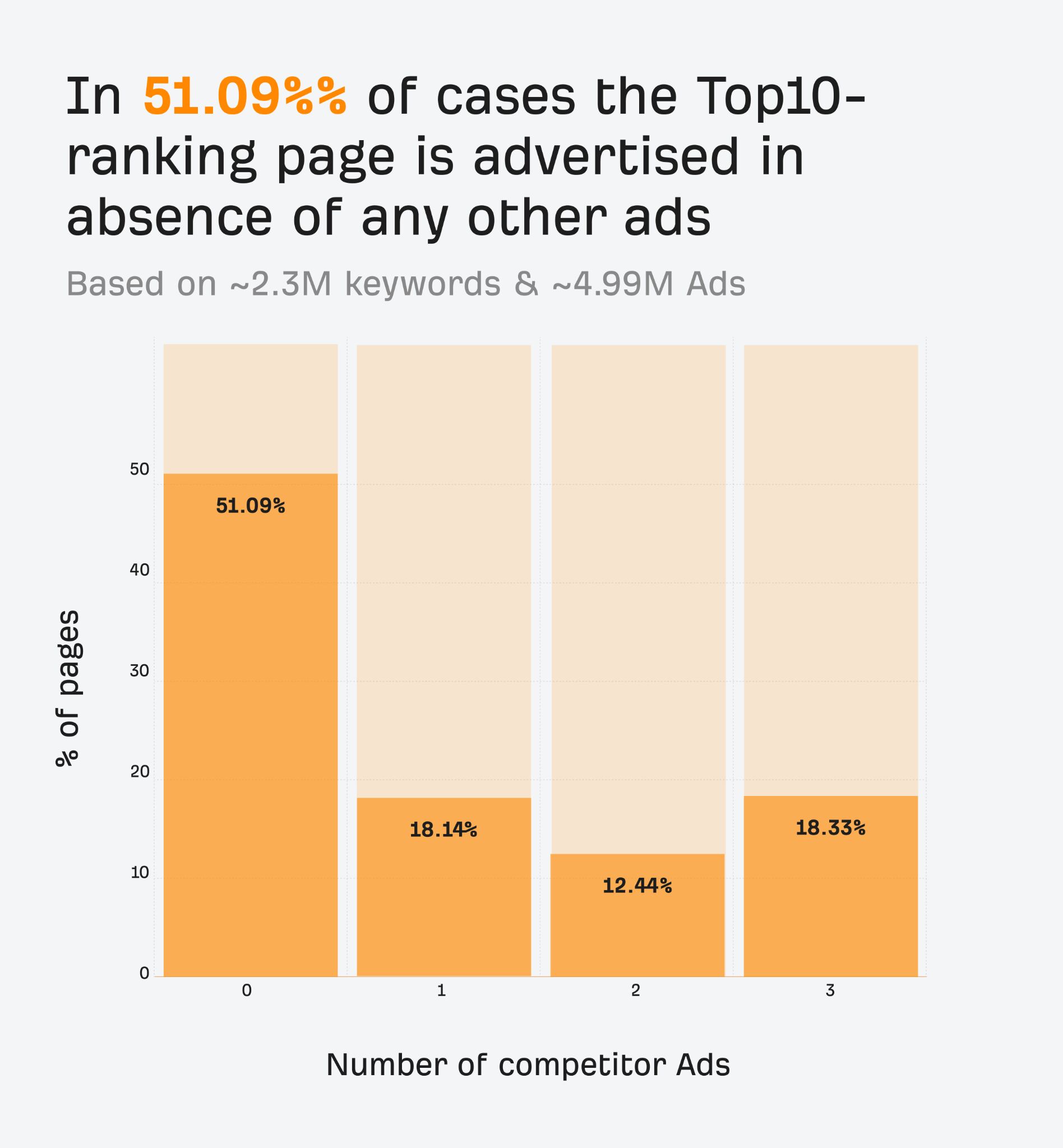
This suggests that many businesses might be running ads needlessly, generating costs without competing against other advertisers.
This overlap between paid and organic raises two important questions.
Are businesses simply trying to dominate the SERPs, or is this a sign of a lack of coordination between SEO and PPC teams?
And perhaps more importantly, does running ads on keywords where you already rank well organically drive significantly more clicks, or is it just inflating your cost per acquisition?
We found answers to these questions and a few others among the comments received on LinkedIn (here and here). Here’s our attempt to summarize the discussion:
- Use PPC selectively: PPC campaigns should only complement organic rankings for highly competitive keywords or those pushed below the fold by ads. Avoid redundant spending where organic visibility is already strong.
- Measure impact on revenue, not vanity metrics: move beyond clicks and CTR. The true measure of success is incremental revenue.
- Rethink PPC for branded keywords: PPC for branded terms often adds little value if you already rank well organically. Shift that budget to something else unless facing direct competition.
- Eliminate siloed strategies: PPC and SEO should work together, not against each other. For example, you can use PPC to test different types of content on the keyword you already rank (thanks for the idea, Olli!), or use it to rank for volatile keywords (like HubSpot does).
In one of the comments Nikolas Garfinkel shared research done in a similar field. Blake, Nosko, and Tadelis conducted a series of large-scale experiments to evaluate the impact of paid search advertising for both branded and non-branded keywords at eBay in 2014.
Their conclusion was that for established brands, running ads on brand terms was largely redundant. The results for non-branded keywords were similar: most clicks attributed to ads would have occurred organically anyway, meaning the return on investment (ROI) from these ads was negative. This aligns with our findings that businesses often compete against themselves by paying for clicks they could have received for free through strong organic rankings.
A big thank you to everyone who contributed with their comments!
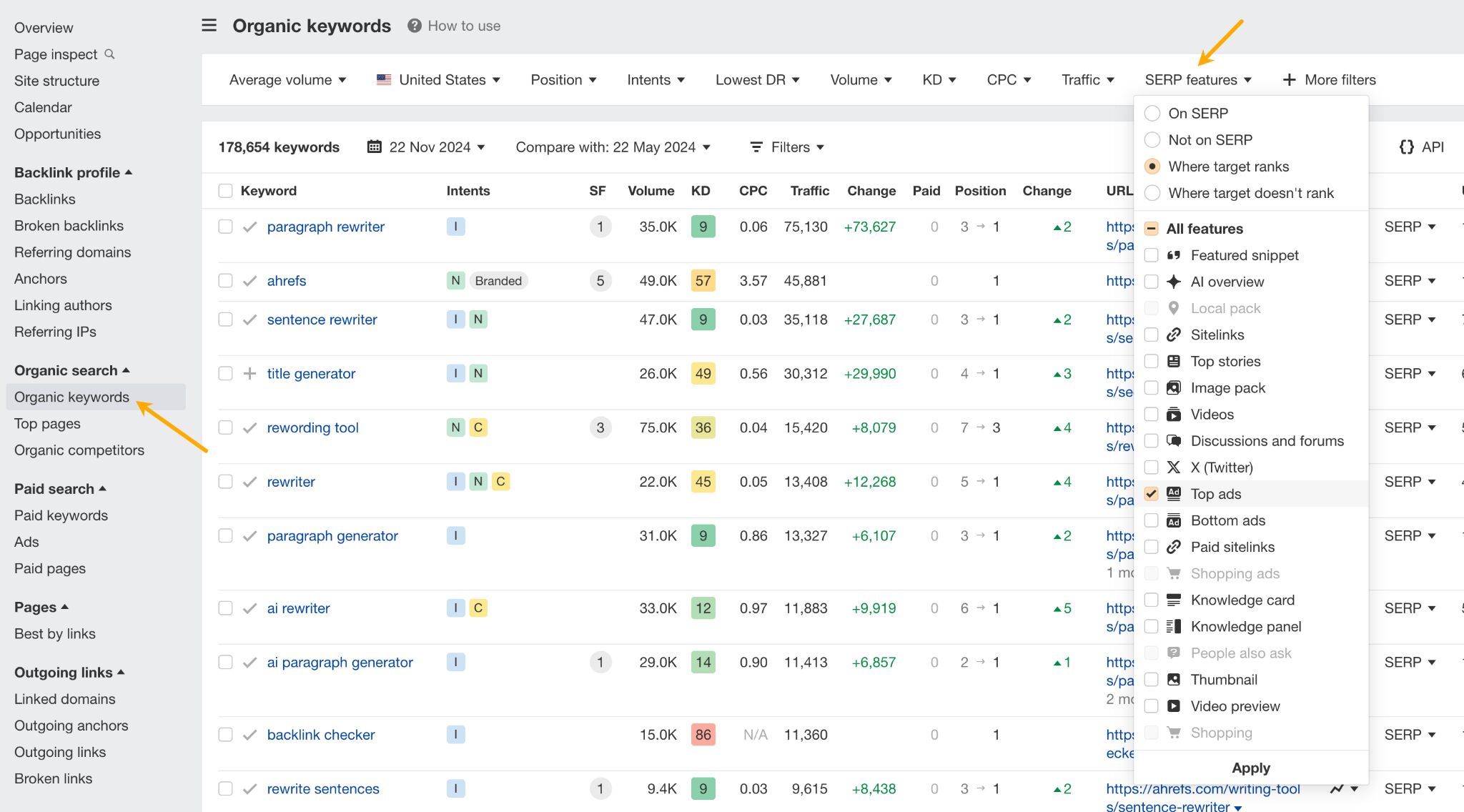
If you want to run similar research on your site, you can use our Site Explorer. Enter your domain, go to the Organic keywords report, and use the SERP features filter (set it to Where target ranks and Top ads).
Final thoughts
Marketers need to evaluate their PPC and SEO strategies in tandem. Are you truly adding value by running an ad for a keyword where you already have a presence, or could those ad dollars be better used elsewhere? Maybe it’s time to sit down with both the PPC and SEO teams and revisit your overlapping efforts.
Got questions or comments? Share them in this thread or let Tim (the author of the study) or me know.

