


If you feel like the nature of workforce management is becoming increasingly more complex, you’re not alone. For many enterprise leaders managing operations across borders, having a global workforce management is becoming a necessity.
But the challenge of maintaining a global system of governance across multiple countries, cultures, and regulatory environments is a balancing act. This means that leaders who can effectively roll out their workforce management strategies on the global stage stand to lead against their competition in our increasingly interconnected world.
This article is the first in our series highlighting insights from the Global Workforce Management Rollout Playbook. The full guide offers even more in-depth best practices on how to craft a successful workforce management rollout strategy.
Why Are Global Workforce Management Rollouts So Challenging?
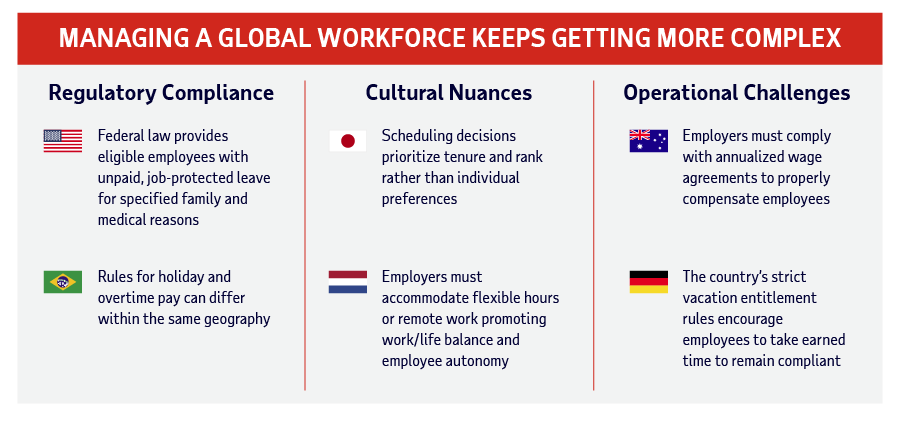
While the promises of seamless, scalable workforce management operations on a global scale are appealing, the journey to get there is complex. And for good reasons. Even with the right workforce management vendor, global organizations must develop a rollout strategy that addresses key challenges like these:
- Regulatory compliance: For each locality they operate in, Global operations are still subject to local labor laws, tax codes, industry regulations, and union agreements present in each country they operate in. Examples like the Family Medical leave Act (FMLA) in the U.S. or union and collective bargaining agreements create complex requirements.
- Cultural nuances: Every culture approaches work differently, meaning employee expectations, work/life balance norms, and engagement strategies may vary substantially from place to place. This requires workforce management practices that can adapt to a variety of customs while maintaining global governance models.
- Operational challenges: Managing scheduling, time tracking, absence policies, and payroll processing in multiple countries add layers of complexity to your rules. Simplifying these steps demands a workforce management solution that natively supports your requirements and reduce manual or people based processes.
The Risk of a Disconnected Workforce Management System
Given how complex each set of regional requirements can be, can a single workforce management solution truly support both global directives and local needs?
Many organizations navigate these challenges by stitching together multiple systems, creating different processes for time tracking, payroll, scheduling, and otherwise. This can result in costly inefficiencies, inconsistent data, and an ongoing struggle to keep up with ever-changing compliance demands.
Fragmented or disconnected workforce management systems like these come with significant risks:
- Inconsistent standardization
- Strained resources
- Data silos and limited visibility
- Increased compliance risk
- Missed opportunities and inefficient labor spend
What separates leading workforce management solutions from the rest is their ability to offer both global oversight and local precision. Best-in-class systems are designed to scale with your growth, adapt to the unique requirements of each region, and deliver a seamless experience for both employees and administrators.
Hallmarks of top global workforce management solutions include:
- Robust configuration options that allow for local rule-setting without complex workarounds
- Consistency with a standardized framework and digitization of global and local regulations
- Real-time data and analytics accessible across all geographies
- Built-in compliance updates tailored to simplify requirements for each market
- Strong customer success and local support teams who understand the nuances of your operating regions
Improving Your Global Workforce Management Strategy
Local labor laws, unique employee expectations, and operational hurdles can turn even the best-intentioned global rollout into a patchwork of makeshift solutions. It may be difficult to imagine, but the right workforce management solution can successfully flex with your business needs on a global scale, all while successfully supporting local requirements.
The key to success? Finding workforce management strategies and software that unite global vision with local execution. Workforce management software like the ADP WorkForce Suite can accomplish this without sacrificing agility, compliance, or employee satisfaction.
This series will cover more strategies for crafting and managing a successful global workforce management rollout.
Read the Global Workforce Management Rollout Playbook to see how the competitive advantage of a connected workforce management system.
The post Is Your Workforce Management Strategy Built for Global Complexity? appeared first on WorkForce Software.

