


More than 3,000 software developers from around the world gathered in San Francisco on Tuesday to learn what will become of software development in the AI era.
They convened under the auspices of AI Dev 26 x SF, a conference organized by Andrew Ng’s DeepLearning.AI.
Jonathan Heyne, COO of DeepLearning.AI, set the scene by framing the problem: figuring out what software engineering will mean five years from now.
Spoiler: No one knows, but a lot was said about the current state of play.
The bottleneck for software development has always been writing code, Heyne said. With AI, “the bottleneck is our imagination.”
That, funding, and time. But let’s focus on our imagination to keep this light. At one point, we might also have cited legal limitations, but so far, the courts seem satisfied with AI code laundering.
Anush Elangovan, corporate VP of AI software for AMD, took a turn on stage to highlight work done on ROCm, AMD’s open software stack for optimizing AI workloads. He glossed over projects like HotSwap, which intercepts GPU kernel workloads and retargets the ISA at runtime; a new native HIP backend for llama.cpp; and a high performance IREE C tokenizer.
Elangovan said AI is transforming the tech industry much faster than prior transitions.
“Speed is the moat,” he said, presumably in reference to a 2023 memo attributed to an anonymous Google employee about that company’s lack of barriers to competition.
We note that there are other business defenses. Being late to market but better funded than the competition, for example, has also proven to be a successful formula. The startup graveyard is full of companies that had a first-mover advantage. It might even be argued that AI has made speed a commodity.
In any event, Elangovan added that now there’s no such thing as “too hard,” a claim that really ought to be qualified.
Marc Brooker, a VP and distinguished engineer at AWS, then took a turn on stage.
“I write software every day, production software often,” he said. “And I will say that this is the most exciting time in my career. I’ve been making money running software for about 30 years and I’ve never seen the pace of change like it is today.
“…It’s an incredibly exciting time to be in the software industry. And an incredibly exciting time to have the opportunity to be shaping part of that industry. But it’s not perfect yet. We’ve got some work to do.”
Brooker doesn’t see AI taking over everything. “The opportunity for agents is limited by the defect rate,” he said, arguing that reducing errors is more important than moving the frontier forward.
What makes agents interesting, he said, is that they’re a feedback loop. “You can take very faulty things and build great things on top of them with that feedback loop,” he said.
Brooker pointed to projects aimed at enforcing code correctness like Hydro, a Rust framework for agents and humans to write distributed protocols; Cedar, a language for writing authorizers; and Strata, an automated reasoning tool. He also emphasized the value of spec-driven development, because giving AI models specifications to work with leads to better results.
AWS’s approach, he said, is to drive down the defect rate. “Across the industry we need to have higher standards,” he said.
It’s always been thus. But failure is the fuel that moves the tech industry forward. We have no doubt that the Amazon outage in early March was instructive to company engineers.
Emma McGrattan, CTO of data intelligence biz Actian, presented next – out of sequence due to traffic delays that bumped the scheduled panel discussion.
Her exploration of how the data layer should be engineered to deliver value for enterprises offered a reminder that technical innovation can’t overcome political reality – specifically, the unease among European governments and companies about housing their data on US soil.
She also offered a reminder that hybrid infrastructure is the norm, not the exception. Edge deployment, on-premises deployment, and cloud deployment each have their own merits.
Finally came a panel discussion on the future of software development.
At the outset, moderator Marina Mogilko from Silicon Valley Girl asked the panelists to rate how bright the future of software development is on a scale of one to ten. Joe Reis from Practical Data Media said eight. Dan Maloney from LandingAI landed on eight to nine. Richmond Alake from Oracle said seven. Michele Catasta from Replit said it was so bright, she rated it a ten.
That’s about what you’d expect from attendees at a conference about developing software with AI. Those inclined toward ratings at the other end of the spectrum are probably already in custody.
Alake said he expects in the future, software development will look a lot more like agent orchestration and agent management. And he expects a lot of roles will blur, with software engineers taking on elements of product management, design, and marketing – speaking to customers to understand their needs.
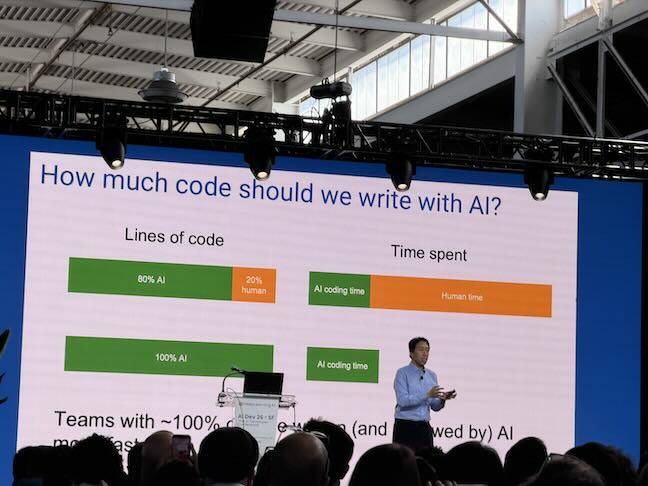
Andrew Ng during his presentation at AI Dev 26 x SF – Click to enlarge
Andrew Ng, founder of DeepLearning.AI, said something similar during his keynote. He argued that small teams of generalists overseeing AI agents look like the way forward. And he suggested that instead of just having AI agents write a portion of code, they should write all of it.
“If I have to review the code, I become the bottleneck,” he said, adding that it’s fine to write code by hand. But for many frontier teams, he said, they’re trending toward 100 percent AI.
The future of software development looks like it will have a lot less actual software development. ®

