


Effective B2B marketing is challenging to get right. Between creative demands, budget limits, and channel decisions, marketers have a lot to juggle when developing their marketing strategy.
However, the biggest determinant of effective marketing is your audience. If you’re not properly targeting your buyer persona, your promotions and advertisements will likely fall flat. In fact, you might as well not be marketing at all.

By the end of this article, you’ll better understand B2B marketing, the most effective B2B marketing strategies, and how you can tap into and convert your business audience.
What is B2B?
B2B stands for “business-to-business,” a business model in which businesses sell products and services to other companies instead of consumers.
The purpose of B2B marketing is to familiarize other businesses with your brand name, demonstrate the value of your product or service, and convert them into customers.
HubSpot is an example of a company that engages in B2B marketing. HubSpot’s customers are other businesses, not individual consumers. Therefore, you can classify all of our marketing efforts as B2B.
B2B vs B2C Marketing
B2B and B2C (business-to-consumer) marketing differ in their respective strategies and applications, as well as in their audiences and how they communicate with them.
B2B marketing targets the needs, interests, and challenges of individuals who make purchases on behalf of, or for, their organization (rather than for themselves), thus making the organization the customer.
Here are a few examples of B2B companies:
- A coworking space that leases office spaces to remote teams and freelancers (like Spaces)
- An on-demand order fulfillment, warehousing, and screen printing service (like Printful)
- A marketing software company that sells social media management tools, lead generation software, and other marketing tools to businesses and organizations (like HubSpot!)
B2C marketing targets the needs, interests, and challenges of individual consumers who make purchases on behalf of, or for, themselves, thus making the individual the customer. Here are a few examples of B2C companies:
- An e-commerce company that sells office supplies to remote or self-employed individuals (like Poppin)
- A store that sells t-shirts and other clothing and accessories (like Target)
- A music platform that sells streaming subscriptions (like Spotify)
For more context, let’s take a look at this chart comparing B2B and B2C customers.
|
For B2B marketing |
For B2C marketing |
|
|
Goal |
Customers are focused on ROI, efficiency, and expertise. |
Customers are seeking deals and entertainment (which means marketing needs to be more fun). |
|
Purchase Motivation |
Customers are driven by logic and financial incentives. |
Customers are driven by emotion. |
|
Drivers |
Customers want to be educated (which is where B2B content marketing comes in). |
Customers appreciate education but don’t always need it to make a purchase decision. |
|
Purchase Process |
Customers like (if not prefer) to work with account managers and salespeople. |
Customers like to make purchases directly. |
|
People Involved in Purchase |
Customers often have to confer with decision-makers and other members of their chain of command before making a purchase decision. |
Customers rarely need to confer with others before making a purchase decision. |
|
Purchase Purpose |
Customers make purchases for long-term solutions, resulting in a longer sales cycle, longer contracts, and longer relationships with companies. |
Customers aren’t necessarily looking for long-term solutions or long-term relationships. |
As much as they differ, B2B and B2C companies intersect in many ways. While Poppin sells office supplies to remote or self-employed individuals, they also design corporate office spaces and branded supplies.
On the other hand, Printful offers order fulfillment and warehousing to businesses and fills e-commerce printing orders for individuals.
Also, as distinct as the B2B and B2C marketing audiences can be, B2B marketers can always learn from B2C campaigns, too.
I can tell you from experience that there are nuances to consider. For example, logic and financial incentives may drive B2B purchase motivation.
However, anyone who understands sales — whether for B2B or B2C — knows there are typically at least some emotions at play behind any purchase.
In B2B, that could be fear (i.e., are we falling behind our competitors?) or frustration (i.e., our current systems and processes are slowing us down.)
It could also be a feeling of hope (i.e., if we invest in this new software, we can become more efficient and stay ahead of our competitors.)
B2B Marketing Strategies

As I said above, marketing depends on its audience. While B2B and B2C marketing vary, not every piece of B2B marketing material is alike, either.
Some of the B2B marketing strategies I’ll cover in this section are preparatory, such as identifying your audience, while others are ready to be executed, such as creating a B2B website.
1. Understand the B2B buyer’s journey.
Before we dive into actual strategies you can implement, you need to understand the B2B buyer’s journey so you can create and implement marketing strategies that meet prospects at every stage of their purchase process.
Because of the higher price point of B2B products, B2B sales cycles tend to be a lot longer than B2C cycles.
Nurturing these prospects via marketing takes a similarly long time, too. That means you must use specific tactics at every stage to drive them toward a purchase decision or a demo request.
In other words: B2B marketing is not as easy as setting up ads on Instagram and hoping for clicks.
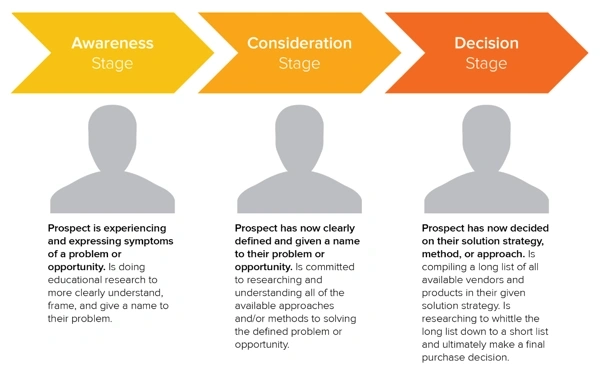
The B2B buyer’s journey is divided into three stages:
- Awareness Stage. The prospect has become aware of a problem and begins educating themselves.
- Consideration Stage. The prospect researches solutions for their new problem.
- Decision Stage. The prospect is ready to make a purchase or formally begin a buying process.
After understanding the buyer’s journey, take this opportunity to create a customer journey map for your company — or, if you’re a new marketer at a B2B company, ask for one for reference.
A customer journey map is a customized version of the buyer’s journey that shows how your brand interacts with prospects during each phase.
With that information, you can understand which marketing strategies, such as content marketing, will be most effective at each stage.
2. Identify your target market and target audience.
Who is taking the buyer’s journey and purchasing your products? You get to decide. But it all begins by identifying who they are.
First up, define your target market. For B2B companies, I recommend first identifying your target companies with firmographic data such as:
- Company size, i.e., small, medium, or enterprise.
- Company region or location, i.e., North America, South America, Africa, or specific countries and regions.
- Company industry, i.e., healthcare, fintech, or SaaS.
- Number of employees.
- Revenue.
Then, define your target audience — that is, the specific human prospect who is looking for your brand’s products or services. Remember, you’re not marketing to other companies. You’re marketing to people who work at that company.
You can use demographic and psychographic data to identify individual prospects you’ll be marketing to. This may include the following:
- Age.
- Location.
- Gender.
- Education level.
- Job title.
- Behaviors.
- Habits.
- Beliefs.
This information will help you create buyer personas and customer profiles, which in turn will help you understand how they make purchase decisions and which marketing channels they’re more likely to use.
For instance, if you’re targeting an entry-level employee, ages 22-26, at a small business in North America, you can likely use social media to reach them effectively.
Pro Tips
It’s a wonderful starting point, but to really understand your target audience — rather than making educated guesses — you need to speak directly to them.
So, where possible, I’d always recommend interviewing existing customers or collaborating with sales, customer service, or customer success teams (basically any colleague who speaks to customers directly).
That way, you can get accurate insights about motivations and pain points. (At a minimum, you can glean some of this from existing testimonials or reviews.)
I would also consider your buyer personas and customer profiles unfinished, flexible documentation. That means you can update the documents to reflect your findings when you discover something noteworthy.
3. Choose your marketing mix (or the 4 Ps of marketing).
Now that you’re armed with your buyer’s firmographic, demographic, and psychographic information, it’s time to start building a B2B marketing strategy tailored specifically to them.
Start by defining your marketing mix, or the 4 Ps of marketing:
- Product — what product you sell.
- Price — how much the product costs.
- Place — where the product is sold.
- Promotion — where customers will find out about the product.
Defining your 4 Ps will help you create a more extensive marketing strategy. It marries all of the information you’ve recently found about your potential customers with the information you already know about your own product.
That will empower you to create a more effective strategy than if you jumped right into tactics and execution.
Featured Resource: Marketing Mix Templates

Click here to download the templates for free.
4. Create a B2B marketing plan and a marketing strategy.
Once you’ve defined your marketing mix, you can dive in even more deeply by creating a marketing plan and a marketing strategy.
A marketing strategy marries market conditions with your company’s goals, and a marketing plan provides an actionable roadmap with specific channels and metrics.
What’s most important is outlining your company’s summary and target markets and deciding where to promote it. We recommend starting with a template to create a marketing plan and strategy.
But, as with your buyer personas and customer profiles, you should see your marketing plan and strategy as something that can change.
That means you can pivot your marketing plan and strategy when you get more data, and it makes sense to do so.
Featured Resource: Free Marketing Plan Template

Click here to download HubSpot’s free Marketing Plan Template.
This template compiles all the information you need to choose the right B2B marketing channels for your company.
You’ll be able to lay out your:
- Business summary and initiatives.
- Target market.
- Market strategy.
- Budget.
- Marketing channels.
- Marketing technology.
In this list, we could have easily shared specific marketing tasks you can do, such as creating online content or publishing short videos.
While these activities will likely be worthwhile, spending your time strategizing to minimize marketing costs and increase your ROI is more important.
Strategizing is the core of your B2B marketing strategy — not implementing specific tactics such as blogging or SEO. Those will come later once you have defined the big picture.
5. Cover all of your B2B marketing bases, such as launching a website.
It’s time to dive into the basics, which will vary per industry. For instance, in a more traditional vertical, you might rely less on your website and more on industry events.
That said, you want to make your B2B company has covered most of the following things (click on each one for a checklist to run through):
No matter which B2B industry you’re in and regardless of your audience type and age, these things will likely benefit you.
Pro Tips
I’ve outlined “B2B marketing bases” above, and as I said, it’s worth implementing each as a starting point. That said, you don’t have to—and arguably shouldn’t—implement them all at once if you don’t have the resources/infrastructure.
Instead, a staggered approach can help you avoid doing everything yet achieving nothing because you’re under-resourced and overwhelmed.
It can also help you set up each marketing area as a pillar that supports, rather than hinders, the next.
In practice, this might mean launching your website first. That means you can get a steady stream of blog content in the hopper, and your blog content operations run like a well-oiled machine.
Then, you might introduce social media and focus on sharing a mix of new content and repurposing your existing blog content.
This is exactly what I did as a B2B marketing army of one. (Of course, if you have the resources and infrastructure to start everything at once, that’s a different story.)
It’s also worth noting that if you get up and running with one of these areas, stick at it for an extended period and use best practices while also experimenting.
But it still doesn’t prove fruitful. You don’t have to keep going just because you think you should.
If you don’t have an in-house specialist and you have the budget, it might be worth bringing in outside expertise. Even an hour consultation with a specialist might help you pinpoint how you can improve your approach.
You might also be better served reallocating your budget and resources to what’s working for you rather than what isn’t.
6. Run a competitive analysis.
To choose your specific marketing strategies even more strategically, conduct a competitive analysis.
Scope out the market and see which businesses are marketing to your target audience. Learn what they’re currently doing — do they have a website? A presence on a specific social media platform, such as LinkedIn?
Things to be on the lookout for when inspecting competitors are:
- Competitor product offerings.
- Competitor sales tactics and results.
- Competitor marketing content and social media presence.
Featured Resource: 10 Competitive Analysis Templates

Getting a general overview of these items can help you recognize your competitors’ strengths, weaknesses, opportunities, and threats — otherwise known as a SWOT analysis.
Once you understand where they stand, you can better compete with them and choose the best channels.
If none of your competitors are on Instagram, for instance, then Instagram marketing may not be a good strategy to pursue (or, at least, you should test it out first before investing too many resources in it).
Another thing you should be looking out for is what you can do better than your competitors. Consider how you can stand out, which leads us nicely to brand positioning.
7. Determine your brand positioning.
Next, define your brand positioning in the market.
This statement is the who, when, why, and how of your brand identity — or how your brand is perceived through the eyes of the customer.
This will help you cultivate a consistent brand image, regardless of the marketing channels and tactics you use.
Devise a brand positioning statement that your team and prospective customers can believe in, and you’ll be ready for the next step.
Featured Resource: Positioning Statement Templates

8. Explore marketing channels to use.
With the previous steps completed, you’re ready to diversify your B2B marketing portfolio and reach the businesses you need to.
Depending on your customer segments and competitor analysis, you can explore channels, strategies, and tools to optimize your leads and customer funnels.
To effectively measure and analyze the success of your marketing efforts across these channels, use HubSpot’s Marketing Analytics software.
This powerful platform will help you track performance, identify trends, and make data-driven decisions to improve your marketing strategy and drive more sales.
Next up, let’s look at the types of B2B marketing you can implement now that you’ve created your overall strategy.
Types of B2B Marketing
The following categories are B2B marketing channels that can connect you to your target audience.
B2B Email Marketing
Email marketing is a tried and true method of reaching both individual consumers and business customers. Most B2B marketers use email — are you one of them?
You should be. Emails lead to engagement, which turns subscribers into leads and then customers.
Download our guide to optimizing email marketing for conversions and learn how to grow your email list, ensure deliverability, and increaseengagement.
Unlike B2C customers, who respond best to emotions and entertainment, B2B customers look for logic and positive ROI. Essentially, they ask themselves, “How can your business help my business grow?“
Because of this, your email marketing must consistently resonate with your business customers and focus on things that matter to them — like time, money, and resources.
(BUT, that doesn’t mean you shouldn’t also — tactfully, might I add — dig into the emotions that might drive their purchasing decisions.)
Email marketing is also a powerful vehicle for sharing your brand’s content.
Many B2B companies use email newsletters as part of their content marketing program, and the B2B marketers we’ve spoken to say these newsletters are most critical to their content marketing success.
With the constant barrage of emails flooding our inboxes today, it’s more important than ever to create and send out effective marketing emails.
To help you create emails that stand out, you can use HubSpot’s AI Email Writer.
B2B Email Marketing Best Practices
- Write enticing subject lines. Your subject line needs to be short and engaging. We recommend spending almost as much time on your email subject lines as you do on the emails themselves. You can also run an A/B test on your subject lines to see what works best for your audience.
- Stick to one call-to-action (CTA) per email. Don’t overload your emails with a dozen CTAs. With one CTA per email, you allow your audience to focus on your email content and, ultimately, one action.
- Segment your email to reach the most relevant audience. Email list segmentation helps deliver more personalized content to your audience, regardless of where they are in their buyer’s journey. Consumers prefer email quality over quantity at times.
- Make sure your email designs are responsive. Most email users access their inboxes on their phones, and emails that don’t show up correctly on mobile devices are often deleted. Ouch. Don’t let your email be one of those.
- Don’t be afraid of the cold email. As uncomfortable as it is, the right email can convert new customers — like these cold sales email templates, which will help you get your leads’ attention.
HubSpot tip: You can’t send marketing emails without any recipients — these people make up your lists. There are plenty of easy ways to grow your email list. Begin with opt-in forms on your website homepage, About page, and blog. Check out HubSpot’s Free Form Builder tool to get started.
B2B Digital Marketing
Every business, whether B2B or B2C, should have a digital presence — which consists of paid ads, search engine optimization, a website, and any other place your B2B company is active online.
Let’s explore several tactics that can strengthen your B2B digital marketing strategy.
1. Define your target audience.
A strong B2B digital marketing strategy starts with defining your target audience or buyer persona. This demographic and psychographic information will inform almost every other marketing activity thereafter.
In short, it makes sure your content and digital material are absorbed by the right eyes and ears (and that no resources go to waste on your end).
2. Create your website.
Secondly, digital marketing can’t function without an informative, engaging website. Most buyers visit a website before making a purchase.
Moreover, the typical B2B sales cycle often involves many key players (such as gatekeepers, decision-makers, and other folks who have to buy into a purchase).
That’s why websites are easy, straightforward ways for influencers to share information about your product or service.
For inspiration on how the best B2B websites are built to impress, check out this video:
3. Optimize your digital presence.
Your website needs to be more than informative and engaging, though it must be discoverable.
You can do this with on-page SEO and technical SEO tactics. These include everything from image alt-text and meta descriptions (what your visitors can see) to structured data and site speed (what your visitors can’t see).
Off-page SEO is also at play here, which refers to external linking strategies and social sharing — SEO tactics that take place off your website.
4. Run PPC campaigns.
Finally, round out your digital presence with pay-per-click (PPC) advertising, which allows you to get your content and brand in front of new audiences via search engines and other advertising platforms.
I recommend maximizing your PPC investment by advertising more than your specific products or services — such as your brand personality, blog or social media content, or company tagline.
The best way to see an ROI from your paid ads is by 1) incorporating your buyer persona data and 2) boosting content that they can relate to.
For example, it’s highly unlikely a brand-new consumer who’s never heard of you is searching for your exact product.
They may be searching for a location-based solution or product feature. To reach the greatest number of potential customers, pay to target relevant categories within your brand vs. promoting your product or services.
B2B Content Marketing
We’ve talked about how B2B customers are focused on expertise, driven by logic, and desire to be educated. What better marketing tool to satisfy these priorities than B2B content marketing?
Whereas a traditional PR marketing strategy interrupts a consumer’s day-to-day with promotional material, a content marketing strategy adds valuable information and informs the consumer — which is precisely what B2B customers are looking for.
Not to mention that content marketing supports SEO efforts, which involves anticipating what your audience is searching for, helping them discover your website and content … and potentially converting them to customers.
It‘s important to note that content marketing is most effective when you align your content to various stages of the buyer’s journey.
As Jonathan Franchell, CEO and Founder of Ironpaper, says, “Effective content in the awareness phase educates the buyer on their pain points.”
A frequent mistake B2B organizations make is educating the buyer on their own company, product, or service, Franchell notes. However, he says the buyer isn’t ready for that. They are just beginning to understand their problem.
Franchell adds, “Additionally, B2B companies should test content. Run a test on an incentive and vary the type of content – use a webinar, an ebook, or a video. Understand what format of content attracts the right types of buyers and measure it down to an individual human level.”
Business decision-makers prefer to get information from an article than an ad. Knowing this, I’d say you should be putting the same (if not more) resources into your content marketing than your traditional advertising strategy.
Because the B2B buyer’s journey is slightly different than the B2C buyer’s journey (which has shorter sales cycles and fewer decision-makers involved), the content you create for your B2B content marketing strategy may vary more than the content you’ve seen as a consumer yourself, as illustrated in the below graphic.

Before you start creating content, though, I recommend creating a business blog.
(Don’t worry; growing your blog readership is easier than you think.)
Your blog will house all the content you create and serve as a home base for readers to visit and subscribe to.
B2B Social Media Marketing
Believe it or not, B2B buyers and C-suite executives can and do use social media when making a purchase. That’s right — social media marketing isn’t just for brands targeting individual consumers.
Many B2B companies struggle with social media marketing, though.
It can be harder to use social media to connect with business customers, especially because (as we mentioned above) there’s typically a lengthier sales cycle and longer chain of command.
Honestly, B2B social media marketing might not be where you convert the greatest number of leads, and that’s OK. It likely comes into play near the beginning of your buyer’s journey.
Social media is a powerful tool for building brand awareness, giving your company an online personality, and humanizing your business — all very powerful factors when it comes to marketing and connecting with potential customers.
Like email marketing, social media is also a highly effective channel for sharing your content and enhancing your brand expertise, the latter of which we know B2B customers appreciate.
While your social media