


As a marketer and content creator who makes content ranging from podcasts to blogs to videos, I‘m often fielding questions about what content creation is and why it’s so integral to marketing.
Content creation is what happens behind the scenes. It‘s how Google can offer the perfect answer to your problem with a link to a blog or website. It’s the videos you watch on YouTube after a tough day.
It‘s why you may find yourself scrolling through TikTok for hours a day. Don’t worry, I’m not judging you. I do it too.

Content creation also helps people discover your business, brand, and products.
And compelling content is what attracts, engages, and delights prospects and customers. It brings new visitors to your site and ultimately generates revenue for your company.
In other words, you’re behind the curve if you’re not creating content.
What is content creation?
Content creation is the process of generating topic ideas that appeal to your buyer persona, creating written or visual content around those ideas, and making that information accessible to your audience as a blog, video, infographic, or other content formats.
Why is content creation important?
Content creation is the ultimate inbound marketing practice.
When I create content, I provide my audience with free and valuable information, attract potential customers to your website, and retain existing customers through quality engagement.
I‘m also generating some significant value for my company. Don’t believe me? Just look at these statistics:
- 50% of marketers plan on increasing their investment in content marketing in 2024.
- Almost 40% of marketers say content marketing is essential to their marketing strategy.
- And 10% of marketers who blog say it generates the biggest return on investment.
Content equals business growth. So, let’s start with the types of content you can create and then review your content strategy.
Types of Content Creation
Blogs
One type of content creation is the kind you’re consuming right now — blog posts! Blogs can educate, entertain, and inspire your audience through the written word.
When someone types a query in Google, the posts that pop up are usually blog posts.

Blogging is worth the time and effort, and I‘m not just saying that because I’m a blogger. 56% of marketers say blogging is their most effective content strategy.
Blogging is also one of the top media formats marketers plan to leverage for the first time in 2024.
Content Creation Ideas for Blogs
1. Answer a Question
One of the posts I write for my column, “The Creative,” addresses a question a lot of beginner content creators have — how and when to seek brand deals.
Think about the questions you had when you were a beginner. Even questions from your recent experience can help someone else in your industry.
Once you have the question, write a blog giving the answer.
Anticipating and answering your audience’s questions can help you earn their trust and improve your search engine results.
2. Compare and Contrast Solutions to a Problem
If you are an expert in your niche, you can share your expert opinion and simultaneously help readers who want to make informed decisions.
For example, one of my most recent blog posts compares and contrasts influencers and creators, helping marketers decide which would be best to leverage in their strategy.
When writing compare and contrast blogs for a product, service, or method, be as open and transparent as possible. List all the potential positives and negatives you can think of. Then, get into detail about how you came to those decisions.
3. Teach Something
If you want to use your blog as a teaching tool, there are a few things you’ll want to think about.
As you choose a topic, it’s wise to start small. So, instead of covering a broad topic, choose a niche topic that people in your industry might be asking about.
For example, this blog post below isn’t about anything and everything concerning blogs. Instead, it gives readers a step-by-step guide to blog writing.

As you start writing how-to blogs, there are a few things to remember:
- Use short sentences and paragraphs and create a clear structure. This will make your instructions easier to follow.
- Avoid jargon and technical terms, and use examples to make new information easier to understand.
- Remember that your directions should be easy for beginners, so don’t skip steps or offer shortcuts.
These tips help your readers learn and bring you more traffic and interest in your educational content.
4. Daily, Monthly, or Weekly Series
Writing a series of posts can be useful for your readers, and it can help you grow your blog. A series will usually run for a set period. You can publish the series daily or on a selected day every week or month.
A series can generate content that you can easily repurpose for other channels. For example, if you run a blog about social media, you could turn a blog series about Instagram Reels into a podcast, ebook, or video.
This strategy makes it simple to explore a particular topic fully. It’s useful for building internal and external links and for establishing you as a thought leader.
5. Quizzes and Surveys
Blog surveys are a great way to collect feedback from your audience. This can help with more than website traffic.
Responses from quizzes and surveys can also help you:
- Figure out other types of content your audience likes
- Choose which products to promote and sell
- Grow your social media following
- Go viral with interactive content
- Anticipate customer service issues
For an effective quiz or survey, define your goals before you start creating. Keeping your quizzes short and offering incentives can improve response rates.
6. Curated Content for Target Audiences
Curated content will make your most important audience members feel important. This could mean your audience turns into a group of promoters who share your content and encourage others to buy your products.
Create curated content that’s specifically for this audience. For example, our target audience is marketing professionals. Therefore, we create valuable content for marketers.
To curate your content, start with detailed buyer personas and competitor research. Next, create clusters of content that are just for that specific buyer persona.
Curated content is also where you‘ll want to highlight quotes and insights from industry leaders. This content shouldn’t just inform a targeted audience. It should make them feel like they are part of an exclusive group.
If you’re looking for help curating your content, check out this useful list of tools.
7. Celebrate Wins
Most blogs are evergreen. This means that once you publish a blog on the internet, it can be a resource for many years. This makes blogs a great place to celebrate wins.
Whether calling out top-performing employees or thanking customers, you can use your blog to celebrate.
Remember to celebrate the little things. Then, use images, videos, and design to make celebration posts feel extra special.
Podcasts
Anyone can make and broadcast a podcast. This means that professional and beginner podcast hosts are competing for the same listening time.
They also have a big audience, and 28% of Americans 12 years old and up listen to podcasts on a weekly basis.
Podcasts are extra interesting to listen to when the audience likes the host and wants to learn something from them. Keep reading for more podcast content creation ideas you might want to try.
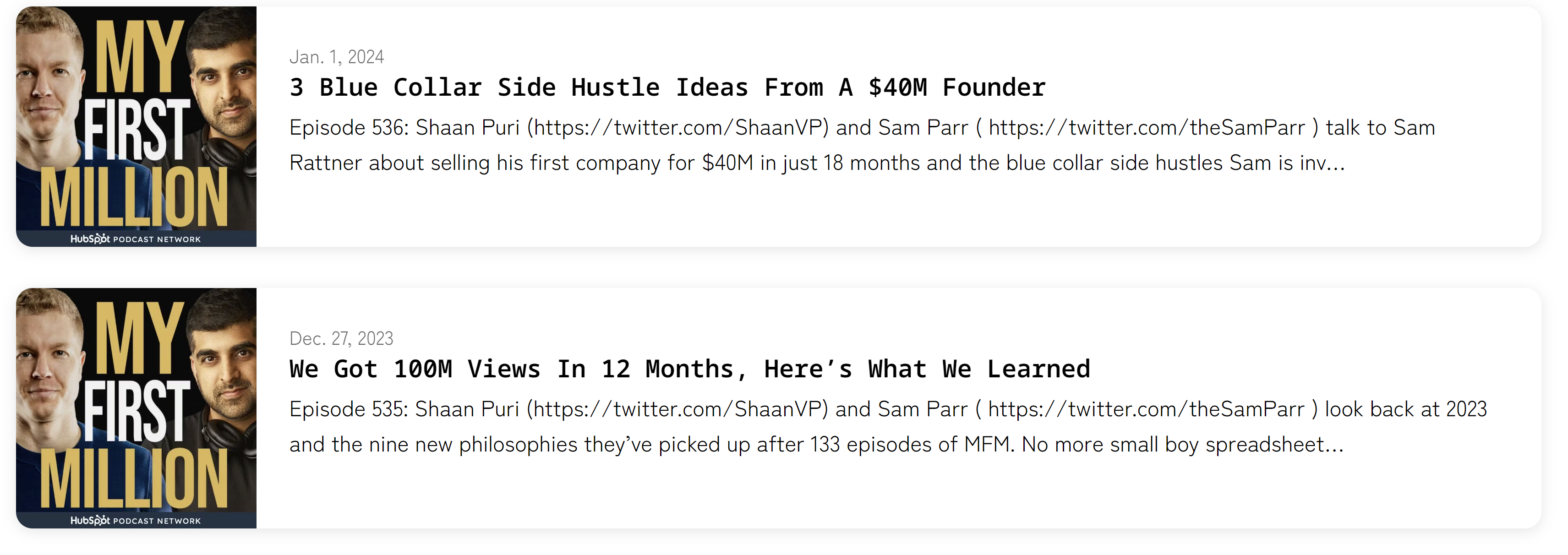
Generally, a great podcast will center on a great idea and then expand on that topic with listener and expert feedback. Storytelling podcasts are popular, and so are educational podcasts.
If you are launching your first podcast, be sure to post with a consistent schedule. It’s also a good idea to follow the same structure for every episode.
Other than that, it’s about being your authentic self.
Content Creation Ideas for Podcasts
1. Thought Leadership
This type of podcast content centers on your professional experience. Be sure to include case studies and other real-life scenarios in this content.
Remember that your audience is listening for different reasons and often has different levels of industry experience. So, offer insights for a range of listeners and share advice that you think your listeners could apply themselves.
2. Interview Influencers
If you want to add influencer interviews to your podcast, knowing who to interview comes first. Don’t just go for the biggest names. Instead, choose interesting guests who can offer value to your listeners.
When I choose guests for my podcast, “Nerds @ Work w/ TsundEri,” I try to think about the story I want to tell and what guests are best suited to tell that story.
Be sure to research your guests and ask original questions. One of the biggest compliments I’ve received as a podcaster is that my interviews are well-researched, and I make sure to understand the work my guests do.
That type of dedication shines through in the content and helps ensure your guests will want to come back later or recommend their colleagues for interviews as well.
Other ways to get the most out of influencer interviews on your podcast include:
- Asking for follower suggestions
- Encouraging participation from your featured influencer’s followers
3. Discuss Trends
Trends provide great content for podcasts. Whether you‘re discussing a long-term trend or the latest fad, this is a smart context to show how your products are relevant to what’s new.
While many people listen to daily or weekly news podcasts, most are evergreen, like a blog. Many podcast listeners will tune into a podcast years after the podcast was first released.
This means that you’ll want to tie trends to larger topics.
For example, Marketing Against the Grain covers trends like the creator economy on their podcast, but they talk about it as part of marketing as a whole. This strategy grounds what could be a fleeting trend into a topic with more staying power.
4. Contests and Giveaways
Contests give your podcast listeners a fun way to participate while also giving you a chance to grow your subscribers.
One way to launch a podcast contest is to post to social media about a prize or giveaway. Interactive contests where a listener can call in to be a part of the podcast are another option.
If you plan to offer a prize, make sure it’s unique and fitting for your unique audience.
Videos
Video marketing is a type of content creation that becomes more popular every year. Short-form and long-form videos both have their place in your content creation strategy. So, be sure to come up with ideas for both types of content.
86% of video marketers say that video is effective for generating leads. This makes original video marketing an important strategy for anyone who is working on content creation.
Some solid video content ideas include behind-the-scenes or time-lapse videos. Let’s go over some other useful ideas for video content creation.
1. Use Animation
Animation makes it easier to understand new or complex information. So, use animated video to show your viewers how your product works or to talk about the specific problem your product solves.
Choose scenarios that people can relate to that clearly connect to your product. Whether you choose to use digital animation or stop-motion, animation can bring a dry topic to life.
For example, tech products often solve problems that the average user doesn’t deal with every day, like a broken connection with an API.
But what about an animation of what happens when the wireless at home gets cut off? A video with this scenario could make that abstract idea easier for the average user to understand.
2. Repurpose Blog Content
Another quick video idea is to use the text from your most popular blog as a voiceover. Long blogs make great content for a video series.
You can also break up key points from blogs into bite-size videos for your social media posts.
Then, add your videos to your blog posts. This gives people who find your blog on search engines another alternative to get the information they’re looking for.
3. How-tos and Tutorials
How-to content is also very popular in video formats. To create a powerful instructional video, stick to short and specific steps. Don‘t skip anything; you also don’t want to overwhelm your viewers with extra information.
Use simple visual steps to help your viewers learn, and offer a clear call-to-action at the end.
It’s also a good idea to engage with the comments on these videos. This reassures your audience that you are available if they have more questions and could help you come up with more video ideas.
4. Product Demos and Unusual Use Cases
Product demos can make it easier for potential customers to see how they can use your products. It’s also a chance for you to share some product design processes.
By sharing the problem you initially solved with your product and how the solution changed through the process, you’re building a relationship with your viewers.
This relationship builds trust and makes them more likely to engage with you and your products.
Show how your product works in an interesting way. For example, the “Will It Blend?” video series on YouTube was a winner for Blendtec because it didn’t just show the power of its blender.
They were inventive and asked for customer suggestions for each video. And the videos were blending objects you normally wouldn’t throw in a blender, like cell phones, golf balls, or glow sticks.
You can also personalize your video content. Video product demos are a great option for connecting individual customers to your products.
Image-based Content
In your blog posts or in your social media posts, you might want to post original graphics. These can be infographics, photography, GIFs, memes, illustrations, or screenshots.
This type of content creation usually requires a graphic designer or a design tool to help you get the job done.
Photo and image-based posts are the content types businesses use most to increase audience engagement.
As you create visual content, ensure you have a strong grasp of the basics. These include:
- Choose the right subject to illustrate your idea
- Think about composition
- Use contrast and color
- Keep it simple
Image-based Content Creation Ideas
1. Visual Storytelling
Visual content is excellent for quick storytelling. As you experiment with storytelling, remember to show, not tell.
For example, say you‘re telling a story about meeting a tough sales goal. A picture of a sales rep talking on the phone won’t tell the story as an image of that same sales rep scaling a tall mountain.
Try to use setting, clothing, lighting, and motion to emphasize the action and drama of every scene in your images.
2. User-Generated Content
Fans of your products are often looking for ways to get involved. And there’s nothing like user-generated content to show your followers that you care about their opinions.
To get your users to create and share content for your brand, invite them to get involved. Try a custom hashtag or contest on social media to start. Email is also a great channel for collecting your customers’ photos, quotes, and stories.
That said, don’t use content from users without asking for their permission. You also want to make sure you credit users for their contributions.
Nothing can damage your relationship with a customer, like using their images without consent.
3. Infographics
There is proof that data visualizations can decrease errors and improve learning and retention by as much as 80%.
If you want your content creation strategy to include infographics, keep these best practices in mind:
- Choose the right data for your target audience
- Choose the right graph or chart for your data
- Do your research
- Tell a simple visual story
- Don’t add too much data
- Make your main points easy to read and remember
And if you’re not sold on using infographics, best believe that your competitors are. 26% of marketers are already using infographics, while 15% plan to leverage it for the first time in 2024.
4. Go Behind the Scenes
Sharing industry and product secrets is exciting and interesting for your readers. It’s also an interesting way to share information about how you make, package, and update your products.
To create visuals that take your audience behind the scenes, start with a plan. Whether you’re sharing photos from a tour of your manufacturing facility or documenting an average day on social media, make it cool.
Think about lighting, composition, and the little details. You don’t want a great product shot ruined by a big, messy trash can or a warning sign in the background.
At the same time, make your images feel authentic. Don’t set up your photos in a space that feels too perfect to be real.
Content Offers
Another type of content is content offers. These are templates, whitepapers, worksheets, or ebooks that your visitors can download.
This is gated content — meaning your audience will need to fill out a form and provide their email to have access to it.
67% of companies use lead generation as the primary metric for content success.
This means that you should combine any content creation efforts with content offers to draw new leads. The best lead magnets solve a problem for your followers.
Usually, they solve urgent issues and offer lasting value to your target audience.
To be immediately useful to your users, a content offer should be specific and quick to use. It should also offer value that reflects your high level of understanding and expertise.
This will keep your audience returning for more and help you convert more leads into delighted customers. These are some content ideas for you to start with.
Content Creation Ideas for Content Offers
1. Ebooks or White Papers
Long-form written content creation is where many businesses start for content offers.
Ebooks and white papers can give your readers a deeper understanding of a topic. They can also help them solve an urgent problem.
While ebooks can be intense projects, you can also use existing content, like blogs, to build your ebooks. A great ebook template can also speed up the process.
2. Original Research
Data drives many businesses, but not every business has the time or the resources to put together the data they need. You can use your knowledge and network to put together research that your visitors can use.
To create high-quality research, you’ll need the following:
- Goals for your research
- A process for sampling and analyzing your data
- Questions
- A process for managing the project
It‘s important to figure out how much time and resources you’ll need to complete the research. A market research template can make it easier for you to organize and compile your research.
Then, you’ll want to decide the best format and channels to present your research to create a stellar content offer.
3. Tools and Templates
A great content offer helps your audience solve a problem faster than they could figure it out on their own. This makes tools like calculators swipe files, and checklists invaluable.
It means that your templates can be useful for your fans both now and later.
And these useful lead magnets don‘t just give you a chance to help out your community. They’re also excellent resources for leads and for creating advocates for your brand.
If someone regularly uses one of your templates, they’re more likely to tell someone else about it. This makes content offers a great way to grow your following by word of mouth.
And word of mouth is one of the most trusted sources for consumers. This makes this type of content offer a win-win.
While some templates and tools need you to have advanced coding or technical knowledge, most are simple to put together. You can easily create a template with tools like Microsoft Excel or Google Docs, tools most people use every day.
As you start building, keep in mind that creating something useful is more important than making it look perfect.
4. Kits and Workbooks
Once you’ve put together a few of the resources listed above, you might be ready to create a larger content offer.
Kits and workbook content offers usually include a range of different resources that work together. For example, say you’ve made a few different templates for social media captions on different platforms.
You can put these together to create the ultimate social media caption kit.
To keep your leads from getting information overload, think about structure. It‘s a good idea to break your kit or workbook into bite-sized pieces.
You’ll also want to use graphics and other media to break up dense sections of text to keep things engaging.
A workbook or kit might also include:
- Worksheets
- A Q&A
- Checklists
- Schedules
- Journal prompts
Social Media Content Creator Ideas
Before I joined HubSpot as a writer and marketer, I managed social media accounts for local news outlets. So trust me, I know creating shareable social media content can be a challenge.
Each platform is a little different and not every post will perform the same on all channels. Still, it is a great way to engage with and grow your audience.
Fortunately, here are a few ideasthat helped me generate new social media content and will help you, too.
1. Share relevant industry news.
As said, I used to work in local news, and it taught me a lot about the importance of relevant content.
Our audience didn’t just want news, they wanted relevant information pertaining to their community, concerns, and industry. Remember this when going the news route with your social media content.
Not everything your brand posts on social media has to be original content. In fact, there are plenty of benefits to sharing relevant industry content and news on your pages.
First, it keeps your audience engaged and informed on the latest news and trends. This can be particularly important in fast-moving industries where staying up-to-date is essential.
Second, it can ensure that you’re always engaging with your audience.
No matter what social media platforms you use, you should stick to a consistent schedule that works for your business.
Including related content in your calendar can make content planning easier and free up time to work on high-value campaigns.
2. Create educational content.
Teach your audience something new by creating educational content.
Perhaps there’s a common problem your customers face that a simple “how-to” video can solve, or maybe there’s a topic area that’s relevant to your industry you can write a blog post about.
By creating educational content, you position your brand as a valuable resource that your audience can rely on when they are looking for new information.
Keep in mind that most consumers prefer to watch short-form videos when learning about a new service or product, so consider breaking up your educational social media content into a series instead of one long post or video.
3. Partner with other companies or influencers.
When you partner with another company or influencer, you get access to your partner‘s audience, which can significantly increase your brand’s exposure and help you gain new followers.
It can also give your brand a boost in credibility. For instance, if an influencer trusts your product, it provides consumers with social proof that your product or service is the real deal.
Collaborating with others can lead to diverse and unique content that you may not be able to produce otherwise. Plus, partnering with others can open up opportunities for future collaborations, joint ventures, and strategic partnerships.
4. Share user-generated content.
Sharing user-generated content on your social media pages can add a layer of authenticity to your brand because it showcases real people who enjoy your product or service.
It can also lead to more social engagement and community building since people like seeing themselves and their peers featured on a business’s page.
Plus, UGC is an easy way to keep your social media pages fresh without having to create more content in-house.
5. Participate in trends.
With how quickly trends cycle through on social media, participating in them may seem like a lost cause. However, if you’re able to jump on them quickly, it can be an effective way to engage with your followers and increase your visibility.
Social media platforms tend to prioritize trending content, which can increase the likelihood of your content being seen and shared. Plus, participating in trends shows that your brand is relevant and has a pulse on what’s going on in the world.
Staying out of touch and churning out stale content will only repel people from your brand.
6. Host contests or giveaways.
Social media contests and giveaways are a great way to promote your brand. After all, who doesn’t like free stuff?
These can help increase engagement by requiring followers to like, comment, or share in order to win.
Contests also give your audience an incentive to share their contact information with you because they have a chance to gain something in return. Ultimately, this can generate new leads and drive sales for your brand.
7. Share testimonials.
A positive testimonial can be the deciding factor on whether or not a consumer buys your product or service. So, sharing them on social media can be an effective way to boost your brand’s credibility.
Posting customer reviews can help build trust with potential customers because it shows that your product actually works. It can also help humanize your brand.
By featuring real people and their experiences, you’re able to show, not tell, your audience how your product or service may benefit them.
Content Planning and Strategy
You wouldn’t start building a house without a blueprint, a sculpture without a sketch, or a company without a mission statement. So, there should be no content creation without a plan. Otherwise, you risk getting derailed from your objective.
A content strategy includes everything from brand and tone to how you will promote your content and eventually repurpose it. Let’s go over how to create your content plan, step-by-step.
Featured Resources
Set your content goals.
Similar to a traditional marketing campaign, your content strategy should be centered on your marketing goals (which should, in turn, be derived from your company goals).
Your goals could range from attracting more visitors to your site to generating more leads to anything in between — as long as they’re SMART goals. An example of this kind of goal would be to increase organic traffic to the blog by 25% in the next quarter.

Once you determine that, each piece of content you create should be aligned with your goal and contribute to your desired outcome.
In sum, start with your goals, then create your content.
Create a buyer persona.
Building a content strategy is more than considering what type of content you want to create. You first need to know who you’re speaking to, how you want to speak to them, and where to find them.

The key to creating successful inbound content is to make each reader feel like you’re speaking directly to them.
The only way to do this is to get intimate with your visitors, leads, and customers — you need to know them like you know an old friend. You should be aware of their obstacles, their pain points, their challenges, and their fears.
Similarly, you should understand their best possible outcome, their dream solution, and their biggest fantasies.
Always remember that you are marketing to humans that want to feel connected.
Ideally, you‘d know and be able to speak directly to every individual who visits your website, but you can’t. The solution? Create a buyer persona.
Your buyer persona is the person that you want to reach with your content.
This semi-fictional character serves as a representation of your target audience, i.e., the people who are most likely to benefit from your message and become customers.
Creating a buyer persona takes a bit of research, some guesswork, and tweaking. But the end result is a clear picture of the person you want to market to and someone who will happily consume your content.
Not sure where to start? Use Make My Persona to build out your buyer persona.
Rely on the buyer’s journey.
If you’ve ever had a headache, the first thing you likely did was try to figure out the cause. Perhaps you were dehydrated, or caffeine-depleted, or maybe you were sick.
After you diagnosed the problem, you moved on to solutions — drink some water, grab an espresso, or take some medicine.
Finally, you decide between solutions: Evian or tap water? Starbucks or Peet’s Coffee? Aleve or Tylenol? Hopefully, your headache then subsided and you were able to go about your day.
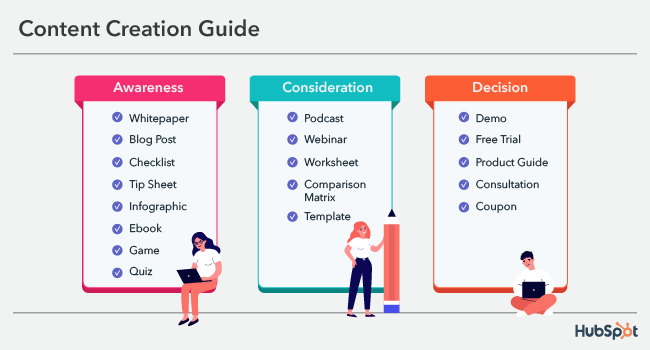
This is a representation of the buyer’s journey. Each of your prospects follows a path to a solution — that path involves awareness, consideration, and decision stages.
But each of your prospects is in a different part of that journey, so it’s important to use your content to appeal to each stage.

By creating content for each stage of the buyer‘s journey, you’re ensuring that no visitors fall through the cracks and that every individual that comes to your site feels like they are receiving relevant, useful information.
You also want to select a format for your content so that it‘s tailored to each stage of the buyer’s journey.
A new visitor in the awareness stage won’t want a live demo of your product, but they would read a quick checklist or blog post that helps them better understand their problem.
Prospects in the decision stage don’t need to know about all the possible solutions; they need a consultation or demo that shows them that your product is the right solution. Always meet your audience where they are.
Here‘s a guide to the best content formats for each stage of the buyer’s journey:

Perform a content audit.
Whether you‘ve been creating content for a while without any clear direction or you’ve been following a strategy all along, every marketing department can benefit from a content audit.
Just because you didn‘t start out with a clearly defined strategy doesn’t mean that the content you already have won’t fit into one.
A content audit is simply taking inventory of the work you’ve already done, then organizing it to fit under your new content plan.
The process might involve some re-writing, or it could reveal gaps that need to be filled with content that appeals to your persona and their journey stage.
Here‘s how you’d perform your content audit:
- Gather all of your content in a spreadsheet.
- Create columns for target keywords, buyer persona, buyer’s journey stage, format, and main topic, then fill these in for each content piece.
- Add columns for your key metrics, like page views, shares, engagement, etc.
- Finally, categorize each post (using highlights or another column) by those that are doing well, need improvement, should be rewritten, or can be merged with another post.
While a content audit may seem tedious, all the manual labor will be worth the increased traffic and leads. Plus, you’ll have a verified plan moving forward.
If this process seems a bit overwhelming, check out this post for some more guidance.
Choose the right format.
Remember that buyer persona you created? You’re creating content for them. That means you should be crafting content in a format that is most easily and enjoyably consumed by your prospects.
The format you choose might be a blog post, video, Slideshare, graphic, ebook, whitepaper, podcast, or whatever your creative mind can conceive. As long as it serves your persona, you’ll be in good shape.
Also, you don’t need to stick to one format for every piece of content that you create. But you should be able to create content — in whatever format — on a consistent cadence.
What I mean is, a podcast series might be a great marketing tactic, but if you lack the resources (and patience) to stick to it, then a blog might be a better route.
Digital content creation is the process of choosing the format (usually digital), and then utilizing the right tools to publish and promote your content online.
Use these questions as a guide when choosing your content format:
- What stage of the buyer’s journey is this for?
- How easy is it for your audience to consume this content?
- Where does your persona spend their time online?
- What format can you create on a consistent basis?
- Are you able to produce this content at a quality level that’s competitive?
Choose capable content creators.
At this point, you‘re ready to start creating content, but first, you’ll need to build a team of content creators. To get started, categorize the type of content you want to create and the type of content creator it takes to produce that content.
Below is an example list:
- Blogs — Writer
- Social media posts — Social media coordinator
- Podcasts — Podcast host/producer
- Graphics — Graphic designer
- Webinars/Lead Magnets — Lead acquisition expert (content offer producer)
- Videos — Videographer/editor
As you can see, there are many different types of content creators you’ll need to either outsource or hire to produce high-quality content that converts your audience from viewers to customers.
In many organizations, there is one person responsible for a lot of this content, and that is a content marketing strategist.
While having one content marketing strategist might make sense, expecting one person to be able to produce all of that content doesn’t.
The best way to go about content creation is to collaborate with freelancers, use influencer marketing to increase your audience reach, and hire a content strategist (or several preferably) to help you organize your content creation.
Promote your content.
What good is it to create all this great content if no one sees it? In a perfect world, herds of people would flock to your site every time you published a new post.
In reality — especially when you‘re just starting out — you’ll need to entice people to consume your content and even shepherd them into your online space.
Hence why content promotion is just as important to your strategy as whatever content you create.
Your promotion plan should be guided by your persona. Where do they spend their time online? What time of day do they use a particular platform? How often do they want to see content from you?
How do they like to consume content? What email subject lines get them to click?
Content promotion varies by medium, and there are specific rules to follow for each.
Social Media
While social media is a relationship-building tool, it can be used to promote content. It’s all about finding the right balance between self-promotion, sharing useful information, and entertainment.