

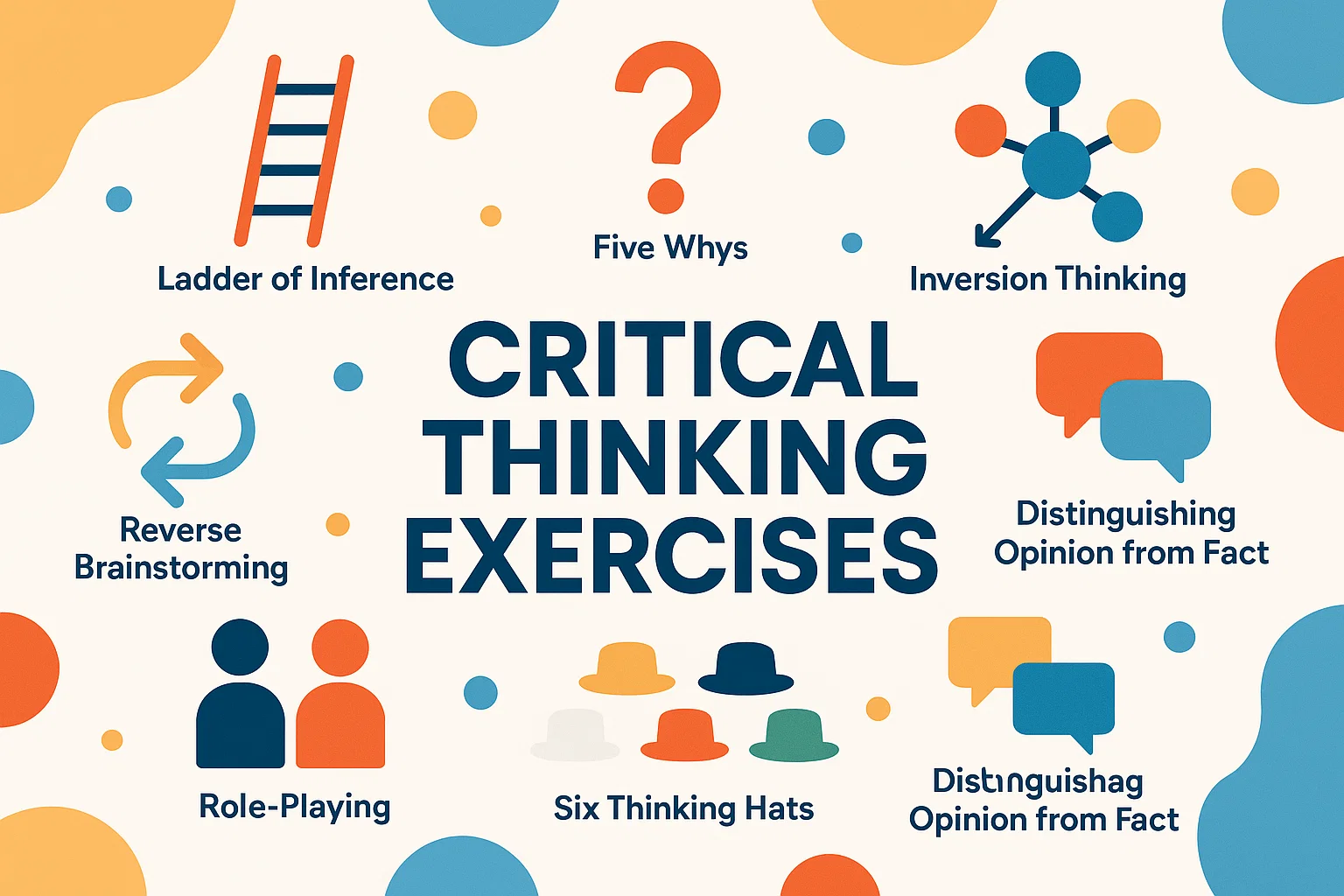
These exercises help employees practice critical thinking in structured and practical ways. Each activity builds different skills and can be adapted to your team’s needs.
The Ladder of Inference
This exercise helps employees understand how quickly they move from simple facts to personal assumptions. Ask the team to write down what they observed and what they assumed during the situation. Discuss both lists to highlight the difference between real information and personal interpretation. This activity builds awareness and reduces rushed or emotional decisions in daily work.
The Five Whys Technique
This technique guides teams toward the true cause of a problem using repeated questioning. Start with a basic question and continue asking why until you uncover the real root issue. Employees learn to focus on the main problem instead of addressing short term symptoms. This improves problem solving and prevents the issue from returning in the future.
Inversion Thinking
In this activity the team explores how a project or goal could completely fail. Employees list actions that would create failure and then convert each item into a positive improvement. This process encourages deeper thinking and reveals hidden risks before they appear. The exercise helps teams build stronger strategies with more clarity and creativity.
Argument Mapping
Argument mapping breaks down complex decisions into clear and organized parts. Create a simple map that shows the main idea supported by arguments and evidence. Review the map together and highlight weak points or missing information that needs attention. This method helps employees think logically and build stronger arguments for team discussions.
Distinguishing Opinion from Fact
This exercise teaches employees to separate personal opinions from real and reliable information. Share different statements and ask the team to classify each one as a fact or an opinion. Discuss unclear statements to help everyone understand why certain ideas lack evidence. This improves clarity and supports better communication during important decisions.
Objectivity and Bias Check Activity
This activity helps employees notice hidden biases that influence their choices. Present a workplace scenario and ask the team to list all factors affecting their decisions. Identify which reasons are based on facts and which reasons come from personal bias. This improves fairness and supports more objective decision making within the team.
Six Thinking Hats
This method encourages employees to explore a problem from many different angles. Each hat represents a unique thinking style such as facts emotions creativity or process management. Teams rotate hats and share insights that help create a complete and balanced understanding. This approach leads to more thoughtful discussions and stronger final decisions.
Role Playing Scenarios
Role playing helps employees practice real workplace situations in a safe environment. Assign roles to team members and let them handle the scenario step by step. Observe how the situation develops and discuss what worked well after the activity. This builds confidence and strengthens communication during real challenges.
Reverse Brainstorming
This exercise encourages teams to explore the opposite direction of traditional brainstorming. Ask the team how they could make the situation worse and list every idea they share. Convert each negative idea into a positive improvement to create a stronger action plan. This method unlocks creativity and helps teams discover solutions they might overlook.

