


In a world saturated with advertisements and digital distractions, capturing consumer attention has become more challenging than ever.
Whether it’s a captivating pop-up event or a memorable brand activation, experiential marketing creates moments that leave a lasting impression and build genuine connections between brands and their audiences.
What is experiential marketing?
Experiential marketing is a strategy that focuses on creating immersive in-person experiences for customers and prospects. It helps foster meaningful relationships and engagement beyond traditional marketing methods.
To truly engage, consumers must leave their homes and participate in activities firsthand. Sharing these moments on social media means capturing photos, not screenshots—you must be there to experience them.
In this article, we’ll examine experiential marketing examples and discuss their transformative impact on converting passive consumers into passionate brand advocates.
Types of experiential marketing
Experiential marketing can be disguised as a variety of other marketing strategies. Let’s take a look at each of them:
Event marketing
Event marketing and experiential marketing go hand in hand. While all events can be considered experiential marketing, not all interactive marketing experiences are events.
What does that mean? An event, by nature, provides an experience. There is a set time for tangible, face-to-face interactions.
However, not all experiential marketing campaigns are events. Events require tickets, a set time, and a place. Guests plan to attend them in advance. Email reminders are sent out, and a dedicated team promotes the event before the day.
Engagement marketing does not always require as much promotion. While you may want to send out a press release and share the event on social media, engagement marketing has an element of surprise. You often won’t send an email inviting your subscriber list to book tickets.
For an example of event marketing that is also experiential, consider event sponsorships, such as the installation at the POPSUGAR Play/Ground festival for women.
Attendees of the inaugural festival had the opportunity to spin the Kohl’s Cash wheel and win coupons worth $10, $20, or $50 in Kohl’s Cash or even a $200 gift card.
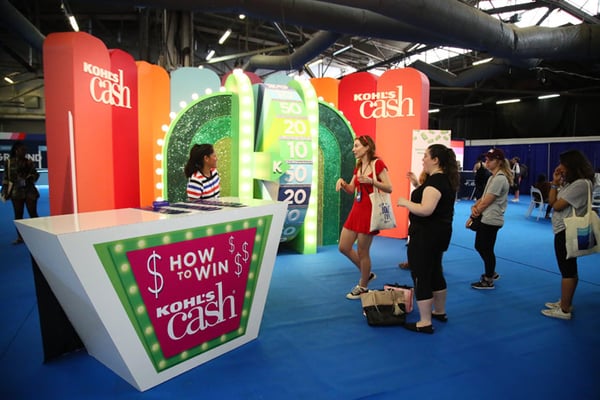
Image source: Service Graphics
I’m not going to lie. I see that wheel, and all I want to do is run up and give it a spin, even the picture is irresistible. (Perhaps it comes from watching one too many episodes of “The Price is Right” growing up!) That desire to engage with Kohl’s makes this a perfect example of engagement marketing at an event.
Brand activations
Brand activation refers to the launch of a company’s new line, product, or service. It is a perfect opportunity for experiential marketing, as companies want to get media coverage and let consumers know their new product is available. They need this to create demand for the new products as it’s much easier to sell an item when customers know it already exists in the market.
One of the best ways to practice experiential marketing in brand activation is through product sampling.
Astound Group, a design and fabrication company, used this strategy to raise awareness and launch three new flavors of Teavana Shaken Iced Tea while working with Starbucks and Teavana.
The company created a mobile pop-up that toured summer festivals throughout the country. At each festival, attendees could stop by the tent to rest their feet on one of the fruity bean bag chairs and taste the new product.
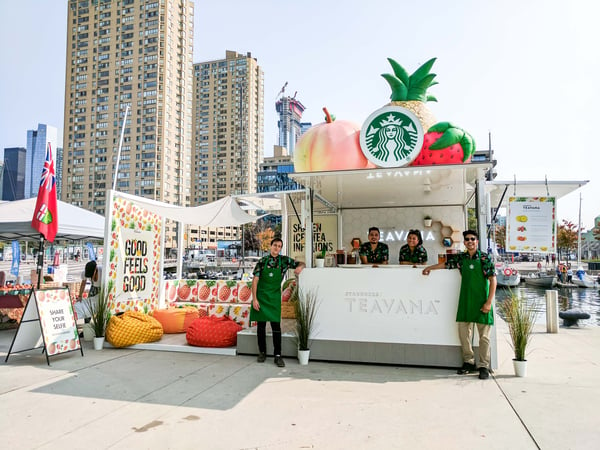
Image source: Astound
The colorful fruit on top of the tent earned the attention of festival-goers in a crowded space. Once at the tent, attendees could choose one of the three new flavors they would like to order. An experienced barista prepared their drink fresh on the spot.
To increase the exposure outside of each festival, pop-up guests were invited to share a picture with their tea on social media, including the campaign’s designated #goodfeelsgood hashtag.
Guerrilla marketing
Like events, guerrilla marketing, and engagement marketing go hand-in-hand. They both involve the element of surprise, often by creating an unexpected display or experience. The surprise is there to incite conversations around the campaign.
Guerrilla marketing is not a traditional advertising campaign with money spent on paid media. For example, sponsorships are not guerrilla marketing. This is why the approach is also known as “ambush marketing.” It often does not ask for permission and risks causing legal issues and misunderstandings.
Guerilla marketing must involve an experience or element of interaction for it to be experiential. Here is an example of guerrilla marketing that doesn’t have an experiential element.
Budweiser spent millions of dollars to sponsor the 2010 Fifa World Cup. That didn’t stop Bavaria, a beer company in the Netherlands, from putting 36 young women in bright orange dresses throughout the stadium of one game.
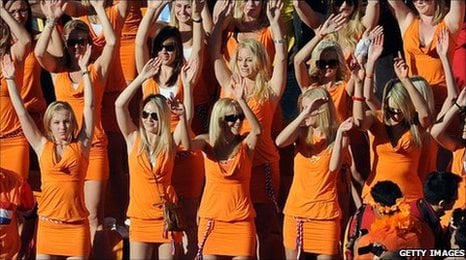
Image source: BBC News
While the story did get headlines, Budweiser and Fifa were less than pleased. The women were forced to leave the stadium and threatened with six months in jail, and two were arrested.
Thankfully, not all guerrilla marketing is illegal. Consider Casino Di Venezia’s Venice Marco Polo airport campaign for an example of marketing that executes both guerrilla and experiential marketing.
Instead of the standard black rubber conveyor belt carrying your luggage to you, Italian advertising agency Admcom turned the baggage claim into a giant roulette wheel.
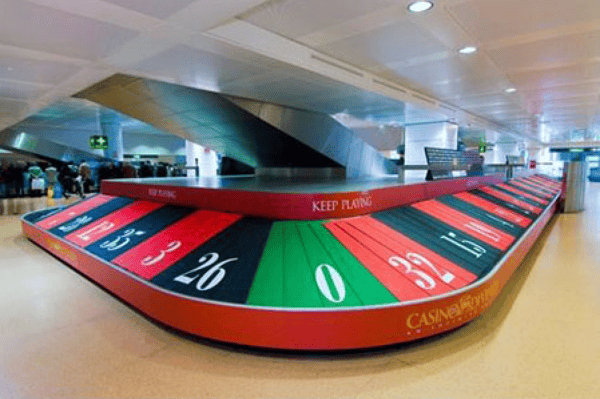
Image source: Oddee
This campaign would, no doubt, have received approval from the airline and payment for the ad’s placement. The roulette baggage claim does, however, still have the surprising element of guerrilla marketing while also providing the experience of engagement marketing.
Retail installations
Are you someone who loves browsing through stores or hates shopping and resigns to sitting bored in the corner?
Either way, experiential marketing gets customers of all kinds into stores and then extends their time.
Engagement marketing in a retail setting intrigues even the most uninterested customers. Joyful shoppers like myself are entitled to a few more moments of guilt-free shopping thanks to our partners’ momentary amusement. The more interactive the display, the longer consumers can be exposed to your products and potentially buy.
For example, there’s only so much time my husband will spend in Topshop. If I let him experience a virtual water slide, he will give me time to try on a few more dresses!
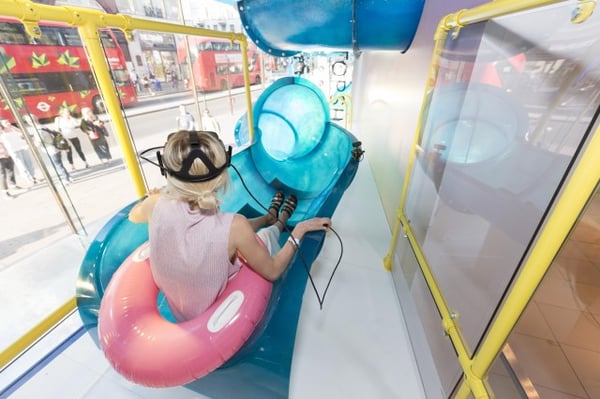
Image source: VR Scout
Experiential marketing is a critical asset for retail shops in the age of online shopping. Even shopaholics like me are regular participants in e-commerce. Between companies like Amazon and Walmart offering two-day shipping and the ability to find what you want at your fingertips, what’s not to love?
Like omnichannel marketing, bricks-and-mortar stores have something online retail doesn’t — the opportunity to interact and engage face-to-face, providing an authentic experience.
Stores have now moved from a place to buy things to branded environments. Strategy and design company Consortia has even created a diagram of the branded spaces in New York City.
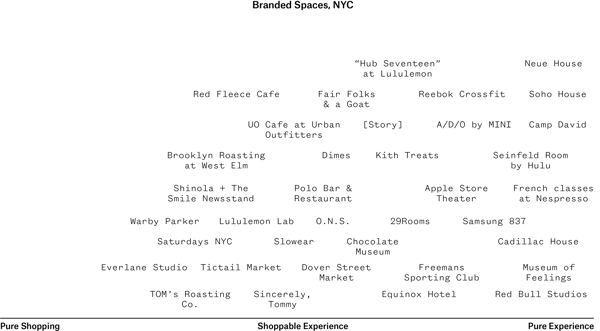
Image source: Consortia
In the image, you can see the vast white emptiness on the left; the more a space focuses on shopping, the less experiential it is. Knowing that the value of engagement marketing comes down to the experience, you can see how brands in the Big Apple have found the sweet spot right in the middle between experiences and shopping. Others, like Nespresso, have moved to full-on experiential by offering classes.
An example leaning towards the pure experience side is Hub Seventeen at Lululemon.
Lululemon’s flagship store in Manhattan’s Flatiron District opened in November 2015. The store offers much more than extensive shopping, including a concierge service and its unique community space, Hub Seventeen.
Lululemon’s general manager of U.S. retail explained Hub Seventeen and why it is vital to the brand: “Innovation is at our core, from our technical product design to our unique guest experience. While all our stores offer in-store yoga and fitness classes and events, Hub Seventeen is the first time we have created a dedicated community space separate from the retail experience.”
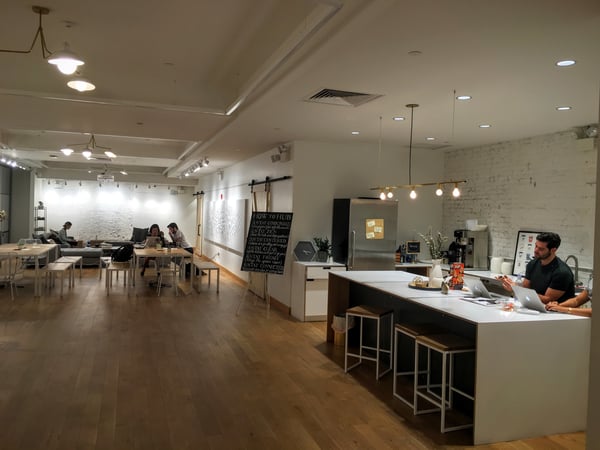
Image source: WorkFrom
Hub Seventeen’s website is separate from the online retail store. It offers yoga and fitness classes, gallery nights featuring local artists, and workshops. This true brand interaction makes Lululemon more than an activewear brand. Hub Seventeen and the experiences it provides make Lululemon a lifestyle brand.
Now that you know the benefits of experiential marketing and the ways you can execute the strategy, let’s look at some best practice guidelines to keep in mind.
Whether this is your first, tenth, or hundredth experiential campaign, it’s important to remember how the strategy relates to your marketing and company goals.
Best experiential marketing campaigns
Experiential marketing campaigns create go beyond traditional advertising by fostering emotional connections and encouraging active participation.
Let’s explore some of the most impactful experiential marketing campaigns:
Red Bull – Stratos: The edge of space jump
In 2012, Red Bull executed one of the most extraordinary experiential marketing campaigns in history with the “Stratos” project.
This groundbreaking initiative featured Austrian skydiver Felix Baumgartner, who ascended to an astonishing altitude of approximately 24 miles—about 128,000 feet—above Earth before making a historic freefall jump. Baumgartner not only set the record for the highest jump but also became the first person to break the sound barrier without the protection of an aircraft.
The Stratos event was more than just a daring stunt; it was a meticulously planned publicity spectacle that captured the world’s imagination. The jump was live-streamed on YouTube, attracting over eight million viewers, and generated extensive media coverage across various platforms.
This monumental achievement not only showcased Red Bull’s commitment to pushing boundaries but also solidified its position as a leading brand in the energy drink market, reinforcing the company’s image of innovation and adventure.
IKEA – The IKEA sleepover
IKEA hosted a unique sleepover event in one of its stores, inviting customers to spend the night in the showroom. Attendees enjoyed activities like sleep-related workshops, bedtime stories, and a cozy atmosphere.
This campaign not only generated buzz on social media but also showcased IKEA’s products in a fun and immersive way, allowing customers to experience the comfort of its furniture firsthand.
Benefits of experiential marketing
Many traditional marketing tactics involve companies pushing out their messaging to consumers through commercials, print ads, and (shudder) telemarketing. These are the messages that many customers don’t want. Depending on the execution, outbound marketing can give marketers a bad name.
Experiential marketing works because it breaks this mold. It’s not about fast-forwarding through commercials on your DVR or flipping past the advertisements in your magazine. Interactive marketing is different from commercials, people WANT to interact with it.
Whether you are executing B2B or B2C marketing, I sincerely believe marketing does not have to be boring. Scratch that, it should not be boring. And there is no better place to beat boring campaigns than experiential marketing.
Increases social media shares
People want to be unique; they want to feel special. Emotional marketing has grown manifold in the past three years. A large number of consumers, when you provide individuals with an experience that makes them stand out on a social media feed, will undoubtedly share it.
One of the biggest benefits of experiential marketing is social media marketing. These experiences are tailored to customers, so those participating want to share them with their friends. Because they have an aspirational quality (or, for lack of a better phrase, by “being cool”), social media shares are sure to be present on every platform.
Measure shares with social media monitoring platforms to identify trending topics or phrases and gain insights into engagement through organized user information.
Creates brand buzz and awareness
Experiential marketing is designed to get people talking. Social media can be one form of word-of-mouth marketing – people share stories, news, and opinions with their networks.
However, you can’t underestimate the power of individual and interpersonal communications. Peer recommendations are still more valuable than any other form of marketing. When it comes to peer feedback and customer reviews, marketers across industries realize the importance of customer reviews.
Experiential marketing is one of the best possible ways to start those conversations. While there’s no way to measure the discussions one has about you with friends and family, you can’t underestimate their value.
Builds relationships and brand affinity
Experiential marketing doesn’t just get customers talking about your brand, it gets them talking in the best possible way. Positive connections with your customers can increase short-term sales and grow brand loyalty.
While growing brand loyalty is a common phrase in marketing, its importance goes beyond being industry jargon.
People who swear by their favorite brands will often tell you about their love for its products and indirectly raise brand awareness. Many brands use media monitoring software to track customer sentiments, provide a delightful customer experience, and build loyalty.
Provides free campaign publicity
The best experiential marketing campaigns get you an extensive audience for your efforts, not just through your customers but also newspapers, blogs, television, and other broadcast media. If you ask me, it’s a golden lesson in generating free PR for your brand.
For example, in 2015, 13 tons of candy covering 14,000 square feet were carefully placed together in Chengdu, China, to promote the IFS shopping center.
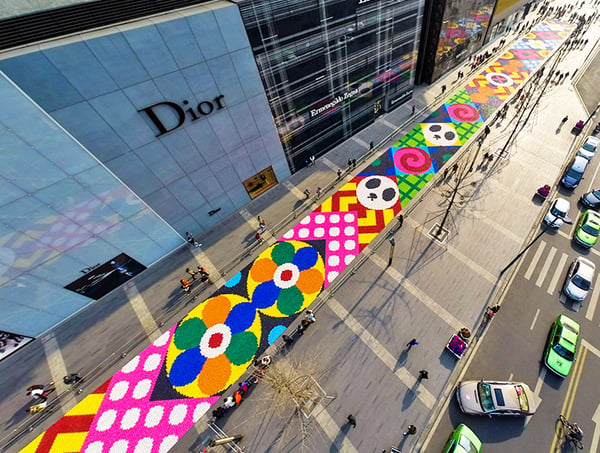
Image source: Inhabitat
Here are just a few of the headlines that resulted from the 607-foot-long candy carpet:
- Acclaim Magazine: “Watch: A Chinese Mall builds the world’s largest ‘Candy Carpet’.”
- Pondly: “A Sweet Tooth’s Delight: World’s Largest Candy Art Carpet.”
- A plus: “Artists Use 13 Tons Of Sweets To Create World’s Largest ‘Candy Carpet’.”
Invite news publications and influencers to a sneak peek at your event before it opens – it gives them an intriguing news story separate from the doom and gloom that happens before your event. This is how you can get people excited to come and interact with your brand before the experience occurs.
Experiential marketing best practices
Like all types of marketing, experiential marketing has best practices. Here are seven best practices to consider when implementing your experiential marketing campaign.
Tie your brand into the experiential activity
Customers having positive memories of interacting with your experience is great. But what if those memories don’t tie back to your brand? It pretty much defeats the purpose of experiential marketing.
Lululemon is the perfect example of an offering experience that ties into the brand. It doesn’t just sell activewear. Its stores are the destination for customers to wear it. Given that its clothing is worn when practicing yoga, which has an element of mindfulness, the company also offers workshops designed to promote this principle.
For example, in December 2015, it held a “Transcend Holiday Madness Meditation” event.

Image source: Hub Seventeen
Another company with an in-store experience intertwining its brand and target market is the clothing store Missguided.
The 20,000-foot flagship space in East London opened in November 2016, and there weren’t just unicorns. Vending machines were selling the dreams and tears of this beloved mythical creature.
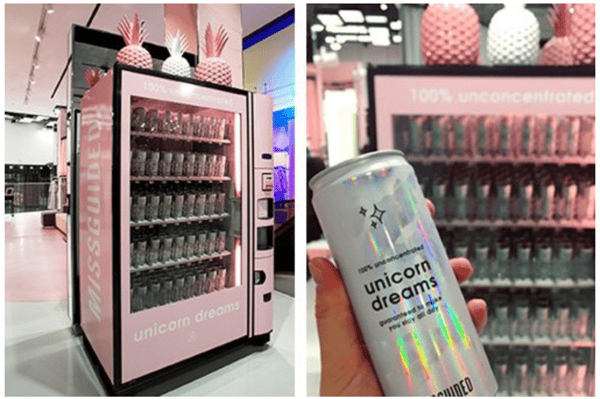
Image source: Prop Studios
In addition to unicorn dreams, there were hashtag props, frosted doughnut tires, and a bejeweled pink monster truck.
Prop Studios, which created these interactive features, shares the experiential part of the goal: “Looking at online competitors and bricks-and-mortar market leaders that Missguided was about to disrupt, we looked for that point of difference to what Missguided would be as an experience.”
The store set itself apart from competitors by creating an experience that would resonate with its customers.
Set marketing goals and measure your success
Why are you executing this campaign, and what do you want it to achieve?
Experiential marketing, by nature, has many benefits that can’t be ignored, including interacting with your customers, building relationships, and raising brand awareness.
For your experiential marketing to be successful, you must get specific. Answer the following questions:
- What exactly do you want consumers to know about your brand?
- How can you measure your success?
Some benefits of interactive marketing, such as brand affinity, are valid and important. However, they are difficult, if not impossible, to track accurately. It’s imperative to measure what you can.
While brand awareness and affinity are essential to growing lasting customer relationships, you need elements you can measure. In addition to guiding your strategy, marketing spending must be justified by a company’s decision-makers. Finding ways to track experiential success gives you a tangible way to back what you did and why.
The Bumble Fab Lab in Sydney, Australia, created an experience tied to its brand and with specific measurable goals.
Bumble is an app initially designed for dating. It has now become a social networking app for relationships, including looking for friends or expanding professional connections. Given this, in 2017, the marketing team’s goal was to educate potential users that the app was now open to everyone—even if they weren’t single.
The company created a truly interactive experience to expose new users to its brand. Based on the event’s description on Facebook, I cannot think of a better example of experiential marketing: “Get ready to…taste, smell, see, and create, all in the one place.” It’s the definition of engaging the senses!
And, watching this video, it’s safe to say it executed with flying colors:
Source: Bumble – The Bumble Fab Lab from Banter
Another of the company’s goals is to give value to its users, and the event was a perfect way to do so.
In this Bumble Fab Lab example, success metrics included measuring foot traffic and feedback. Because downloading the mobile app was the only requirement for entry, the experience also resulted in a higher number of users. The number of app downloads is a goal that could be measured. The company also looked at media coverage.
The measurements you can take when looking at your event’s success include:
- Broadcast media coverage: Keep track of your exposure to news publications, especially television coverage. You don’t have to be a big company to have a great story! Don’t forget more traditional platforms like radio and newer channels like podcasts.
- Online mentions: Besides social media shares, look for media coverage online. The great thing about digital coverage is you can measure it. Social media analytics software notifies you when your brand is mentioned on the World Wide Web. Alternatively, set a free Google alert. Set the signal for your company or campaign name, and Google will send mentions directly to your inbox.
- Sales: While you may not be able to measure all sales resulting from experiential marketing, track what you can. For example, hand out cards on-site with a promo code specific to the campaign. When attendees use that code, you’ll know the sale came from the event.
- Attendance: As you may have noticed, pop-ups are a common tactic in experiential marketing. Maintaining attendance records is easy to show how many individuals interacted with your brand.
- Social media shares: Given social media is such an essential element of experiential marketing, you can’t forget to track it! Measure the number of times your handle or the campaign hashtag was used on all channels, including Facebook marketing, Twitter, and Instagram marketing. Utilize platform analytics, such as your Twitter analytics dashboard, and measure social media engagement during the campaign compared to the average.
Know what action you want users to take
When looking for ways to measure your success, think about the action you want attendees to execute. This, combined with your measurable goals, will ensure you can back up the logic behind your campaign.
Devoting your company’s revenue to 14,000 square feet of candy might not make sense to your accounting department. As a marketer, you have the metrics we just mentioned, such as publicity and social media shares, to measure your effectiveness.
Your CEO and finance team don’t care about social media shares if they don’t result in revenue. Think about the actions people can take to serve goals company-wide, not just your marketing team.
Take this example from Globetrotter, a German company that provides sporting and outdoor equipment. Is that jacket as warm as it looks? Before lining up at the cash register, customers at the Globetrotter store can test new gear.
Stores were outfitted with rooms designed to simulate the experience the clothing was designed for, including freeze chambers with temperatures as low as negative 30 degrees Celsius.
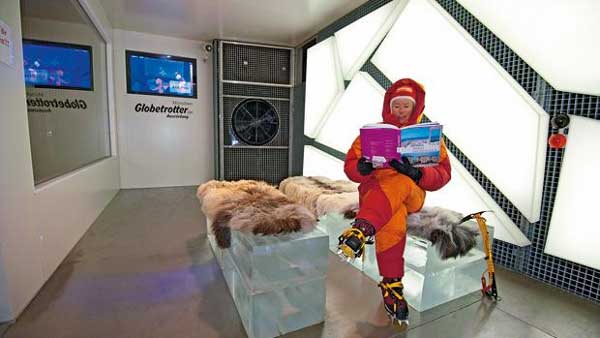
Image source: